Over the past two decades, information technology has grown from around 11% of the MSCI World Index to 30%, while energy and materials have shrunk from around 15% to just 7%. For most investors, this shift did not happen by choice but passively, through index funds that allocate capital by company size rather than conviction, leaving many portfolios with remarkably little exposure to the companies that produce the energy, metals and food the global economy depends on.
We believe this under allocation is one of the more overlooked opportunities in portfolio construction today. Natural resource equities are driven by a different set of forces from the technology and financial companies that dominate global benchmarks, which makes them a valuable diversifier at a time when portfolios are increasingly concentrated. They may also offer a degree of protection against inflation and, perhaps most compellingly, currently trade at a substantial discount to global equities while having delivered comparable risk-adjusted returns.
The Global X S&P World Natural Resources ETF (NRES) offers access to this opportunity through 90 of the world's largest natural resource companies outside Australia, divided equally across three pillars: agriculture, energy, and metals and mining.
Key Takeaways
- Two decades of disappointing commodity returns and the rise of technology have left investors structurally underweight natural resources, just as supply constraints and new sources of demand are strengthening the long-term outlook.
- Natural resource equities have shown low to moderate correlations to global equities and near-zero correlations to bonds, offering meaningful diversification for increasingly concentrated portfolios, along with a potential hedge against inflation and US dollar weakness.
- The NRES index (S&P Global Natural Resources Ex-Australia Index) trades at around a 40% discount to the MSCI World Index on forward earnings, yet has delivered five-year risk-adjusted returns in line with global equities.
Positioning for a New Era in Natural Resources
For much of the past two decades, the investment environment for natural resources has been challenging. The commodity supercycle of the early 2000s, driven largely by China's rapid industrialisation and infrastructure development, encouraged producers to invest heavily in infrastructure and production capacity. However, the GFC in 2008 marked a turning point, triggering a sharp contraction in global economic activity. China's recovery from the crisis proved insufficient to sustain the previous decade's extraordinary growth rates, and as demand moderated, a wave of new production capacity developed during the preceding boom began entering the market. The result was a prolonged period in which supply growth outpaced demand, leaving many commodity markets oversupplied and prices under pressure. The consequences are still reflected in prices today with broad commodity benchmarks remaining below their peaks reached before the GFC.
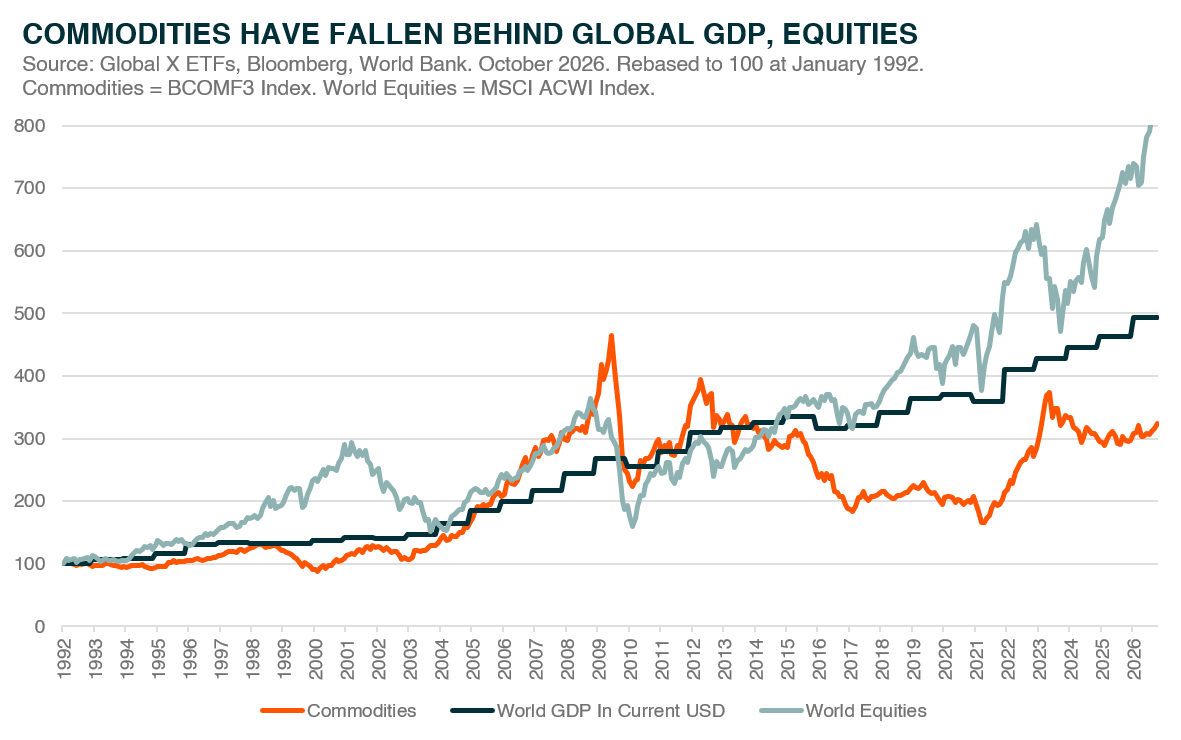
Past performance is not a reliable indicator of future performance. Commodities = Bloomberg Commodity 3 Month Forward Index. The performance data shown is past performance only in Australian dollar terms. BCOMF3 Index was launched on 14/07/1998. Index performance shown prior to this date is simulated using the Index methodology. Index returns assume reinvestment of dividends/coupons and do not include the impact of fees or costs of investing.
After years of disappointing returns, many investors have come to view natural resources as a tactical trade rather than a strategic allocation. This perception has been reinforced by the market capitalisation weighting of global equity benchmarks, where stronger-performing sectors naturally gain a larger share of the index at the expense of weaker-performing ones.
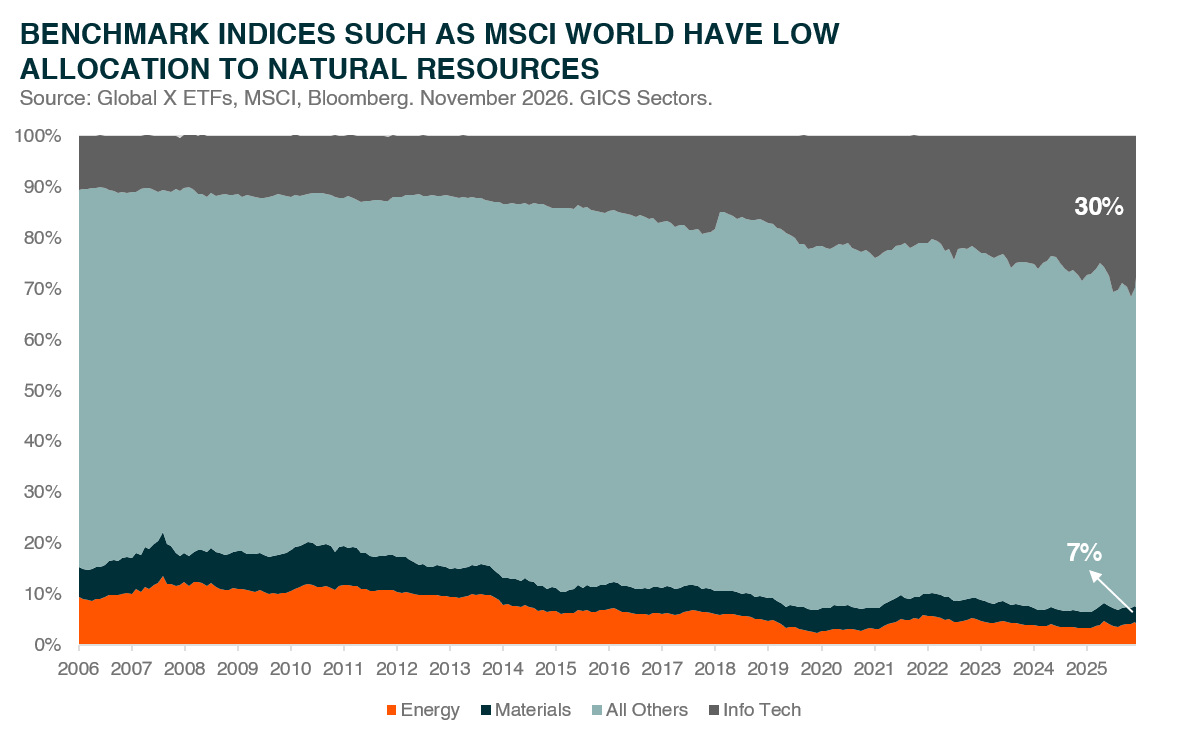
As technology companies have grown in prominence, the weighting of energy and materials has steadily declined, falling from a peak of 22% in 2008 to just 7% in 2026. As a result, investors tracking global equity benchmarks today hold almost four dollars of technology exposure for every dollar invested in energy and materials. Nor are investors necessarily compensating for this declining exposure through direct commodity investments, with commodity ETFs accounting for just 4% of total assets in the Australian ETF market.1
Nevertheless, being underweight a sector is not particularly a concern while the prospects of that sector remain weak. However, in our view, the conditions which kept natural resources out of favour are now changing on both sides of the supply and demand equation.
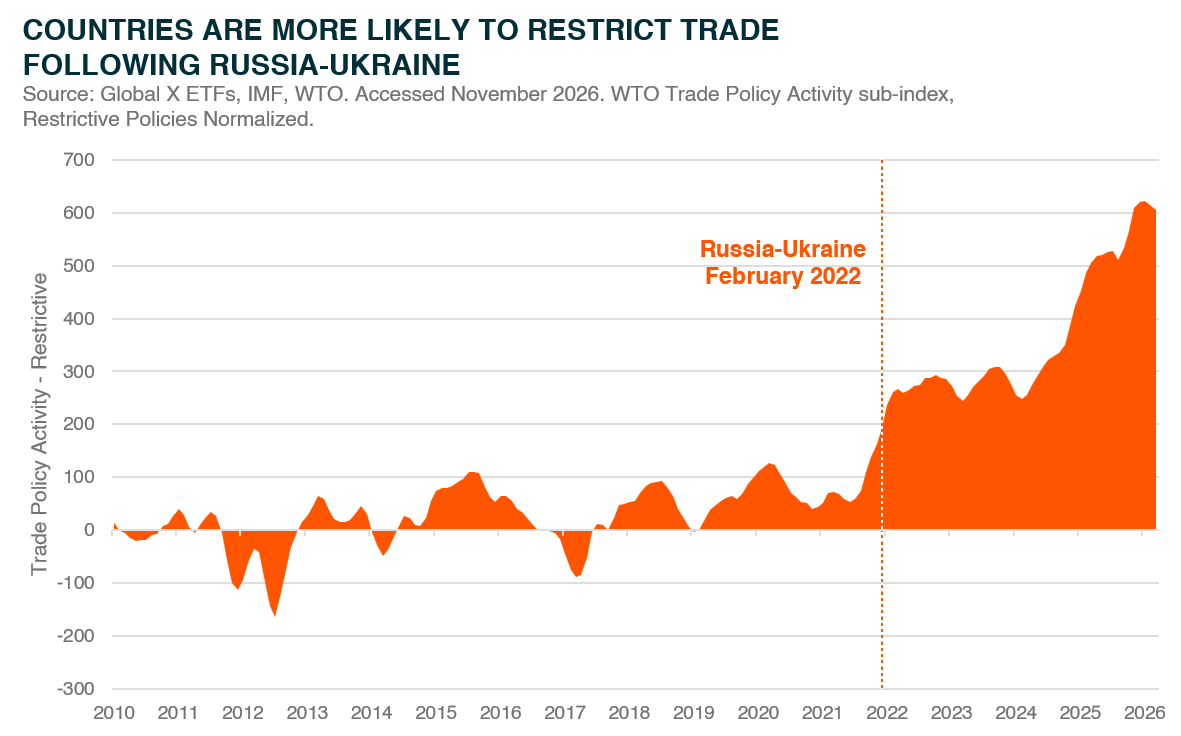
Supply is becoming less reliable. Rising geopolitical tensions, trade protectionism and resource nationalism are disrupting the supply chains that globalisation built. US tariffs on copper products, energy disruptions stemming from the Russia-Ukraine and Iran conflicts, China's export controls on rare earth elements and the Democratic Republic of Congo's restrictions on cobalt exports all show how access to resources is becoming politicised.2 According to the OECD, export restrictions on critical raw materials have increased fivefold since 2009,3 and with a single country accounting for around two thirds of global nickel production and 60% of aluminium,4 what matters is no longer simply how much of a resource exists, but how much is reliably accessible. We believe this could justify a more persistent risk premium for strategically important commodities.
On the demand side, unlike the previous supercycle, which depended heavily on China, today's demand growth is supported by a wider set of structural developments, including AI infrastructure, the electrification of transport and industry, and the adoption of renewable energy and battery storage, making commodities and natural resources well positioned for a much longer duration and sustainable period of appreciation. Examples of growth in commodity dependent technologies and infrastructure are aplenty. The International Energy Agency expects global electricity consumption to grow by an average of 3.6% a year through 2030,5 meanwhile EV sales are expected to nearly double by 2030 after already increasing almost sevenfold since 2020,6 and data centre energy consumption is also set to roughly double over the same period.7
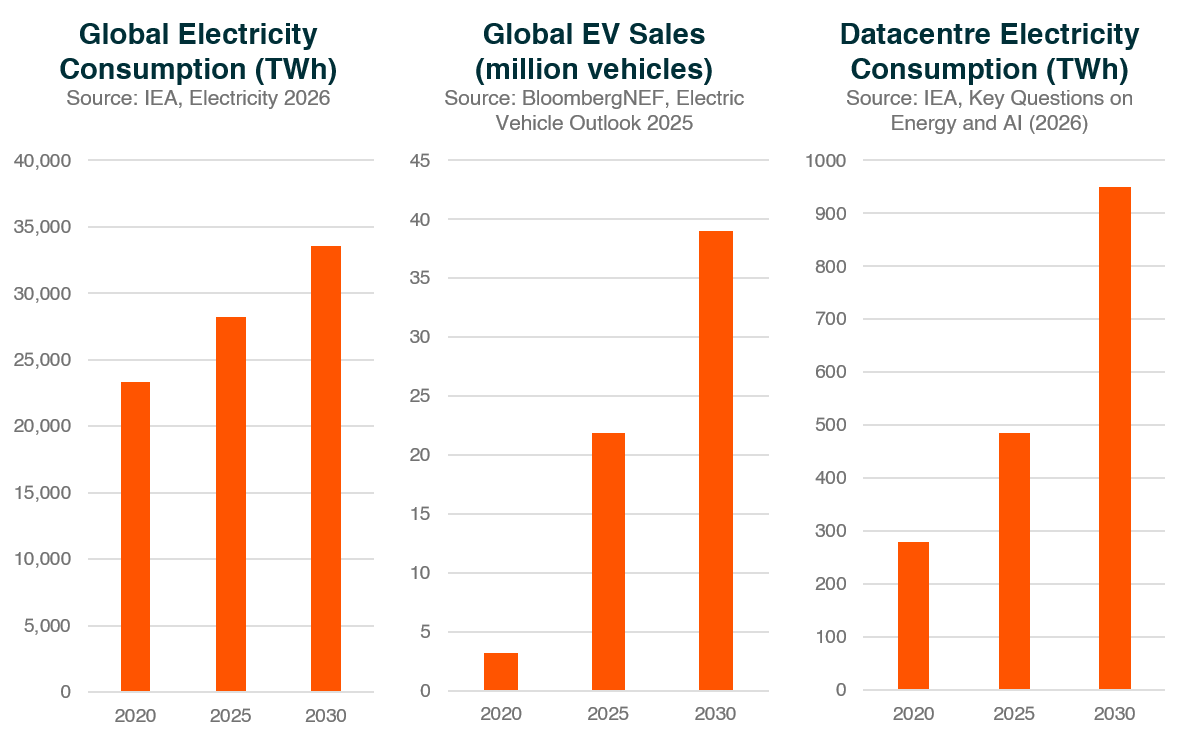
Forecasts are not guaranteed, and undue reliance should not be placed on them. This information is based on views reasonably held by Global X as at 05/11/2026.
Taken together, we believe these shifts are fundamentally reshaping the long-term investment case for natural resources. While the past two decades were characterised by expanding supply capacity and demand heavily dependent on emerging market economic cycles, the coming decade is likely to be defined by increasingly constrained supply and a broader, more structural set of demand drivers. Yet investor positioning appears to remain anchored to the conditions of the past two decades, rather than the environment now emerging.
A Diversification Masterclass
Long-term investment case aside, we believe natural resource equities also offer diversification benefits that have been largely underappreciated by investors. Unlike much of the broader equity market, where earnings are heavily influenced by interest rates, consumer spending and technology adoption, natural resource companies derive their revenues from the production and sale of physical commodities. Their earnings are therefore exposed to a different set of drivers, including agricultural conditions, energy supply disruptions and mining investment cycles. This distinction is reflected in their historically low correlations with traditional asset classes. Over the past decade, the index underlying NRES has exhibited a correlation of just 0.56 with the MSCI World, 0.47 with the S&P 500 and close to zero with both Australian and global bonds.
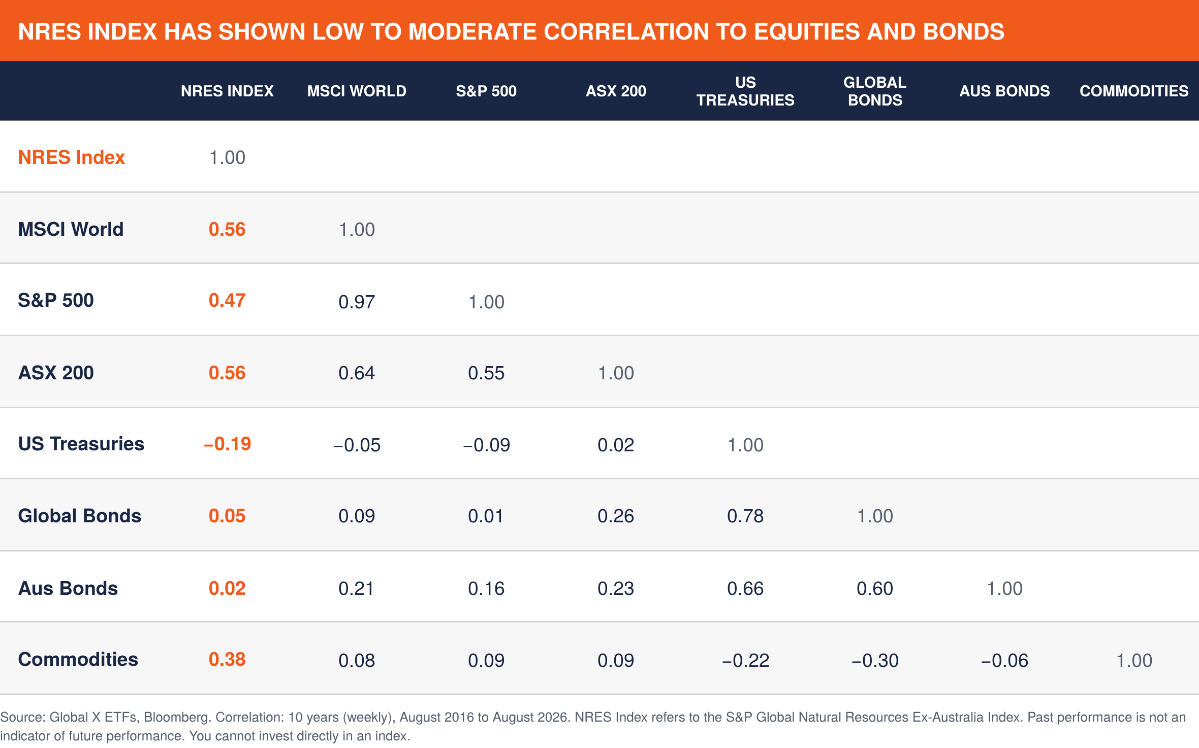
For Australian investors who may already have substantial exposure to the resources sector through their domestic equity holdings, it is reasonable to question whether these diversification benefits still apply. Interestingly, over the past decade, the index underlying NRES has exhibited a correlation of just 0.56 with the ASX 200, lower than the 0.64 correlation between the ASX 200 and MSCI World. In other words, global natural resource equities have historically offered greater diversification from Australian equities than the broader global equity market itself. Importantly, NRES also excludes Australian companies, providing access to global resource producers without duplicating existing domestic holdings.
Beyond traditional diversification benefits, natural resource equities may also provide a degree of protection against two risks that traditional portfolios can struggle to navigate: inflation and US dollar weakness.
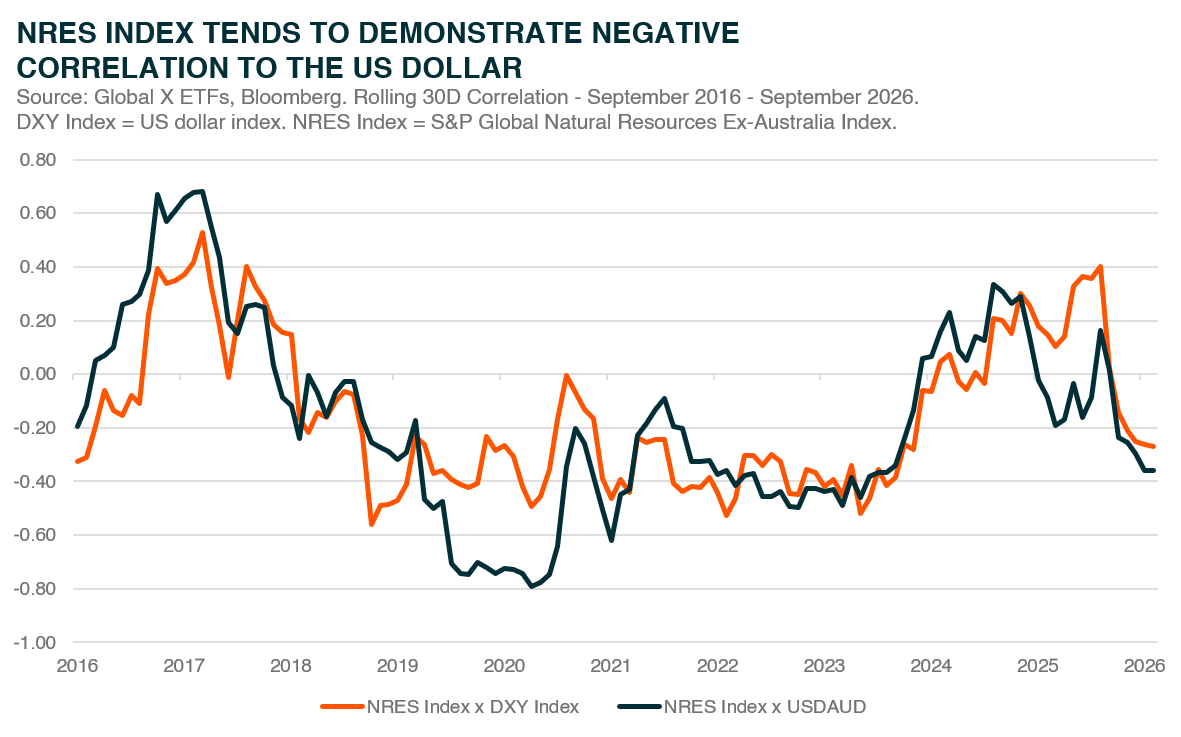
As inflation drives up the prices of physical goods, commodity producers may benefit through higher revenues, while their underlying real assets, including mines, reserves and farmland, provide a degree of protection against the erosion of purchasing power. Similarly, with Australian investors increasingly exposed to US assets, natural resource equities may offer a useful counterbalance to US dollar movements. Over the past decade, the index underlying NRES has exhibited a negative correlation with the US Dollar Index in approximately three quarters of the period, providing a modest but valuable natural offset to US dollar exposure.
You cannot invest directly in an index.
Taken together, these characteristics make natural resource equities more than simply a way to express a view on commodity prices. They offer investors access to differentiated earnings drivers, meaningful portfolio diversification and exposure to real assets at a time when traditional portfolios are becoming increasingly concentrated in similar sources of risk.
Finding Value Without Sacrifice
Diversification is valuable, but it becomes considerably more compelling when investors are not being asked to pay a premium for it.
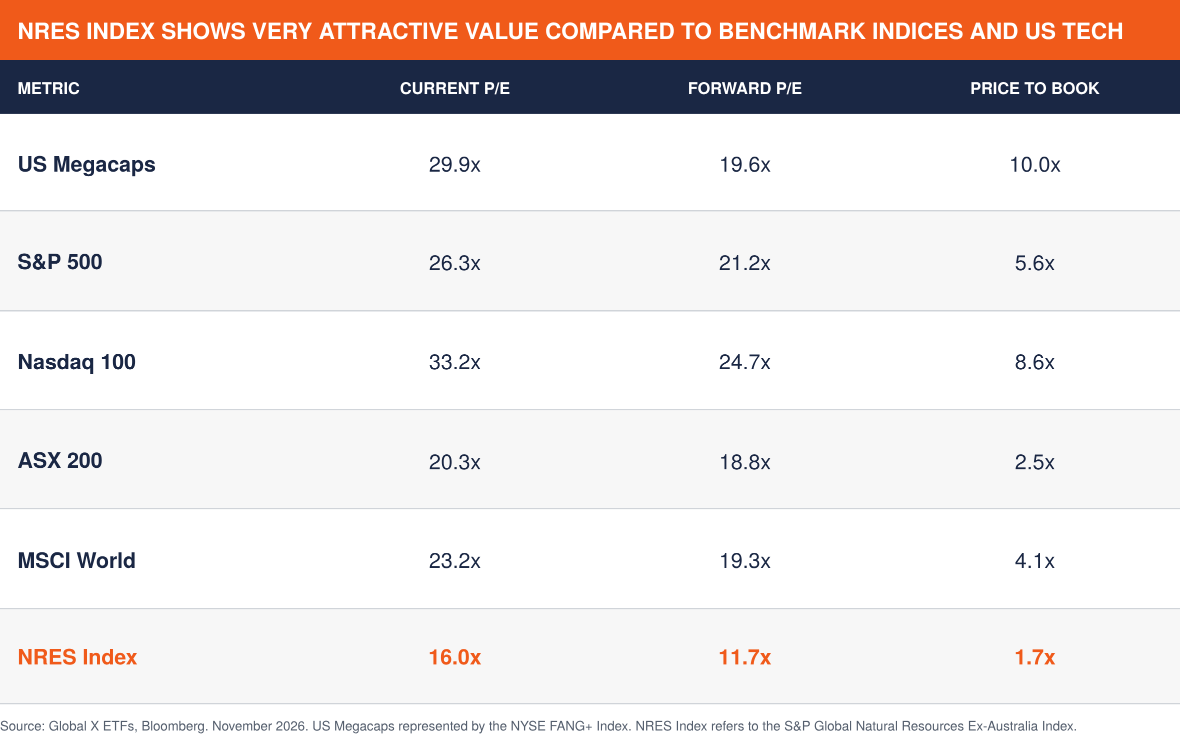
As of November 2026, the index underlying NRES trades at just 16x trailing earnings and 12x forward earnings, compared with 23x and 19x for the MSCI World. This represents a discount of nearly 40% on a forward earnings basis. The valuation gap is even more pronounced on a price-to-book basis, with natural resource equities trading at just 1.7x compared with 4.1x for global equities, meaning investors are paying considerably less for each dollar of book equity.
Importantly, this discount does not reflect weaker earnings expectations. In fact, the difference between trailing and forward earnings multiples implies that analysts expect earnings growth of around one third for natural resource equities over the coming year, compared with approximately 20% for the MSCI World. While these forecasts are far from guaranteed, they suggest that investors in natural resource equities are paying significantly less for stronger expected earnings growth.
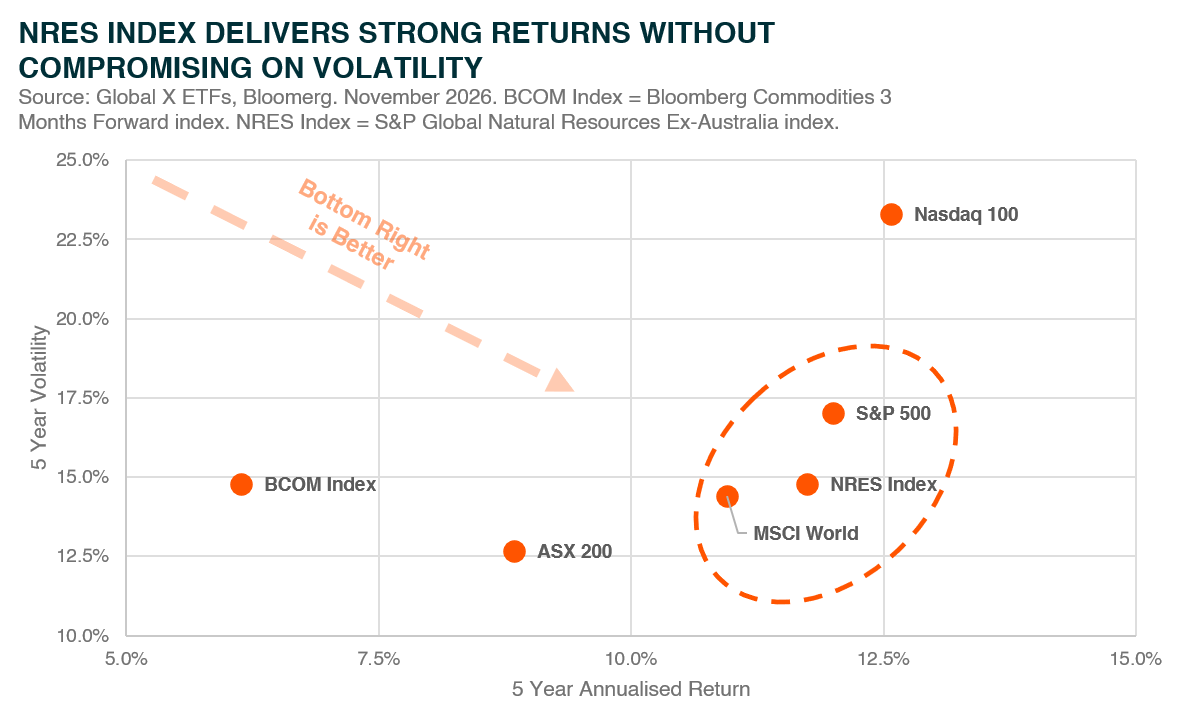
Beyond valuations, one of the more common objections to natural resource equities is their perceived cyclicality and volatility. Yet their recent performance challenges this assumption.
Past performance is not a reliable indicator of future performance. You cannot invest directly in an index. The performance data shown is past performance only in Australian dollar terms. Returns for periods greater than one year are annualised. NRES Index was launched on 11/09/2026. Index performance shown prior to this date is simulated using the Index methodology. Index returns assume reinvestment of dividends/coupons and do not include the impact of fees or costs of investing.
Over the past five years, the index underlying NRES has delivered an annualised return of 11.7% with volatility of 14.8%, compared with 11.0% and 14.4% for the MSCI World. This represents a stronger return per unit of risk than global equities, and a better risk-adjusted outcome than both the S&P 500 and Nasdaq 100.
Unearthing the Opportunity in Natural Resources
To conclude - for two decades, investors have treated natural resources as a trade to be timed rather than an allocation to be held, and benchmarks have systematically reduced their exposure further, but we believe it may be time for that view to shift. A sector that is under owned, genuinely diversifying, cheaper than global equities and competitive on a risk-adjusted basis should, in our view, not be just a tactical bet but can play a more prominent role in a resilient portfolio.
For investors who share our view, the Global X S&P World Natural Resources ETF (ASX: NRES) may present a solution. NRES offers a diversified way to access natural resource equities by tracking the S&P Global Natural Resources Ex-Australia Index, which invests in the 90 largest eligible companies in natural resources production by selecting the top 30 companies across agriculture, energy, and mining. The fund weights each pillar equally to ensure investors remain diversified and gain equal exposure to each category.
Related Fund
NRES: The Global X S&P World Natural Resources ETF (ASX: NRES) provides access to 90 of the largest global companies operating across natural resources and commodities, excluding Australia. The portfolio is structured around three equally weighted clusters covering Agriculture, Energy, and Metals & Mining, providing diversified exposure to the essential resources underpinning the global economy.
Considerations for investing
All investments involve risk. An investment in this fund may be affected by risks related to: Markets, Investment Objective, Index Tracking, ETF Pricing, Liquidity, Currency, Concentration, & Emerging Markets. The nature and level of risk may vary depending on the fund’s investment strategy and assets. The value of your investment can rise or fall, see the PDS for a full list of risks.