India’s share market may have lagged broader emerging markets this year, but structural forces may be aligning for a potential turnaround. Fiscal discipline, strategic trade deals, and a multi-year AI infrastructure buildout are setting the stage for India to move from a sentiment-driven underperformer to a contrarian growth opportunity.
Key Takeaways:
- Indian Market Lag: The Indian share market has started 2026 with its worst relative performance versus emerging markets in over 30 years, reflecting sentiment-driven pressures.
- Policy and Trade Support: US-India trade deal eases export uncertainty, while India’s latest fiscally disciplined budget underpins infrastructure, manufacturing, and medium-term growth confidence.
- AI Acceleration: Hyperscaler investment and domestic adoption signal India’s rapid emergence as a global AI infrastructure hub, transforming the country from an outsourcing base to a potential long-term growth market.
India is Lagging the Broader Emerging Market Rally
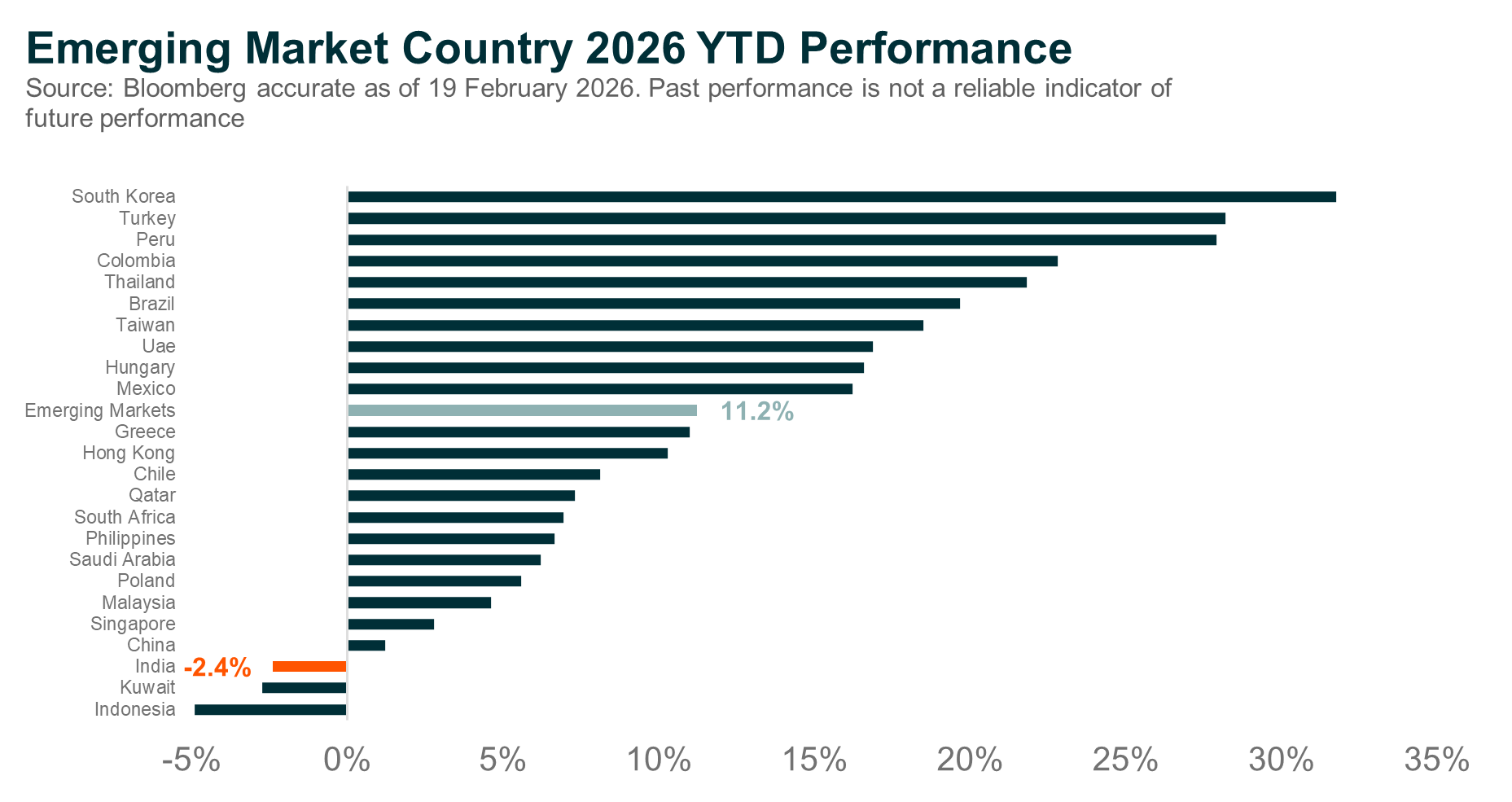
While emerging markets have recently surged, Indian equities have struggled to keep pace, leaving investors questioning what’s holding the market back. The Nifty 50 Index has fallen 1.4% so far in 2026, underperforming the broader MSCI Emerging Markets Index, which is up around 11% YTD, marking the worst relative start to the year for India since 1991.1 This is in strong contrast to other emerging markets like South Korea and Taiwan, which have flourished amid strong technology performance. The underperformance seems to be largely reflecting sentiment-driven pressures rather than structural deterioration, including punitive US tariffs, heightened geopolitical tensions, and cautious domestic adoption of AI technologies, which limited India’s participation in the global tech rebound.
With the long‑anticipated US‑India trade deal and ongoing trade discussions with the European Union, a key overhang on markets has eased. Early February saw the first meaningful rebound in foreign portfolio flows after months of underweight positioning, signalling improving sentiment.2 Coupled with a fiscally disciplined Union Budget, resilient GDP growth, strong demographic dividend, potential upside in corporate earnings, and easing policy support, India’s fundamentals remain compelling. Moreover, as US tech giants expand capital expenditure in the country, India is positioned to benefit from the global AI infrastructure buildout. India was perceived as an excessively priced equity market, but valuations have returned to its ten-year average, as well as improving manufacturing, consumer and business confidence.3 The IMF also projects India’s GDP to grow around 7% p.a. over the next few years4, highlighting the country’s resilient economic fundamentals and structural growth story. All these factors reinforce India’s potential to re-emerge as a country many investors should not discount just yet.
Fiscally Prudent and Strategic Budget Boost
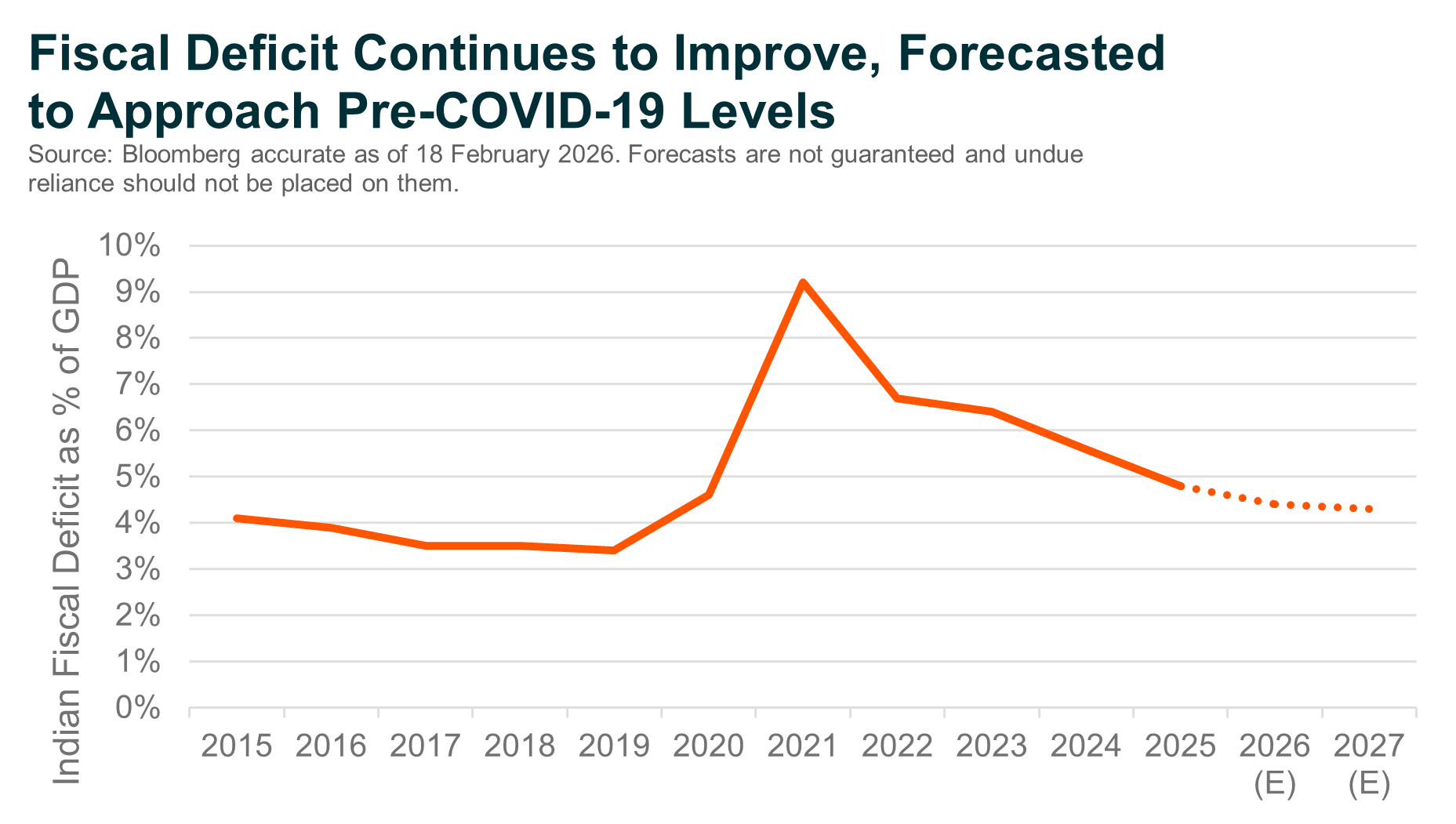
India’s FY27 Union Budget strikes a careful balance between growth support and fiscal prudence, reinforcing a credibility-first approach under Prime Minister Narendra Modi. The government’s fiscal deficit target of 4.3% of GDP (down from 4.4% in FY26) signals gradual consolidation, avoiding abrupt tightening while maintaining room for strategic spending. Capital expenditure remains steady at ~3.1% of GDP, backing infrastructure-led productivity gains in transport, power, and defence. Record infrastructure allocation of around US$135 billion reflects a long-term commitment to modernising India’s economic backbone.5
Policy measures continue to support industrial and technological advancement, with incentives for electronics, semiconductors, clean energy, and global cloud providers operating from Indian data centres. Duty exemptions on 25 critical minerals and the doubling of the Electronics Component Manufacturing Scheme further strengthen domestic supply chains and manufacturing self-reliance.6
The budget’s credibility-focused approach, prioritising supply-side growth, is positive for medium-term investor confidence. On the minor downside, higher-than-expected borrowing has pressured bond yields, and consumer-focused relief was limited. Overall, the recent budget reflects Modi’s commitment to nurturing India’s economy through disciplined, targeted, and forward-looking fiscal policy.
US-India Trade Deal Strengthens Growth Outlook
The US-India trade deal represents a meaningful clearing event for markets, removing a long-standing overhang on investor sentiment. The agreement will see US tariffs on Indian goods reduced to 18% (from 25%) in exchange for India’s commitment to purchase US goods and energy worth $US 500 billion over the next five years. While some Section 232 tariffs on autos, steel, and aluminium remain, the deal alleviates a major source of uncertainty for export-oriented companies and foreign investors.
The announcement sparked one of the sharpest positive moves in the Indian share market7, signalling relief and reaffirming India’s position within US-aligned supply chains. Beyond sentiment, India’s fundamentals remain robust as FX reserves are elevated, external buffers are strong, and domestic liquidity and institutional depth continue to support structural growth. Coupled with ongoing partnerships in critical minerals and advancing EU trade talks, the deal highlights India’s strategic positioning as it future-proofs supply chains and cements its role as a resilient, long-term growth market rather than a short-term macro risk.
AI Catalyst: India’s Multi-Year Buildout
India has long been absent from the global AI narrative. Unlike the US and China, it lacked a “Magnificent 7”-style cohort of leading AI companies and a cohesive national story to attract global attention. This perception meant that, until recently, India was seen more as an outsourcing hub than a centre for AI infrastructure and innovation. That is potentially on the cusp of changing.
For decades, India’s technological narrative was defined by a massive appetite for consumption and a lagging physical infrastructure, but the nation is potentially pivoting to a foundational builder. India’s AI ecosystem is accelerating, driven by both major hyperscaler commitments and domestic investment. Global tech giants are scaling cloud, AI, and data centre infrastructure across the country, while domestic firms are expanding their own AI-ready platforms, creating a multi-year buildout that spans computing, power, and materials. The India AI Impact Summit in February has welcomed leaders from OpenAI, Microsoft, Google, Nvidia, and Anthropic, highlighting the country’s growing role as a policy, governance, and AI hub. Combined with a thriving startup ecosystem, which ranks as the third largest in the world, these developments reinforce India’s position as a structural growth market for AI, transforming it from an outsourcing base to a centre for infrastructure, innovation, and investment.
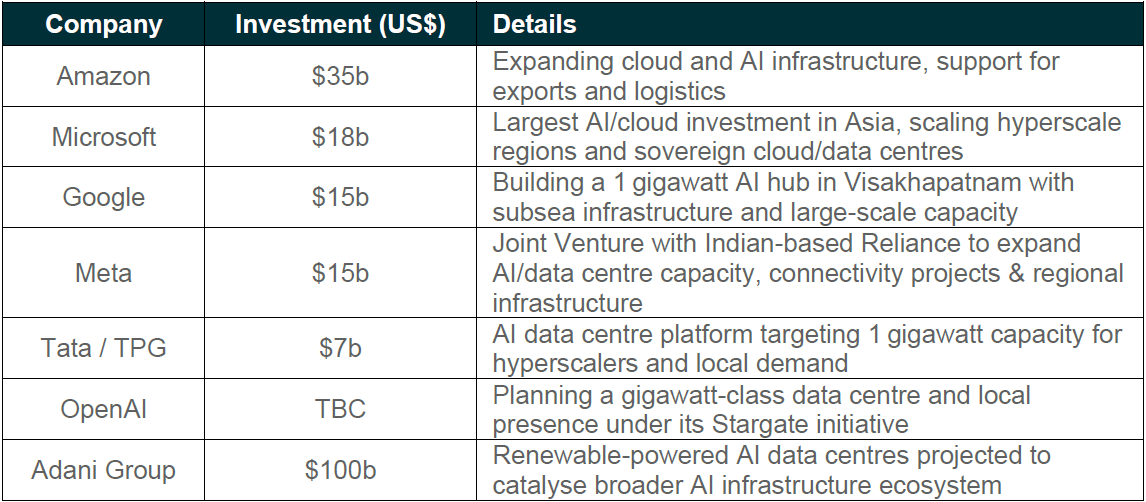
Source: Company Announcements, Reuters, Bloomberg, The Economic Times as of 18 February 2026.
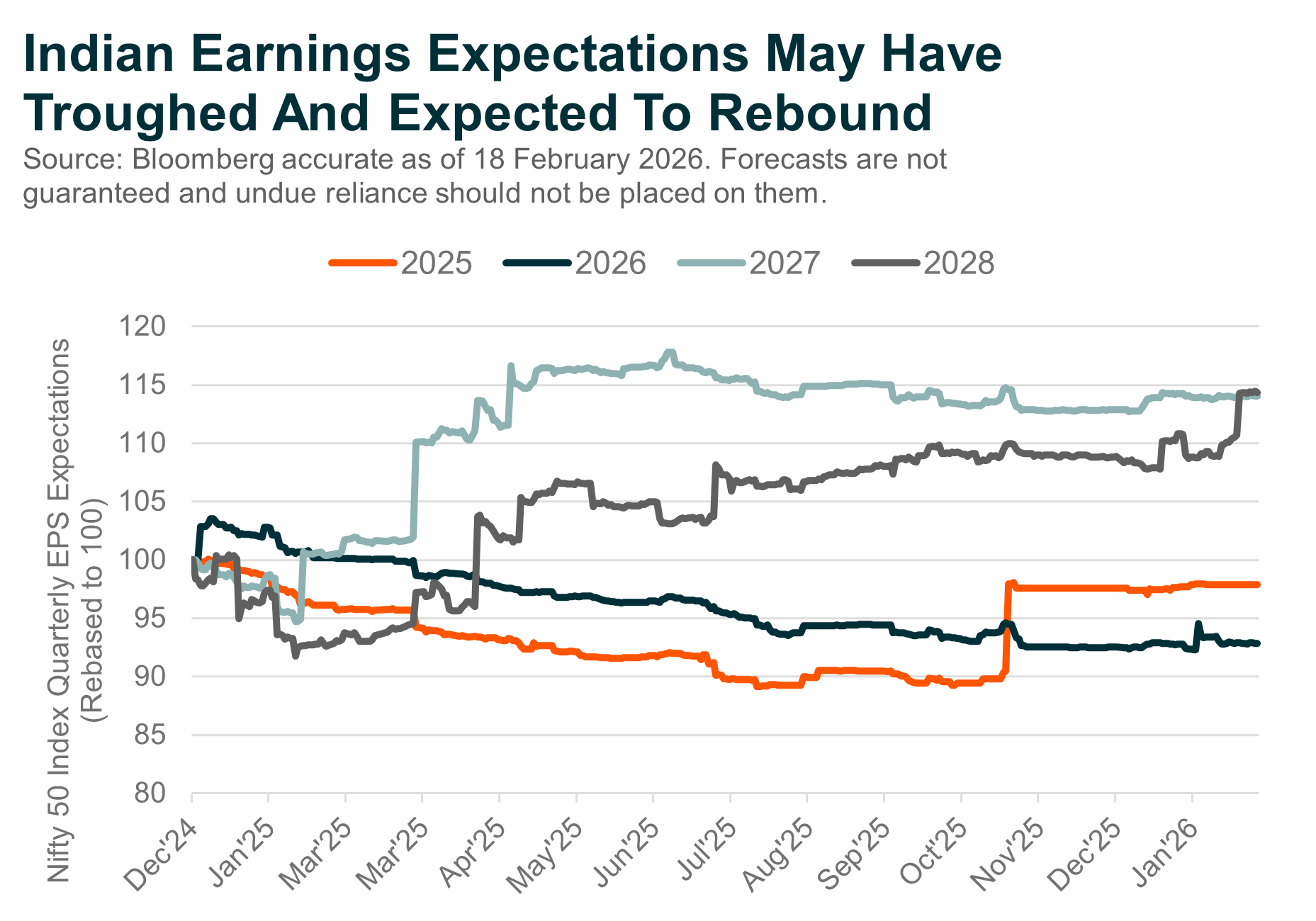
India’s AI story is now infrastructure-led, and with hyperscaler capex projected at ~$600 billion in 2026 (equivalent to ~15% of India’s GDP)8, India may be moving from a perceived laggard to a structural AI growth market. Corporate earnings have yet to fully justify earlier valuation expectations, with forecasts revised down through 2025 and remaining relatively subdued for 2026. However, improving policy clarity, easing trade-related headwinds, fiscally supported growth, and the emerging AI investment cycle suggest earnings momentum could begin to re-accelerate over the next couple of years.
A Potential Contrarian Entry Point
After months of being beaten down like Rocky Balboa in the ring, India is showing unmistakable signs of re-emergence. Following a period of material underperformance, Indian equities have reminded investors of the risks around valuation excess, earnings volatility and sensitivity to global capital flows, though improving fundamentals and policy tailwinds suggest conditions may now be turning more supportive. Fiscal prudence, clearing events like the US-India trade deal, and multi-year AI investment suggest the market may be discounting outdated narratives and overarching weaker sentiment. Rising gold prices – a key store of household wealth in India – could also begin to feed through to consumption via a positive wealth effect, reinforcing domestic demand. Corporate earnings now loom as the next potential spark that investors should watch to see if it ignites the next phase of recovery. India is quietly circling back, creating a rare contrarian entry point for investors looking to back the country’s long-term structural growth story.