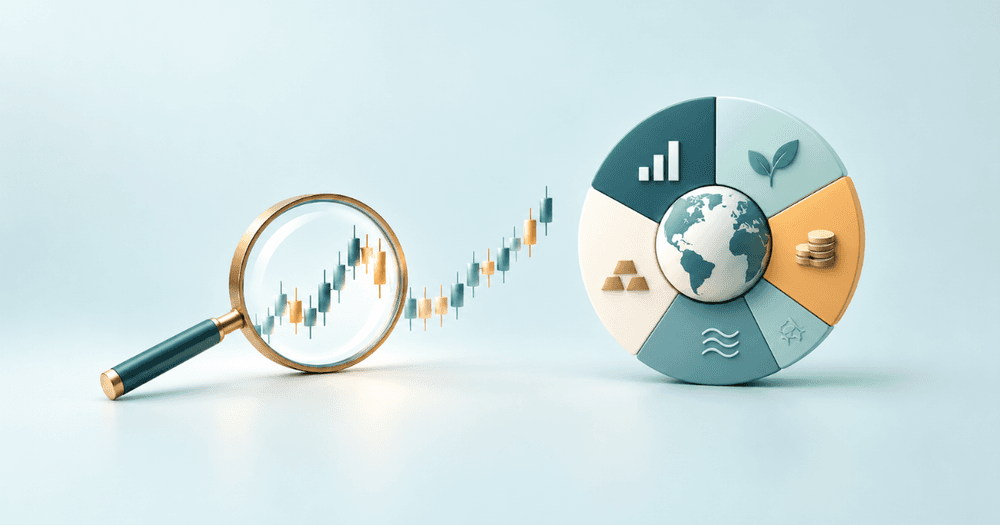
- An ETF gives you instant diversification by holding a basket of shares, bonds, commodities or other assets, all packaged into a single tradeable fund.
- A stock represents ownership in one specific company, such as Commonwealth Bank, Telstra or BHP.
With an ETF, your risk and return are usually spread across many holdings. With an individual stock, your outcome depends entirely on one company’s performance.
Why Australian investors use ETFs
ETFs have exploded in popularity on the ASX because they offer:
- Diversification in one trade
- Lower costs
- Transparency
- The ability to invest smaller amounts
- Hands-off portfolio management
For many first-time investors, ETFs provide a simple, lower-stress entry point.
But that doesn’t mean individual stocks don’t have a place in a diversified portfolio. Individual stocks give investors the chance to back companies they believe in.
Why Australians invest in individual stocks
Individual stocks remain a core part of how Australians invest. Many investors are drawn to stocks because they:
- Allow you to back specific companies you believe in
- Offer the potential for higher returns
- Provide access to dividend income, particularly from established Australian companies
- Give investors a greater sense of control over their portfolio
5 Key Differences: ETFs vs Individual Stocks
Here we break down the five most important distinctions for Australian investors: diversification, cost, time commitment, risk, and trading considerations.
1. Diversification: Broad vs Concentrated Exposure
ETFs
When you buy one ETF, you instantly gain exposure to dozens, hundreds, or even thousands of companies. For example, the Global X A300 ETF (A300) provides exposure to the 300 largest companies on the ASX. Meanwhile, the Global X Russell 2000 ETF (RSSL) tracks approximately 2000 US small-cap equities.
This diversification helps reduce the impact if one company performs poorly. Your risk is shared across many holdings. However, it’s important to note that diversification depends on the type of ETF. While broad market ETFs spread risk widely, commodity, sector or thematic ETFs can still be concentrated and may move significantly if that sector rises or falls.
Individual Stocks
Buying a single stock provides zero diversification on its own. Your returns rely entirely on that company’s performance. If the company falls on hard times, your investment suffers directly.
To build proper diversification with stocks alone, you may need to buy many different companies across sectors and countries, which takes time, research, and usually more capital.
In short: ETFs do the diversifying for you. Individual stocks require you to build and manage diversification yourself.
2. Cost Differences: Management Fees vs Brokerage Costs
ETFs
ETFs charge an ongoing management fee, also known as the MER (management expense ratio). This fee is built into the fund and expressed as a percentage of your investment, often between 0.04% and 0.60% annually, depending on the fund.
You also pay brokerage when you buy or sell ETF units through your broker.
Individual Stocks
Individual stocks have no ongoing management fees. You only pay:
- Brokerage fees when you buy or sell
- Potential FX costs for international stocks (depending on the broker)
This can make stocks cost-effective if you trade infrequently or prefer not to pay recurring fees.
However, building a diversified portfolio of individual stocks usually means more trades, which increases brokerage costs.
3. Time, Effort and Skill Required
ETFs
ETFs make investing simple. This is especially valuable when you’re targeting complex themes like AI infrastructure, robotics or semiconductors, or specialised areas such as energy and metals. These sectors often involve fast-moving technology, global supply chains and market dynamics that can be difficult for everyday investors to track.
With an ETF, the fund provider handles:
- Portfolio construction: selecting companies that meaningfully align with the theme, whether that’s robotics manufacturers, chip designers, energy producers or precious metals suppliers.
- Rebalancing: keeping the portfolio aligned with shifts in the sector, such as emerging AI hardware leaders or changes in commodity markets. The Fund will also sell out of names that fall below certain performance or liquidity thresholds and replace with names that do.
- Index tracking - ensuring the ETF follows a clear, rules-based strategy rather than relying on investor guesswork.
- Corporate actions: managing dividends, stock splits, mergers and other events automatically.
Whether you want exposure to the rise of machine learning, the global semiconductor supply chain or the long-term demand for copper and gold, ETFs offer a simple, low-maintenance way to participate.
Individual Stocks
Buying individual companies, especially in advanced technology or commodities sectors, requires significantly more effort and specialist knowledge. You’ll need to:
- Research financial statements to understand profitability, debt levels and competitive positioning.
- Understand industry trends, such as semiconductor cycles, robotics innovation or energy price movements.
- Monitor company announcements, from earnings results to production updates and strategic shifts.
- Keep up with global market news, including supply chain disruptions, commodity price changes or regulatory developments.
4. Risk: Market Risk vs Company-Specific Risk
All investments carry risk, but the types differ.
ETFs
Because ETFs hold many companies, they may reduce company-specific risk. Your main exposure is to broader market risk, the ups and downs of the index or the sector the ETF tracks.
Individual Stocks
Individual stocks carry much higher company-specific risk, including:
- Management decisions
- Earnings results
- Competition
- Industry disruption
- Regulatory changes
Returns can be volatile, both positively and negatively. High risk can lead to high reward, but it also increases the chances of losses.
5. Trading Differences: Liquidity, Spreads and Pricing
ETFs
ETFs trade on the ASX just like shares, but they behave differently behind the scenes.
When you buy or sell ETF units:
- Market makers help keep the price close to the value of the underlying assets (NAV).
- The biggest driver of liquidity is actually the liquidity of the underlying holdings and not the on-screen liquidity of the ETF.
Individual Stocks
Trading depends entirely on supply and demand for that specific company. Popular ASX blue chips (like BHP or CSL) tend to have:
- High liquidity
- Tight spreads
- Fast execution
Smaller companies may have wider spreads, slower execution, and higher volatility.
Which Option Is Better for You?
There’s no universal best choice. ETFs and individual stocks each serve different investing styles. What matters most are your goals, your level of experience, and how involved you want to be in managing your portfolio.
ETFs may suit you if:
- You’re a beginner and want a simple way to start investing.
- You prefer low-maintenance investing, without needing to research every company individually.
- You want instant diversification, both across sectors and across countries.
- You want exposure to global themes such as AI infrastructure, robotics, semiconductors, clean energy, or critical metals - that would be difficult to access through ASX-listed stocks alone.
- You’re focused on the long term, and want a smoother, more stable way to participate in fast-growing sectors.
- You value predictable, lower-cost strategies, where one ETF can provide access to dozens or even hundreds of international companies.
ETFs allow Australian investors to move beyond the limits of the local market and tap into global innovation. Instead of relying on a handful of ASX companies, you can access entire industries across the US, Europe and Asia with a single trade.
Individual stocks may suit you if:
- You enjoy researching companies and forming your own investment thesis.
- You want to build a highly customised portfolio, selecting specific companies you believe will outperform.
- You’re comfortable with higher risk and greater volatility, especially when investing in single companies.
- You’re seeking the potential for outsized returns, understanding that the trade-off is a higher chance of losses.
Summary
Both ETFs and individual stocks can play a valuable role in an Australian investor’s portfolio. ETFs offer an easy, cost-effective way to get diversified exposure with minimal effort. Individual stocks allow you to take targeted positions and potentially capture higher returns with higher risk and a greater time commitment.
You don’t need to choose one or the other. Start with what helps you build confidence, then evolve your strategy as you learn.