For generations, investing has been portrayed as a treasure hunt. Find the next Afterpay, buy the next Nvidia before everyone else catches on, or uncover the overlooked company destined to become tomorrow's market darling. The implication is that successful investing is about being clever enough to pick the right stocks. However, what if the biggest mistake investors make is focusing on the wrong game entirely?
The evidence suggests that investing is less about consistently picking winners and more about avoiding the losers, capturing the market's long-term growth and putting the right pieces together. In other words, the evolution of investing has been transformed from being a better stock picker to becoming a better portfolio builder. It is a philosophy reflected in Global X's H2 2026 Market Outlook, which explores how investors can build more resilient portfolios.
The Stock-Picking Game is Harder Than it Looks
Think of investing like tennis. Matches are often decided not by spectacular winners but by which player makes fewer unforced errors. Consistently going for the ambitious winners might produce incredible shots, but keeping the ball in play and managing risk can be just as important. Investing works much the same way. Picking spectacular winners is possible, but consistently avoiding costly mistakes is extraordinarily difficult.
Research has found that just 4-6% of US-listed companies accounted for all net wealth created by the US share market over a 90 year period1. In Australia, the results are quite similar, with only around 8% of companies having outperformed the broader index over the past 20 years.
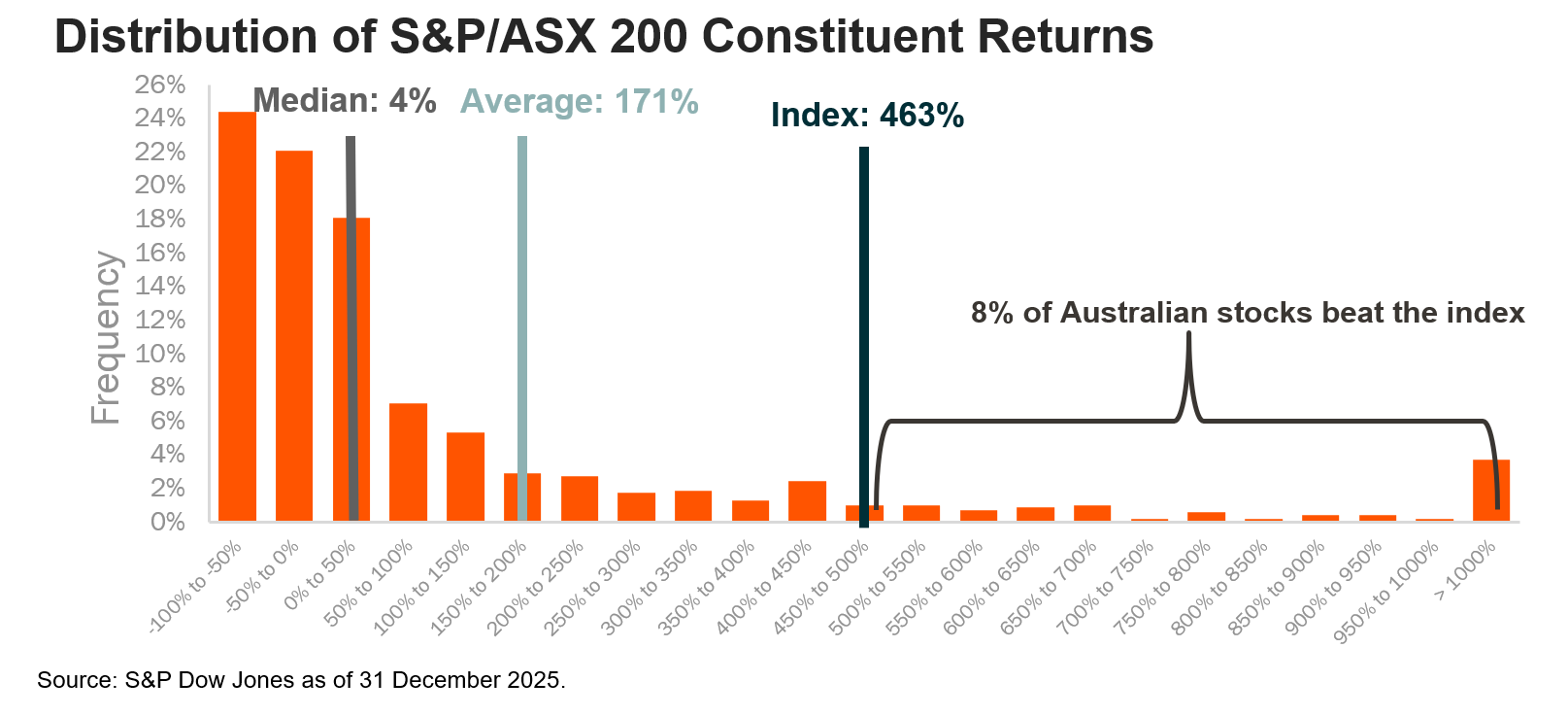
The challenge is compounded by the downside. J.P. Morgan Asset Management research found that approximately 40% of stocks suffered catastrophic losses (of greater than 70%) from which they never recovered, 58% lost money for shareholders and 67% underperformed the broader market.2
The message is confronting but abundantly clear - investors must avoid permanent losers while ensuring they own enough of the relatively few companies that drive market returns. When a small number of extraordinary winners drive so much of the market’s returns, missing them can have an outsized impact on performance. That raises a more fundamental question - how can investors capture the winners without having to predict them in advance?
From Finding Winners to Owning the Market
In the early 1900’s, railroads dominated the share market. Today, technology and AI are reshaping the index. Market leaders change, making it difficult to pick tomorrow’s winners.
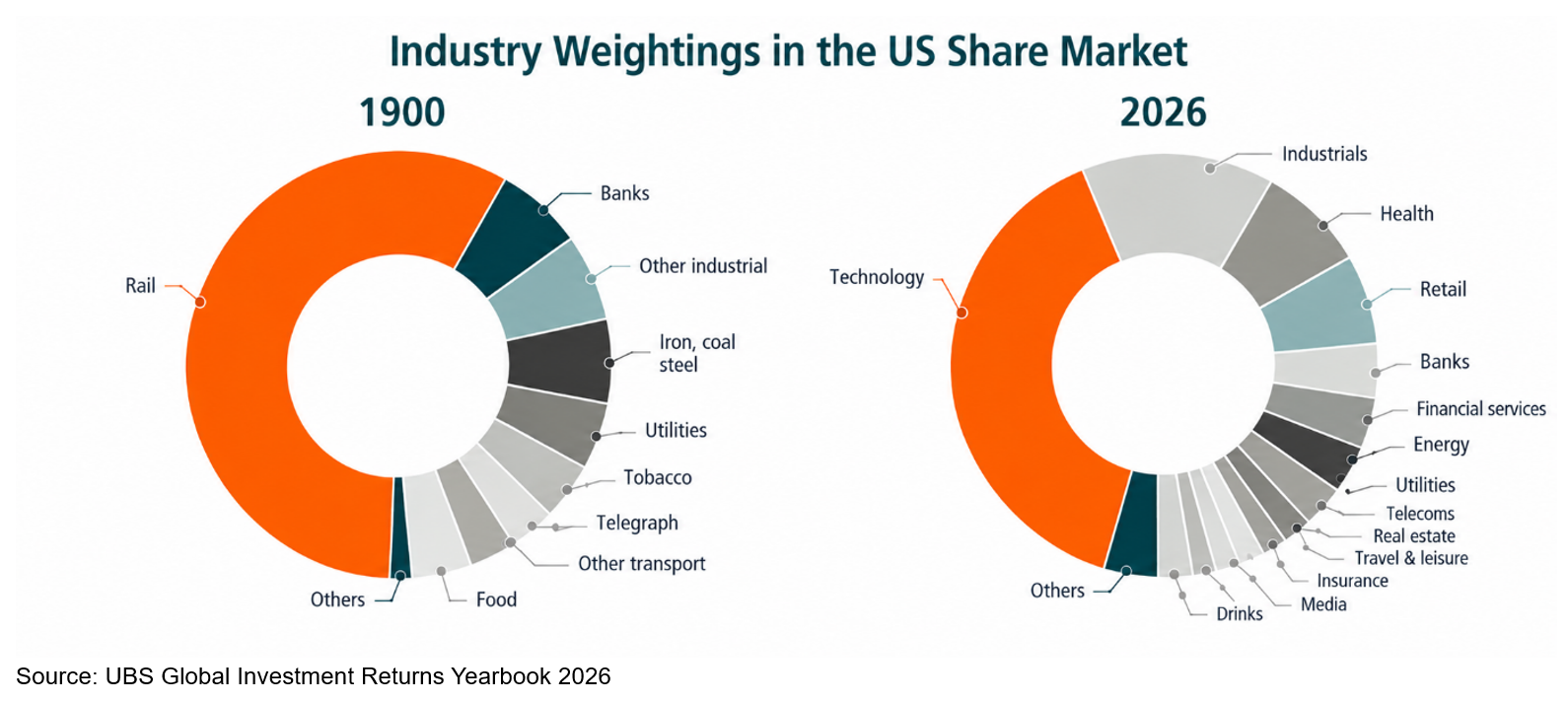
The difficulty of identifying winning stocks has helped drive a fundamental shift in portfolio construction. Since the first exchange traded fund (ETF) launched in Canada in 1990 and Australia in 2001, investing has become increasingly accessible. Unlike many traditional unlisted managed funds, which can require substantial minimum investments, ETFs allow investors to start with comparatively small amounts and build diversified portfolios progressively.
Rather than guessing which company will outperform, investors can own a basket of stocks to diversify their risk and exposure. ETFs may not guarantee superior returns or eliminate market risk, but they reduce the consequences of being wrong about any one company while helping investors participate in the long-term growth of markets.
Even the Professionals Struggle to Beat the Market
If professional investors, armed with research teams and sophisticated analytical tools, struggle to consistently pick winners, what chance does the average investor have? Professionals whose job it is to pick stocks face an uphill battle, with well-established research showing that more than 85% of actively managed funds underperform their benchmark index over the long term3. And even when managers outperform, sustaining that success is another challenge, as research highlights how few top-performing active funds maintain their relative performance across successive periods4.
This matters because investors often chase yesterday's winners, allocating money to funds after strong performance. Yet past outperformance provides little assurance of future success. If stock picking is only one piece of the puzzle, where should investors focus? The answer is portfolio construction - deciding how much to allocate to Australian and international shares, bonds, gold, cash and other assets, and how those investments work together.
Research on portfolio returns has long highlighted the importance of asset allocation, with frequently cited studies attributing more than 90% of return variability to allocation decisions5. Think of building a house. Investors can spend months debating the kitchen fittings or the colour of the front door, but none of those decisions will compensate for a poorly designed foundation. Portfolio construction is that foundation. The balance between growth and defensive assets, the mix of domestic and global investments, and the amount of risk taken should come before deciding which individual company to own.
As outlined in Global X's H2 2026 Market Outlook, balance may prove more valuable than making a single bullish bet. With market leadership evolving and valuations diverging, diversifying across different sources of return can help investors navigate an increasingly complicated market.
ETFs Make Portfolio Construction Accessible
ETFs allow investors to build diversified portfolios without becoming expert stock pickers. Individual stocks can still play a role for investors with genuine conviction or an analytical edge. However, for most investors, the priority should be building a diversified portfolio, not finding the next big winner. For a deeper discussion on moving beyond stock picking and building diversified portfolios, download our H2 2026 Outlook.