US equities have continued to perform strongly through 2026, particularly among the largest AI names. Less remarked upon is what has been happening elsewhere. As market breadth has improved, several markets outside the US have started to offer a combination of earnings growth and structural change that was difficult to find a few years ago.
One market we believe has become particularly attractive in recent months is Japan. The concerns are real and well-rehearsed: long-term fiscal sustainability, a persistently weak yen, and a central bank that has been slow to normalise policy. However, we see those concerns as now widely understood by the market. In the background, Japan’s economy is now further along the path to recovery, policy is gradually normalising, and corporate reform is showing up in company accounts rather than only in policy documents.
Throughout this piece we look at Japan through the TOPIX 100, the 100 largest companies listed on the Tokyo Stock Exchange. It is a deliberately large-cap, globally connected slice of the market: technology hardware, industrials, autos, trading houses and banks, most of which earn a substantial share of their revenue offshore. It is also the index tracked by the Global X Japan Topix 100 ETF (J100).
Key Takeaways
- A weaker yen has generally coincided with stronger Japanese equity returns over the past two decades, through improved export competitiveness and the translation of overseas earnings.
- Corporate reform is showing up in the numbers. Return on equity has passed 10.5% for the first time since 2019, and analysts expect it to move above 11% within two years.
- Japanese equities offer a forward earnings yield premium of roughly 3%, well ahead of the US and Australia, and in our view that premium may even be understated.
Three Forces Supporting Japanese Equities
Before turning to the detail, it is worth being clear about what would make Japan interesting rather than simply cheap (which it has been for quite a while). Plenty of markets look inexpensive at any given moment and most of them stay that way for years because a low price on its own tells investors very little. Instead, there must be something genuinely changing beneath that price to drive the case for owning the market.
On our reading, Japan meets this test on three separate counts: a weaker yen is supporting Japan’s export economy, corporate reform is visibly improving capital efficiency, and relative valuations suggests a stronger margin of safety relative to developed market peers. We expand on each below.
1. Exporters and the Yen
The most immediate of the three forces is also the easiest to observe. The Japanese yen has been weakening for the majority of the year, and we see this as a tactical and potentially short-term tailwind for Japanese equities.
A large share of the top Japanese firms are exporters, meaning earnings are often generated outside Japan, across technology, industrial goods and autos. A weaker currency helps these companies in two different ways. The first is competitive. When the yen falls, Japanese goods become cheaper for foreign buyers relative to those produced elsewhere, which tends to support both sales volumes and margins. The second is arithmetic. A Japanese business that earns its revenue in US dollars or euros converts those earnings back into yen before reporting them, so a weaker yen turns the same underlying performance into a larger reported profit.
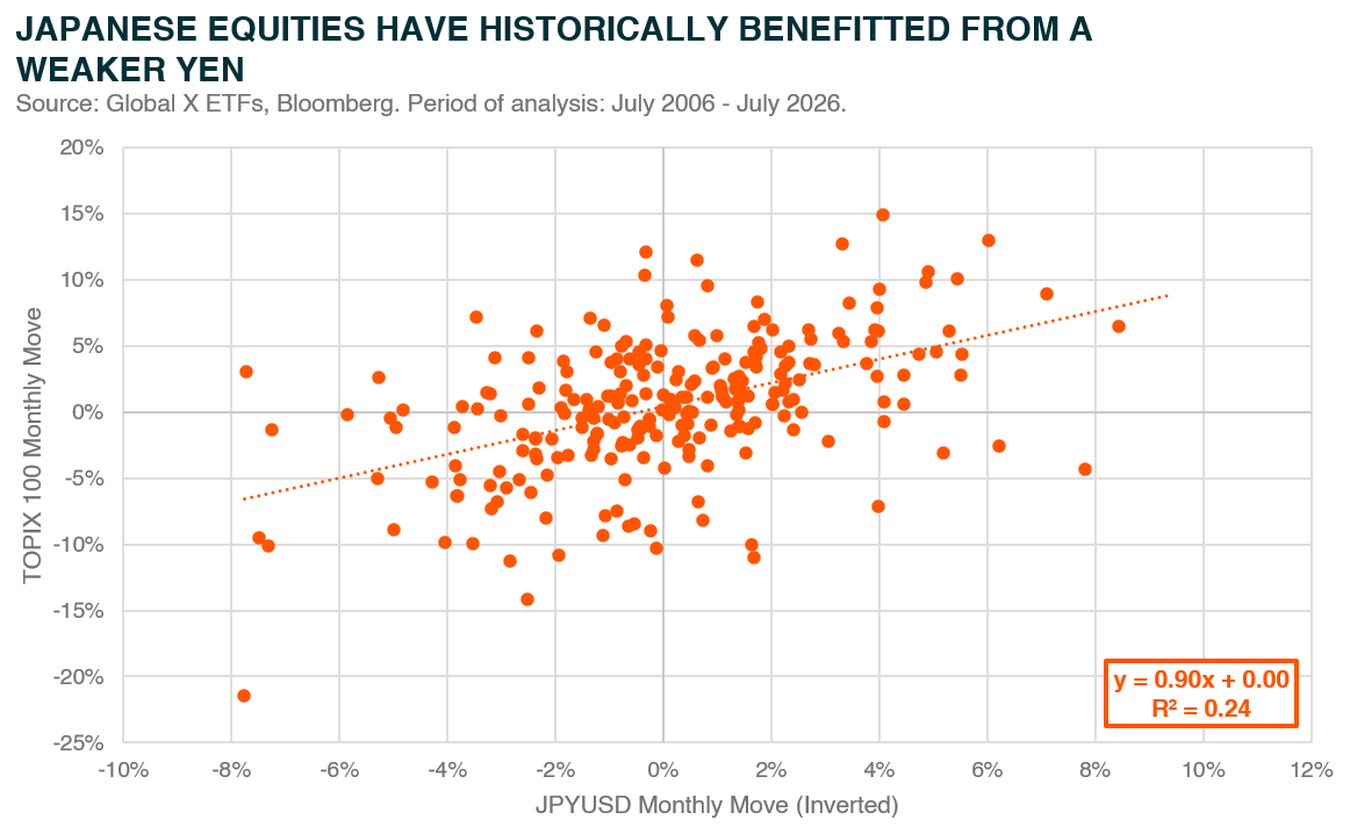
These two dynamics have historically created an inverse relationship between the yen and Japanese equity performance. With the yen historically weak, we expect this tailwind to continue supporting corporate profits and, in turn, equity valuations.
2. Corporate Reform Taking Effect
For much of the past three decades the complaint about corporate Japan was remarkably consistent. These were often sound businesses with good products and strong market positions, but they carried very large balance sheets, holding idle cash, cross-shareholdings in one another and property, and earned comparatively little on any of it.
The measure that captures this is return on equity, which compares the profit a company makes with the amount of shareholder capital it uses to make it. For years Japanese companies sat at the lower end of the developed market range on this measure, which is a large part of why they traded at a persistent discount to global peers.
That picture has been shifting. Tokyo Stock Exchange listing reforms have pushed companies trading below book value to publish plans for improving capital efficiency, and a more assertive shareholder base, both domestic and foreign, has kept the pressure on management to follow through. When we launched the Global X Japan Topix 100 ETF (J100) in late 2025 this was central to the investment case, and the evidence has continued to accumulate through 2026.
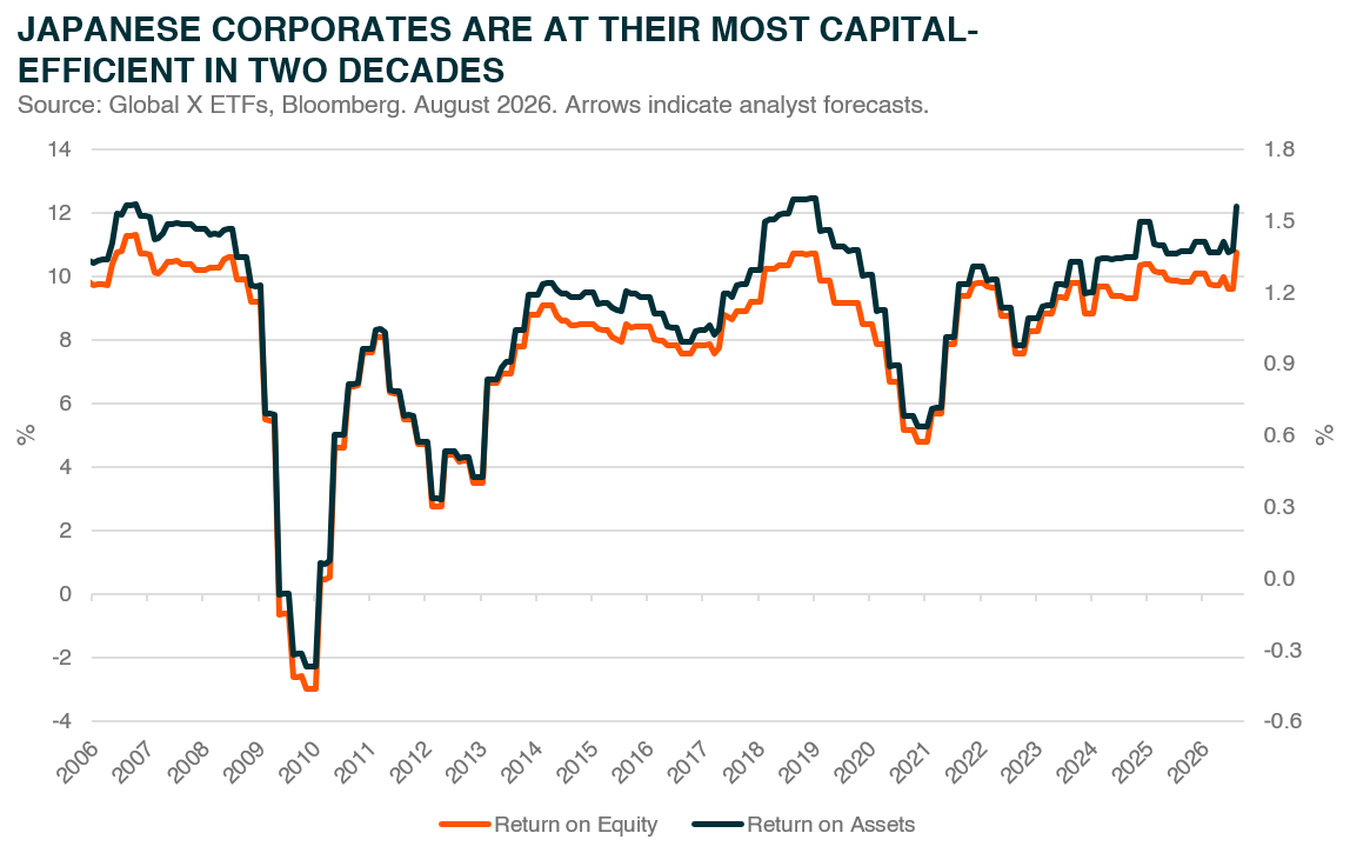
Following the most recent earnings season, return on equity passed 10.5% for the first time since 2019, and analysts now expect it to rise above 11% over the next two years, which would be its highest level in two decades.1 Return on assets has improved alongside it, which we consider an important detail, because it suggests the gains are coming from the operations themselves rather than from companies simply borrowing to shrink their equity base.
3. Japan Now Offers “Genuine” Value
The third argument concerns price, and it takes a little more explaining than the other two, although the underlying idea is straightforward.
An investor buying shares gives up the certainty of a government bond in exchange for the possibility of something better, so it is reasonable to ask what they are being paid for accepting that risk. The earnings yield premium is one way of answering the question. Take the earnings a company is expected to generate over the coming year, divide them by its share price to give an earnings yield, then subtract the yield available on the local ten-year government bond. What remains is the additional return investors are being compensated with for taking a risk on company earnings rather than lending to the government. The wider that gap, the more room there is for earnings to disappoint before an investor would have been better off in bonds.
Japan has screened well on this measure for a long time, however, for most of that period the result was also easy to dismiss. With Japanese government bond yields pinned close to zero, almost any equity market in the world would have looked generous by comparison. The premium, on this reading, said far more about the poor value available in Japanese bonds than about any particular value in Japanese equities.
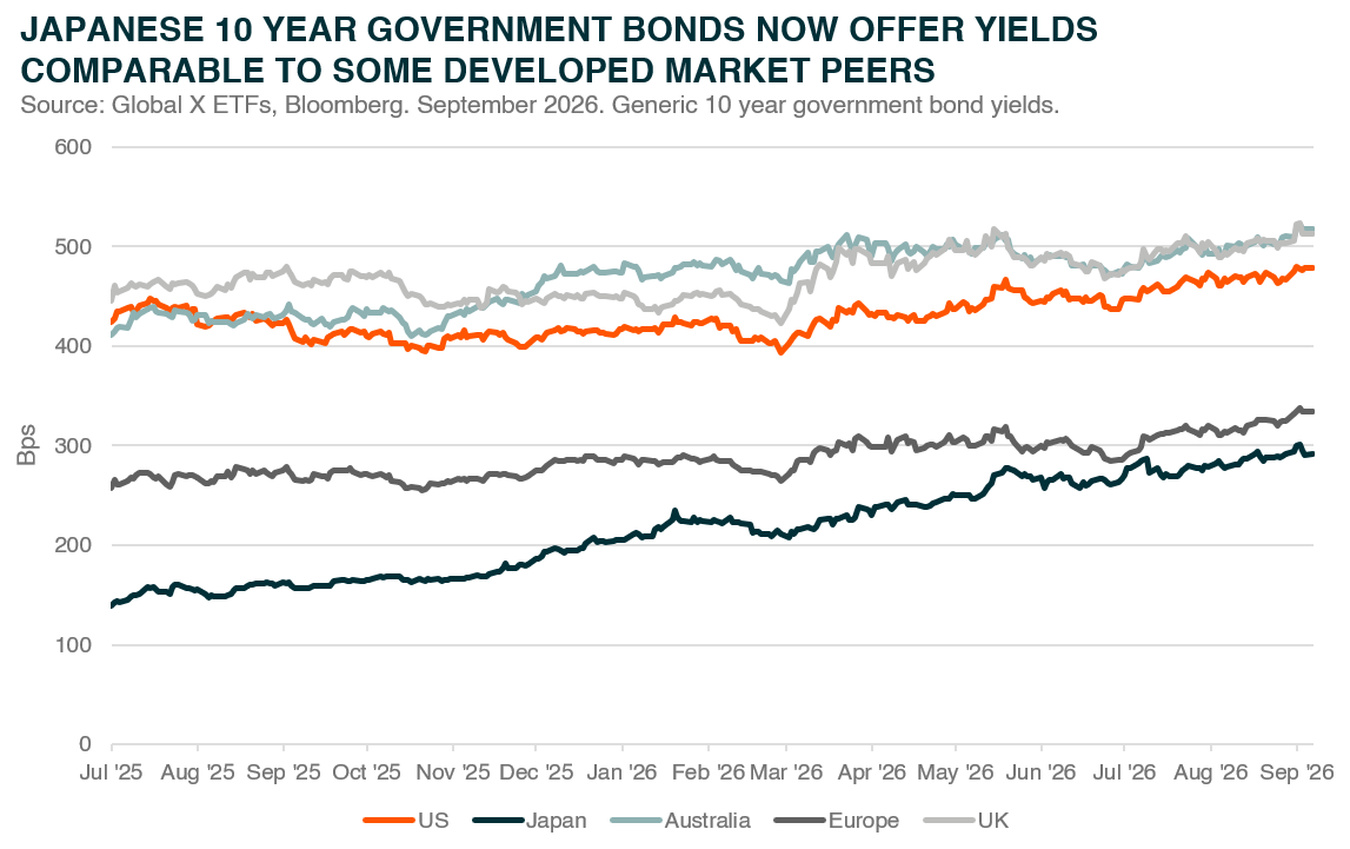
But this view may be outdated today. As of September 2026, ten-year Japanese government bond yields are trading at thirty-year highs of around 3%, which is a respectable return and a genuine alternative to owning shares. Despite that, the TOPIX 100 still offers a forward earnings yield premium of roughly 3%. This makes its comparison with other developed markets much more instructive.
Currently, both the US and Australia sit close to zero on the same measure, meaning investors in those markets are being paid very little for taking earnings risk over bonds, while the UK sits below 1%. Europe (another region we like) is the only region which screens broadly in line with Japan.
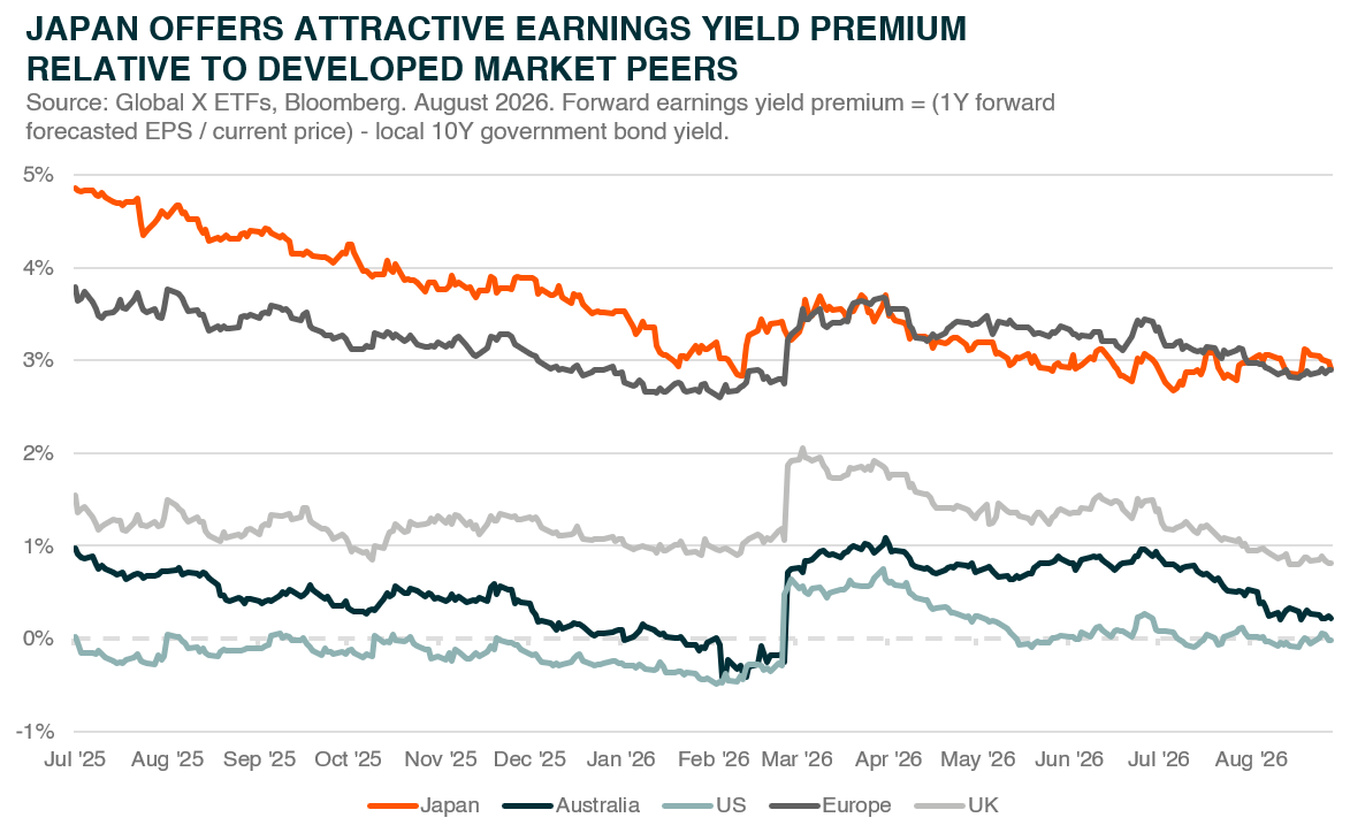
Interestingly, though Japan’s earnings yield premium is already comparatively attractive, we believe it may still be understated. The premium is calculated using analyst forecasts of future earnings, which means it is only as reliable as those forecasts are. Japanese companies have just delivered an exceptional earnings season, comfortably exceeding consensus expectations and leaving actual earnings well above the estimates analysts are still carrying for the third and fourth quarters of 2026 and into 2027.
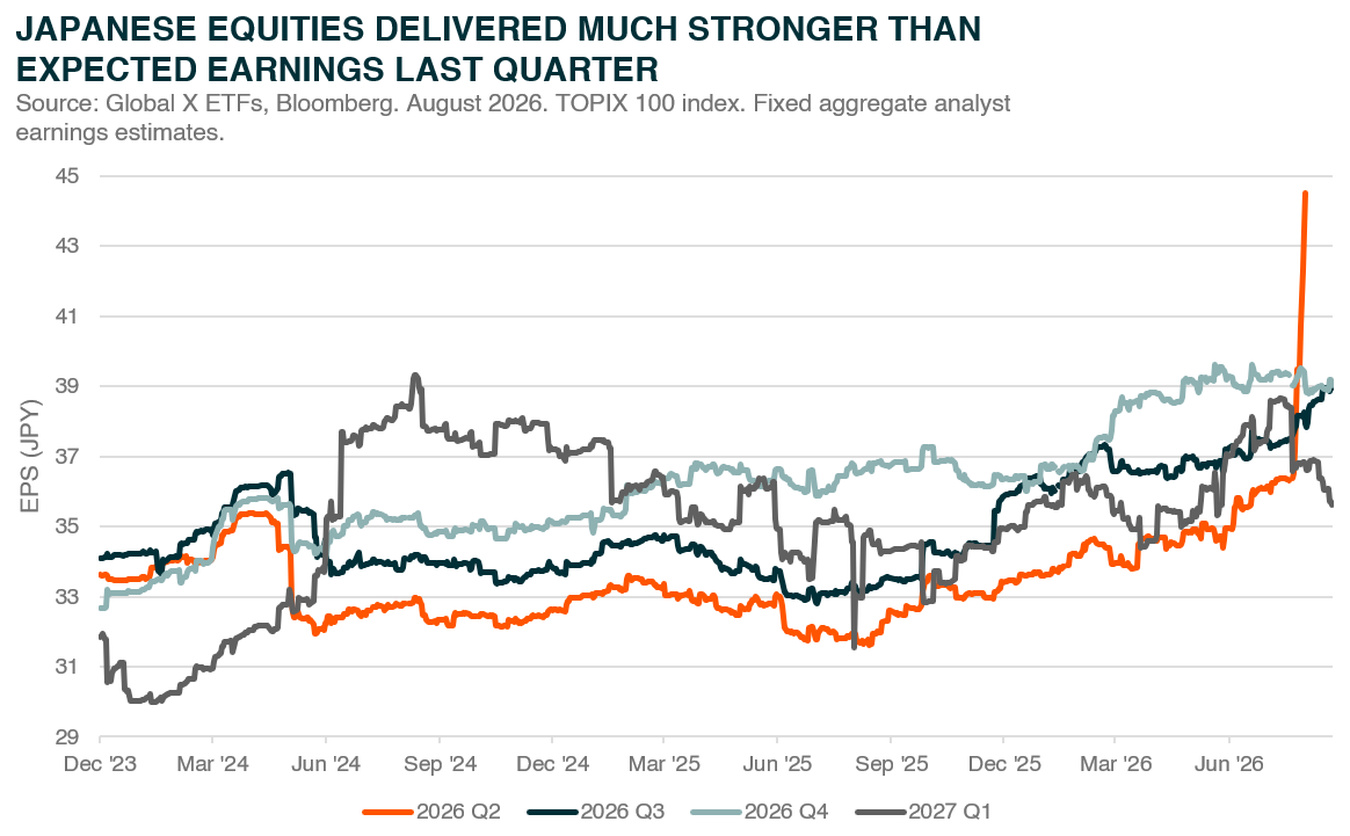
If analysts revise their forecasts upwards to reflect this higher earnings base, the forward earnings yield rises with them and the premium over bonds widens accordingly. We see little reason to expect the step up in earnings to reverse in full over the coming quarters, which leads us to think that Japan's current premium understates rather than overstates the valuation advantage on offer. Put another way, the discount may be wider than the published figures currently suggest.
A Closer Look at the Yen
Having argued that a weak yen is helping Japanese earnings, we should be equally clear that it is also the most obvious risk to the investment case. The gap between Japanese and US interest rates is still wide, the government continues to favour fiscal expansion despite the level of public debt, and the Bank of Japan has moved slowly on rate rises. Anyone who has held Japanese equities without hedging the currency has felt the consequences in their returns.
We are not forecasting a sharp reversal, and we would be cautious of anyone who is. What we do think is that the pressure on the yen is becoming less one-directional than it has been, and that positioning against it from here is a less comfortable trade than it was a year ago. Below are four quickfire reasons as to why we have this view.
- The rate gap should narrow. The single largest driver of yen weakness has been the interest rate differential with the US, and both sides of that gap are now moving. Markets currently price the Bank of Japan to raise rates three times by June 2027, while the Federal Reserve has not proven as hawkish as many had anticipated.
- Intervention risk has risen. Both Japanese and US authorities have been active in the currency market and are increasingly vocal on the subject. In our view the prospect of official intervention makes sustained one-way positioning (against the yen) considerably less attractive than it was twelve months ago.
- The trade balance should improve. Japan imports almost all of its energy, which leaves the currency unusually sensitive to fuel prices.2 Those costs have begun to ease, meanwhile technology exports (of which a large part is related to AI) is expected to grow rapidly. Should the trade surplus return, it brings with it a steady structural source of demand for the yen.
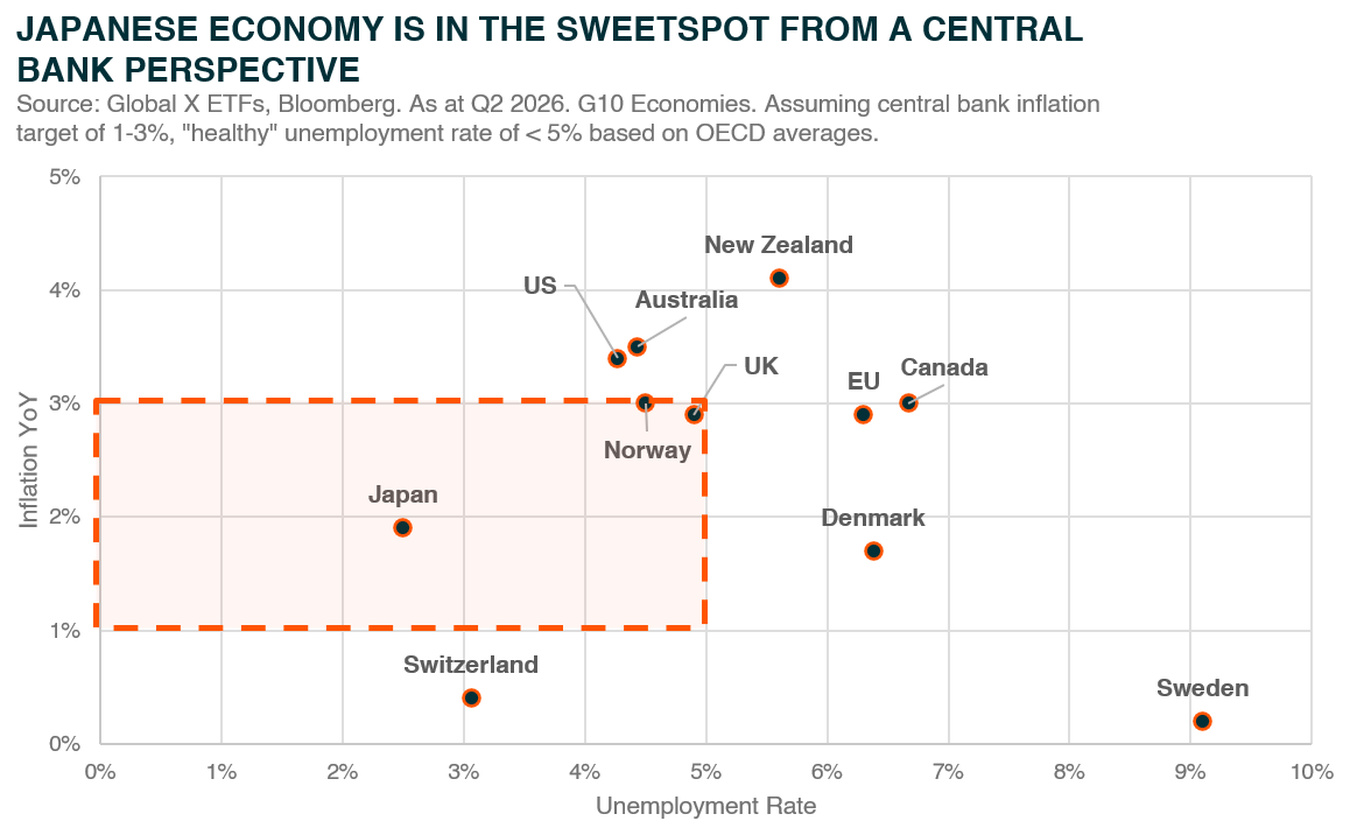
- All things considered, the domestic backdrop is healthy. Inflation is running close to 2% and unemployment near 2.5%, which places Japan further inside the range most central banks would regard as comfortable than any other G10 economy. On its own that sounds unremarkable, but for Japan it represents the end of a very long period of stagnation, and currencies rarely stay historically cheap when the underlying economy looks like this.
Conclusion: Japan Shifts Gears
Japan has spent three decades teaching investors to discount its recoveries, and after those many false dawns a degree of scepticism is entirely rational. We think this one warrants a more open mind, largely because it arrives with both evidence and tailwinds - something that earlier versions lacked. Corporate reform is showing up in reported returns on equity and on assets rather than in policy announcements alone. Exporters continue to benefit from a currency that remains historically cheap. And the valuation premium over bonds has survived a rise in domestic yields to thirty-year highs.
The yen does remain a risk, but we believe the balance of forces is becoming less one-sided as rate differentials narrow and Japan’s external position improves.
For investors looking to diversify beyond an increasingly concentrated US market, Japan offers exposure to many of the same structural growth themes, but at a more attractive starting valuation and with a greater margin of safety. After years of false starts, Japan may finally be shifting gears.
Related Fund
J100: The Global X Japan TOPIX 100 ETF (ASX: J100) tracks the Topix 100 Total Return Index, which is a subset of the broader TOPIX (Tokyo Stock Price Index) and represents the 100 largest and most liquid companies on the Tokyo Stock Exchange.