After nearly two decades of violent booms and busts, news headlines about Bitcoin’s “imminent death” have become less a warning and more a ritual. Each sharp drawdown brings with it a fresh wave of obituaries, confidently declaring the experiment over. Yet the pattern is by now familiar: price falls, conviction is tested, and the narrative of collapse resurfaces almost on schedule.
The latest episode is no different. As of March 2026, Bitcoin has declined roughly 40% from its October peak of US$125,000 to around US$74,000.1 In response, headlines questioning its viability, or its failure to fulfil the promise of “digital gold”, have re-emerged with renewed urgency. But these takes, much like those before them, risk focusing on short-term price action at the expense of the broader structural story.
While the recent trend has been decisively negative, it is far from anomalous. The current downturn aligns closely with Bitcoin’s historical four-year cycle, a pattern that has repeatedly defined its market behaviour. More importantly, the nature of this drawdown may be more telling than the drawdown itself. Bitcoin’s behaviour in this phase suggests an asset that is gradually maturing, with volatility compressing and wider investor participation providing a more stable foundation. Rather than undermining the investment case, this evolution arguably strengthens Bitcoin’s trajectory toward being recognised as a legitimate asset. From a technical standpoint, current price levels may also present a compelling entry point for long-term investors.
Key Takeaways
- Bitcoin’s current drawdown is closely aligned with its traditional four-year cycle and is far from anomalous. However, the nature of the recent decline suggests lower volatility and a more mature crypto ecosystem.
- US-listed spot Bitcoin ETFs may provide a stabilising force for the asset, with ETF investors showing notable resilience during market downturns as well as stepping in as dip buyers.
- Current price levels appear technically well supported by the 2021-22 cycle peaks and the 2024 accumulation phase. At the same time, Bitcoin’s “digital gold” narrative is beginning to re-emerge, with recent price resilience amid the ongoing Iran conflict suggesting signs of demand.
Old Habits Die Hard
For newer entrants to the crypto market, Bitcoin’s recent price action can feel undeniably unsettling. A ~40% drawdown in a matter of months, coupled with persistent negative headlines, can give the impression that something structurally broken is unfolding.
However, for more seasoned Bitcoin observers, the current environment looks far less anomalous. Instead, it aligns closely with Bitcoin’s well-documented four-year cycle, a pattern that has broadly persisted since 2011. At the centre of this cycle is the “halving” event, which occurs roughly every four years and reduces the rate at which new Bitcoin supply is created. Historically, halvings have acted as a powerful catalyst for bull markets by tightening supply dynamics just as demand begins to accelerate. What typically follows is a period of rapid price appreciation, eventual overheating, and then a multi-month drawdown as excesses are unwound. In that context, the current correction fits remarkably well within prior cycles.
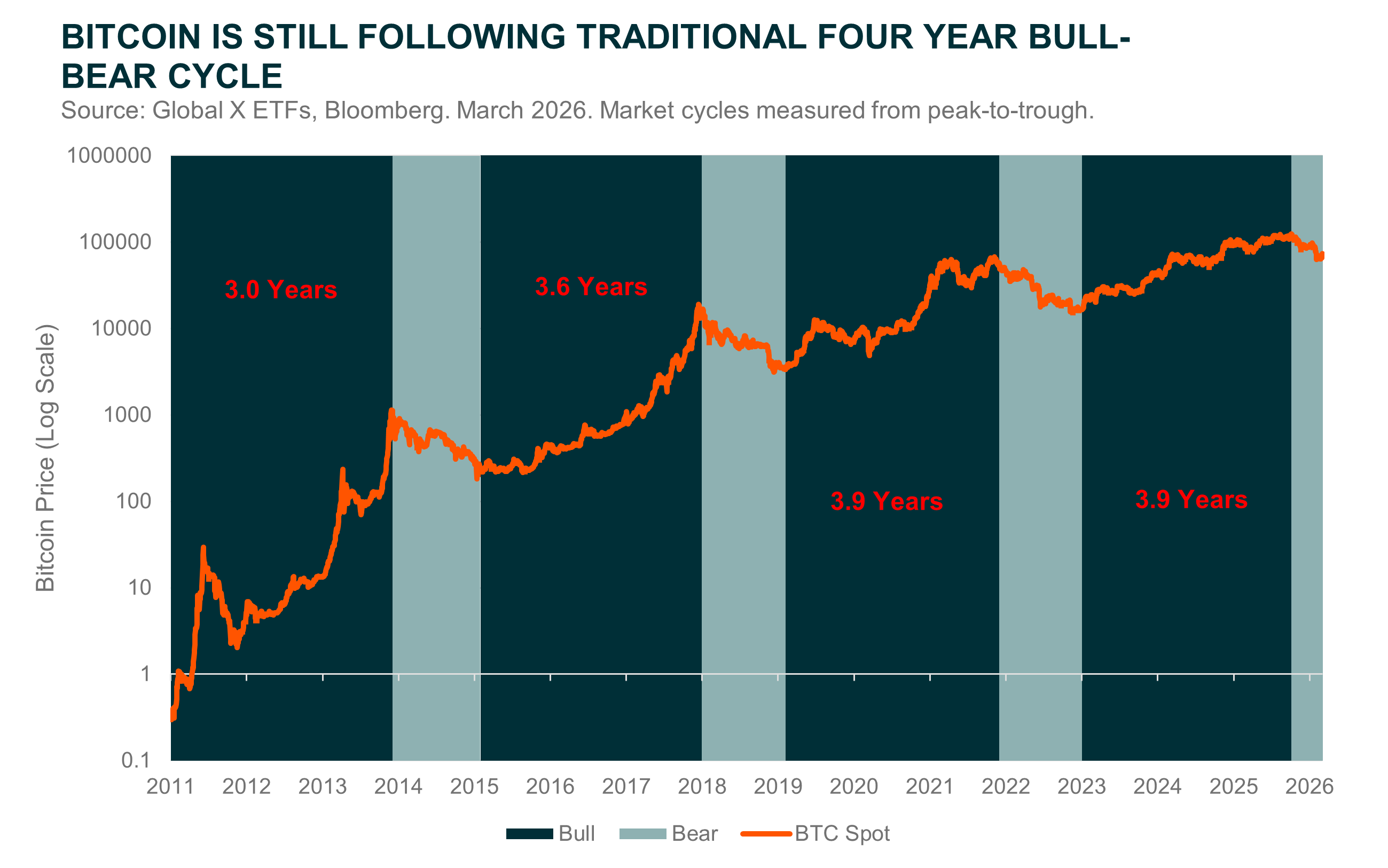
Past performance is not a reliable indicator of future performance.
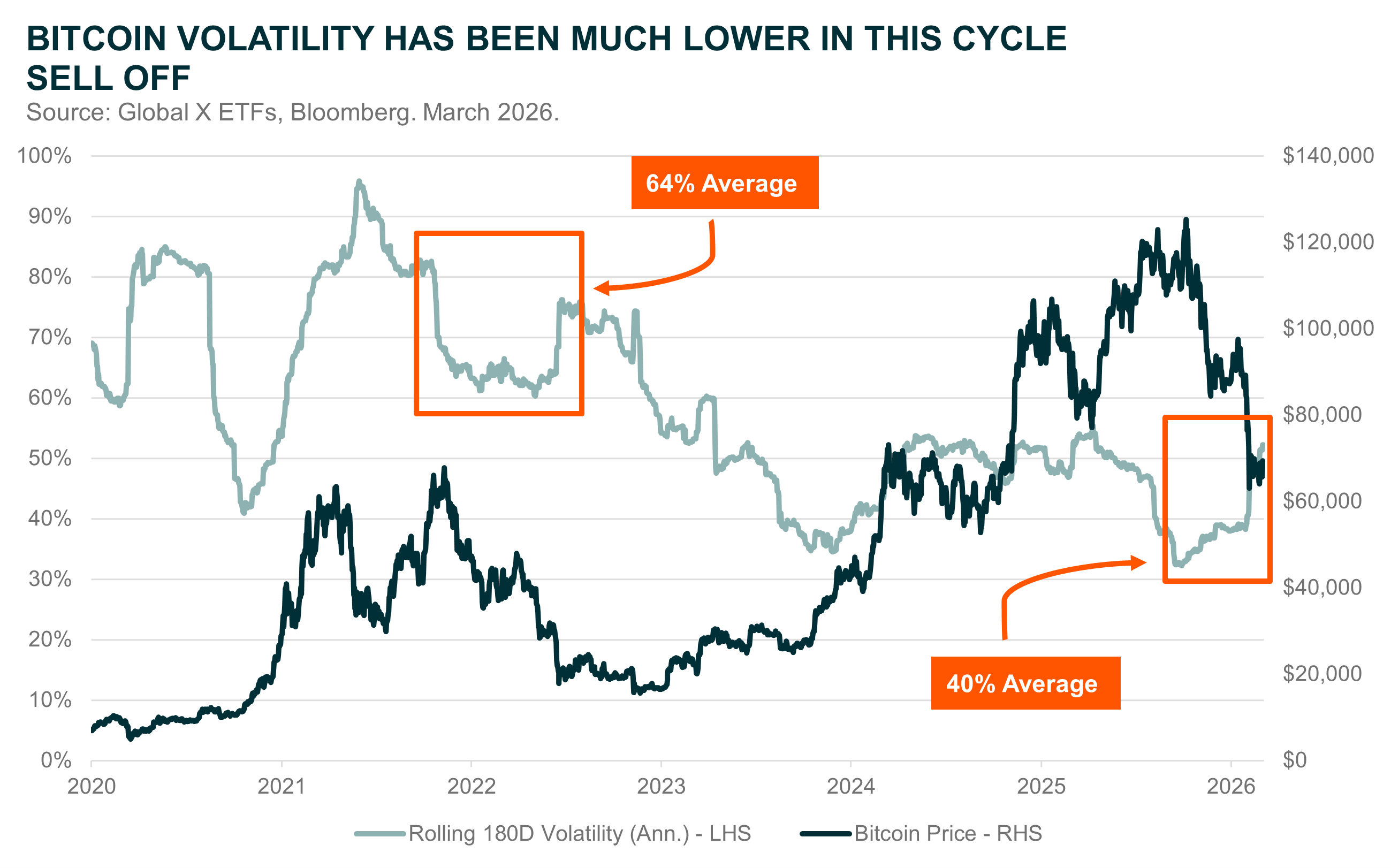
The difference this time, then, lies less in why Bitcoin is correcting, but how it is doing so. Rather than the sharp, disorderly crashes that characterised earlier cycles, this drawdown has taken the form of a slower, grinding decline, accompanied by meaningfully lower volatility. The drivers of the sell-off also appear more macro-oriented than crypto-specific. Tighter global liquidity conditions, rising real yields, and Bitcoin’s residual correlation to technology equities (which were hammered by AI disruption concerns) have all played a role. This lingering “high-beta tech” behaviour reflects the reality that Bitcoin is still a relatively young asset, and parts of the investor base have yet to fully internalise its distinct value proposition. At the same time, simple buyer exhaustion following a strong 2024-2025 rally likely also contributed to softer demand. Taken together, these dynamics point not to fragility, but to evolution. Lower volatility and more orderly price action are hallmarks of a maturing asset class.
Furthermore, it is notable that - unlike previous cycles - this downturn has not been punctuated by a major systemic failure within the crypto ecosystem. Past bear markets were often accelerated, if not outright triggered, by high-profile collapses of exchanges, lending platforms, or algorithmic structures. The absence of such an event in the current cycle is significant. It suggests that the market is gradually moving beyond the era of speculative excess and weak infrastructure that once defined it. In its place, a more resilient foundation is emerging, supported by institutional participation and the growing influence of ETF-based investors. These participants tend to be more measured, longer-term in orientation, and less prone to panic-driven behaviour. This shift in the composition of the investor base is critical. It marks an important step in Bitcoin’s transition from a fringe, speculation-driven asset to one that is increasingly integrated into the broader financial system.
ETFs Provide the Path Forward
The maturation of Bitcoin has long been tied to the evolution of its investor base, with the rise of ETFs representing one of the most important structural shifts in the asset’s history. Indeed, Bitcoin ETFs now account for around 7% of total supply, up from just 3-4% in 2024 when the first US spot Bitcoin ETFs were approved and listed.2
Against this backdrop, we have been closely tracking ownership trends across these products, particularly through the recent drawdown, to assess how this new cohort of investors is behaving under pressure.
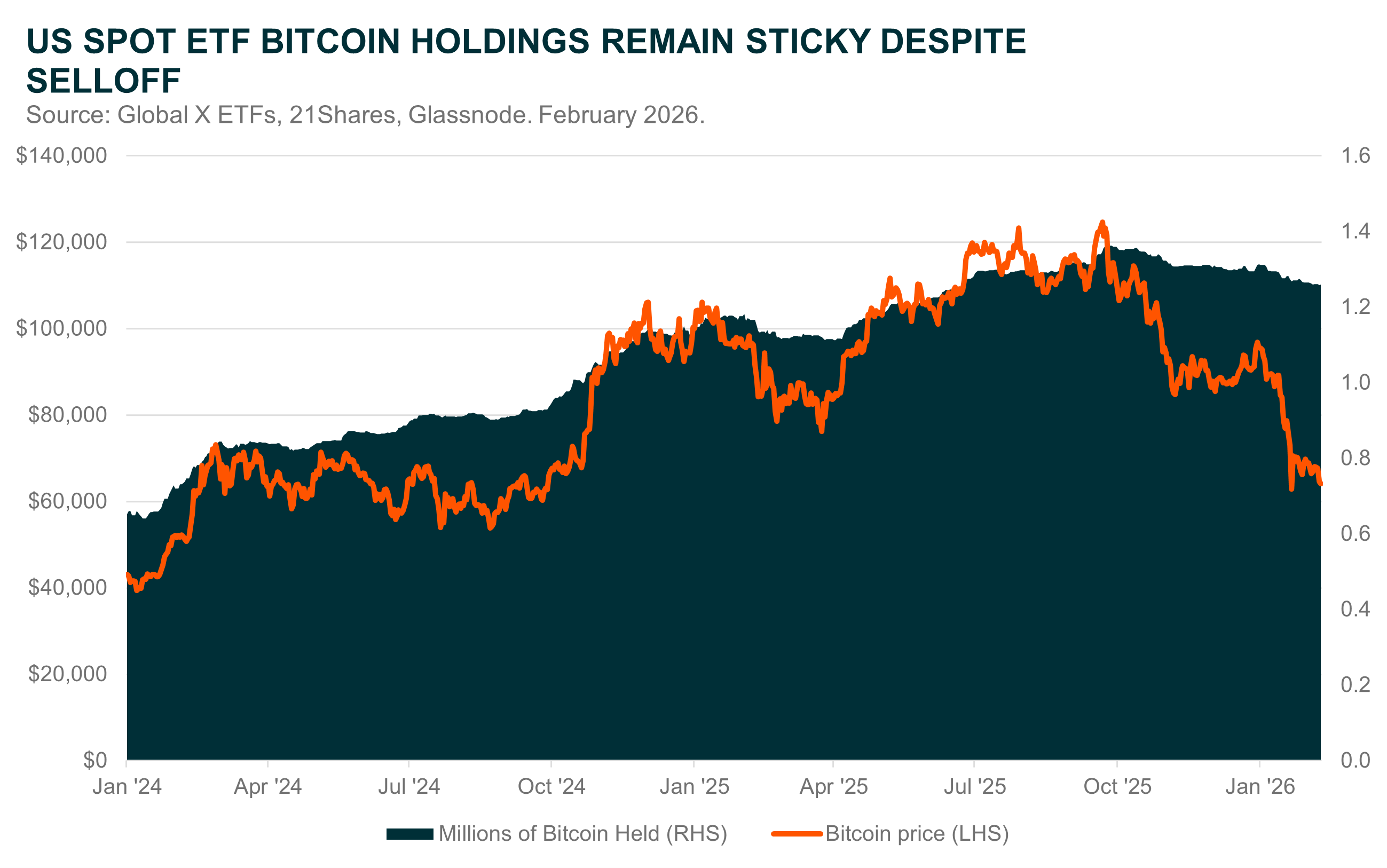
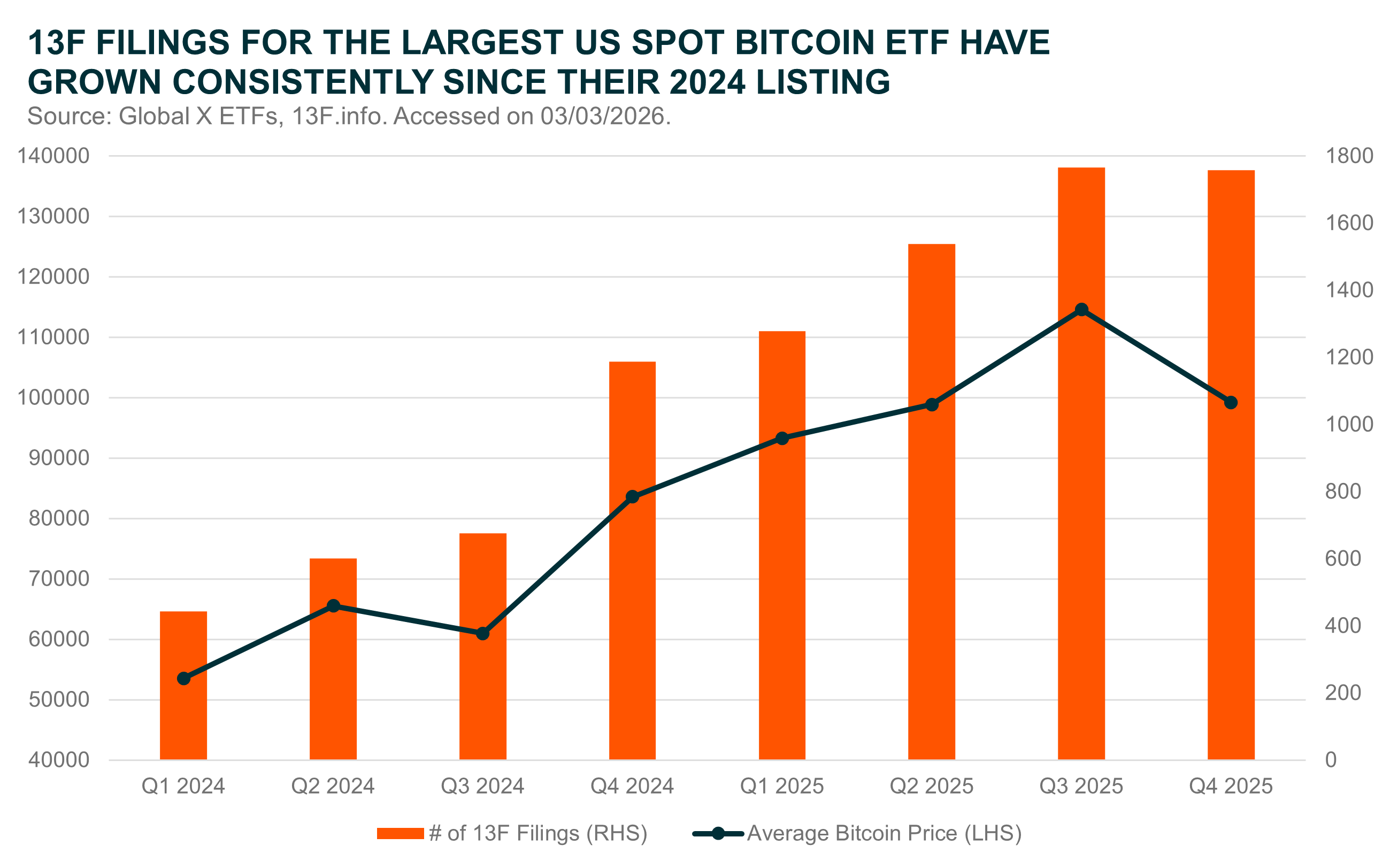
What stands out is the relative resilience of ETF holdings despite a significant correction in price. Since peaking at around 1.36 million total Bitcoin in December 2025, total holdings across US spot ETFs have only declined modestly to approximately 1.26 million as of the end of February. This comes against a backdrop of a more than 45% fall in Bitcoin’s price. Institutional positioning data tells a similar story. Based on 13F filings, the number of institutional investors with exposure to Bitcoin ETFs has trended higher each quarter since their launch in Q1 2024. The only exception came in Q4 2025, where the number dipped marginally from 1,767 to 1,758 investors. Even so, this remains a negligible decline in the context of the broader growth trend and suggests that institutional participation has remained largely intact through the volatility.
The trend is not isolated to the US. In Australia, Bitcoin ETFs have yet to record a single month of outflows since June 2022.3 That equates to 45 consecutive months of inflows, despite significant price volatility over the same period. This consistency further reinforces the idea that ETF investors represent a structurally different and more stable source of demand.
This behaviour marks a clear departure from what has historically characterised crypto markets. Previous cycles were often defined by sharp, reflexive positioning shifts and forced liquidations. In contrast, ETF investors appear more measured, with positioning that is less sensitive to short term price movements and more aligned with longer term allocation decisions.
Taken together, these developments point to a gradual and potentially meaningful shift in Bitcoin’s market dynamics. As ETF adoption continues to broaden, the growing presence of long term, institutionally driven capital has the potential to dampen volatility and reduce the amplitude of future drawdowns. While Bitcoin may still exhibit cyclical behaviour, the underlying investor base is evolving and with it, the nature of the asset itself.
Getting Technical: Current Levels Appear Attractive
From a technical perspective, current price levels are beginning to look increasingly constructive. The grind lower that began in late 2025 has now stabilised within the US$60,000 to US$70,000 range, a zone underpinned by multiple layers of support. This band aligns with prior cycle highs reached in 2021 and 2022, and is further reinforced by a notable accumulation node from ETF inflows during early 2024. While a decisive break below US$60,000 could still trigger a sharper leg lower, price action to date suggests that buyers are stepping in with conviction around these levels.
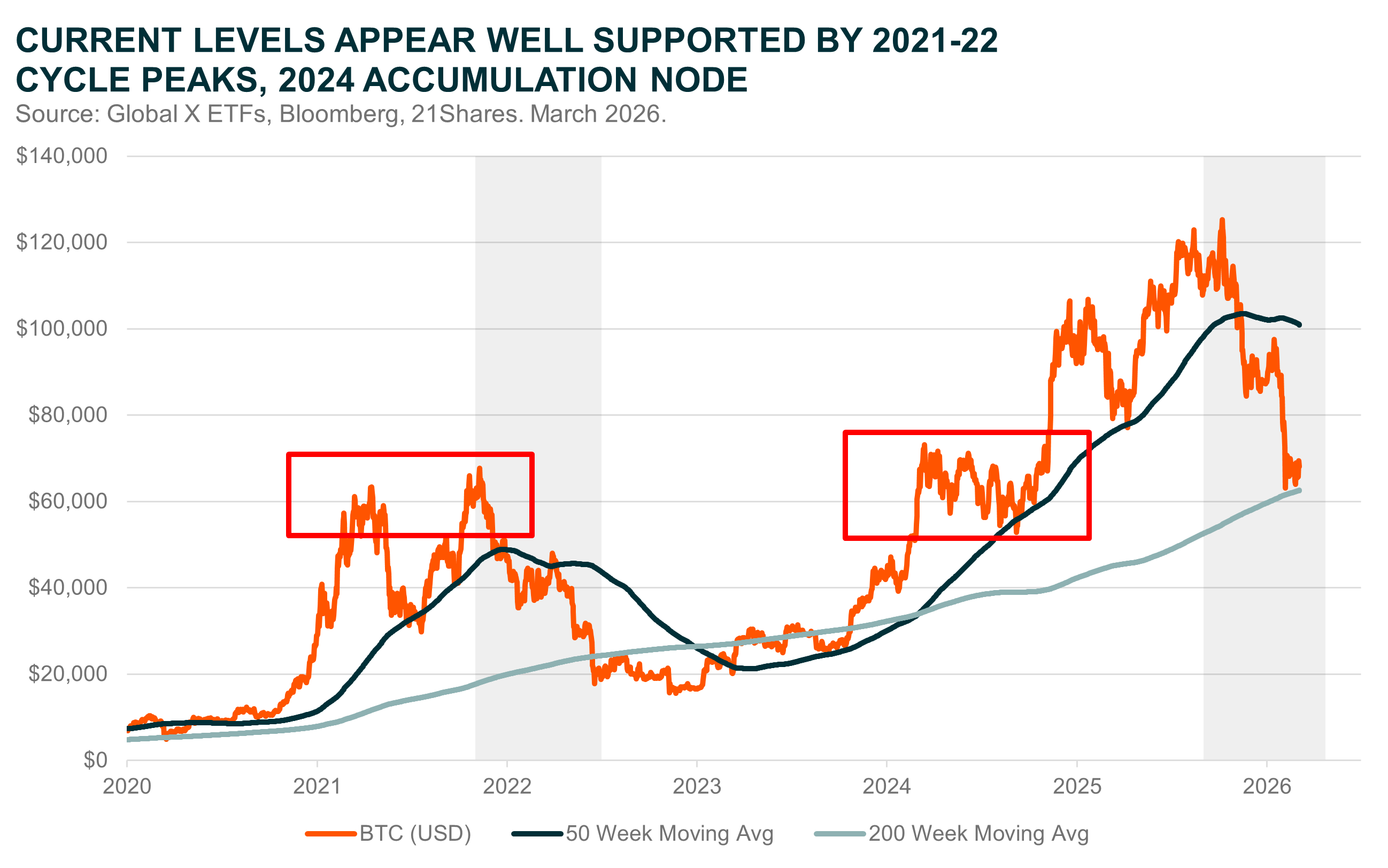
Crypto native data further supports this view. The number of Bitcoin wallet addresses holding between 10,000 and 100,000 Bitcoin has risen sharply throughout February 2026, signalling renewed accumulation from large, long-term holders.4 This marks a clear reversal from the July to October 2025 period, where these cohorts were actively distributing into strength as prices approached all-time highs near US$120,000.
All in all, the backdrop is materially cleaner than in prior phases of the cycle. Volatility is lower, ETF holdings appear sticky, and long-term holders remain firmly engaged. While near-term volatility may persist, current levels increasingly resemble an attractive accumulation zone for investors with a longer-term horizon.
Zooming in to recent events. Bitcoin has, quite interestingly, been one of the top performing assets since the onset of the war in Iran, outperforming both US and Australian equities, as well as traditional safe haven assets such as gold.
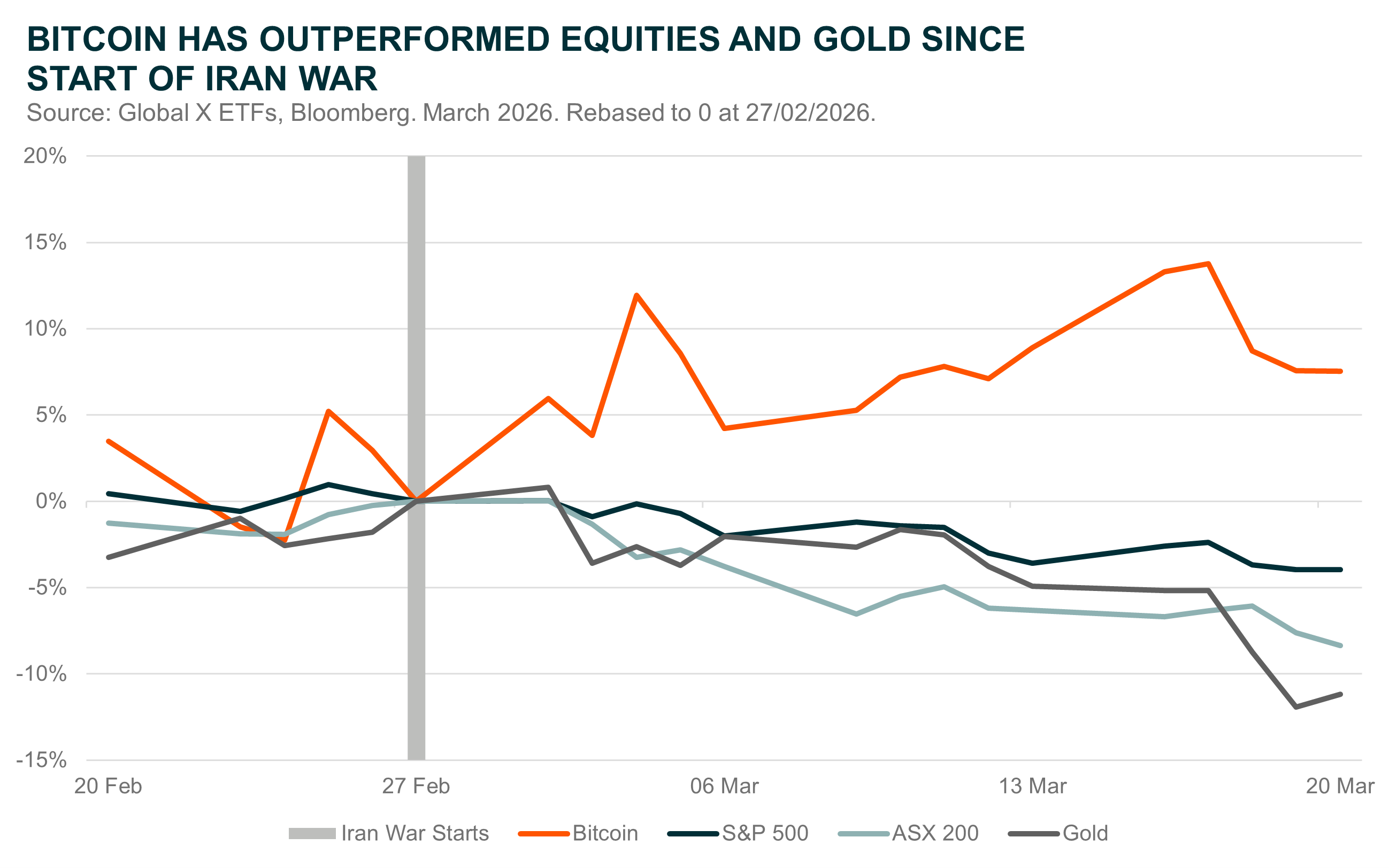
This type of price action is notable given the broader risk-off backdrop and suggests that Bitcoin is responding differently to macro stress than in previous cycles. There are echoes here of the resilience seen during Liberation Day last year, where Bitcoin similarly outperformed equities and gold while exhibiting lower volatility than many would typically expect. In both instances, the asset has shown an ability to hold its ground during periods of heightened uncertainty, challenging its traditional classification as purely a high beta risk asset.
While it would be premature to suggest that Bitcoin has fully transitioned into a safe haven over such a short period, these developments do point toward a gradual decoupling from traditional risk-on behaviour. At the margin, Bitcoin appears to be evolving toward its “digital gold” narrative, with growing evidence that investors are beginning to recognise and position for that role.
Buying the Bitcoin Dip
From here, we believe that the current setup appears to present a highly compelling entry point. Bitcoin is now trading within a well-defined support range, against a backdrop of improving market structure and resilient ETF flows. Unlike prior cycles where excess leverage and weak hands amplified downside, this drawdown has been characterised by orderly positioning resets and sustained institutional participation.
Importantly, the investor base underpinning Bitcoin today is materially different. ETF investors have shown a clear willingness to hold through volatility, while large holders are once again accumulating at lower levels rather than distributing into strength. At the same time, Bitcoin’s recent relative outperformance in a risk-off environment hints at a gradual shift in how the asset is being perceived within portfolios.
For investors, this combination of technical support, cleaner positioning, and evolving demand dynamics suggests that current levels may represent an attractive accumulation opportunity, particularly for those with a longer-term horizon. The Global X 21Shares Bitcoin ETF (EBTC), offers a simple and regulated way to participate in Bitcoin’s continued maturation.
Related Fund
EBTC: The Global X 21Shares Bitcoin ETF (EBTC) offers exposure to physical Bitcoin. It is Australia’s first spot Bitcoin ETF.