Growth at a Reasonable Price (GARP) is an investment philosophy built around the idea that investors do not necessarily need to choose between growth and value. Instead, GARP seeks companies with attractive earnings growth, strong financial fundamentals and reasonable valuations. While the acronym may be relatively unfamiliar to some investors, the philosophy is well established. GARP can trace its roots back decades, with investors such as Peter Lynch helping popularise the approach in the 1980s through his focus on finding companies capable of growing earnings without paying an excessive price for that growth. Rather than being a new investment style, GARP has evolved as a way of combining two long-standing investment disciplines: the potential of growth with the discipline of value investing.
The Best of Both Worlds
Growth and value are often treated as opposing investment styles, but each offers something valuable to a portfolio. Growth investors seek companies with above-average revenue and earnings growth. The attraction is that businesses can sustainably grow their earnings and have the potential to compound shareholder value over time. Yet growth comes with a price. As investors become increasingly optimistic about a company's prospects, its valuation can rise well ahead of its fundamentals. If expectations are not met, even a high-quality company can experience a significant re-rating.
Value investors take a different approach, seeking companies that appear inexpensive relative to their fundamentals. The challenge is distinguishing between a genuine opportunity and a value trap. A company may look cheap because its earnings are deteriorating, profitability is falling or its competitive position is weakening. GARP seeks to navigate between these two extremes. The opportunity lies where these characteristics intersect. GARP doesn’t just blindly pay for growth or buy what looks cheap. It is about finding businesses where the growth opportunity is supported by quality fundamentals and where the price remains reasonable.
A Framework Designed To Navigate Changing Markets
Investment factors can behave very differently across market cycles. There are periods when growth leads, periods when value comes back into favour and environments where quality or other characteristics become more important. The challenge is knowing when those rotations will occur.
Rather than trying to predict which factor will lead the market next, GARP combines several characteristics within a single framework. This can provide advisers with a more balanced approach to factor investing, seeking exposure to companies with sustainable earnings growth while maintaining discipline around valuation and quality.
This also recognises that not all growth is created equal. Strong sales growth is attractive, but sustainable shareholder returns ultimately depend on earnings and the strength of the underlying business. A company with high growth but weak profitability or excessive leverage may not offer the same investment proposition as one with similar growth supported by strong margins and a healthy balance sheet.
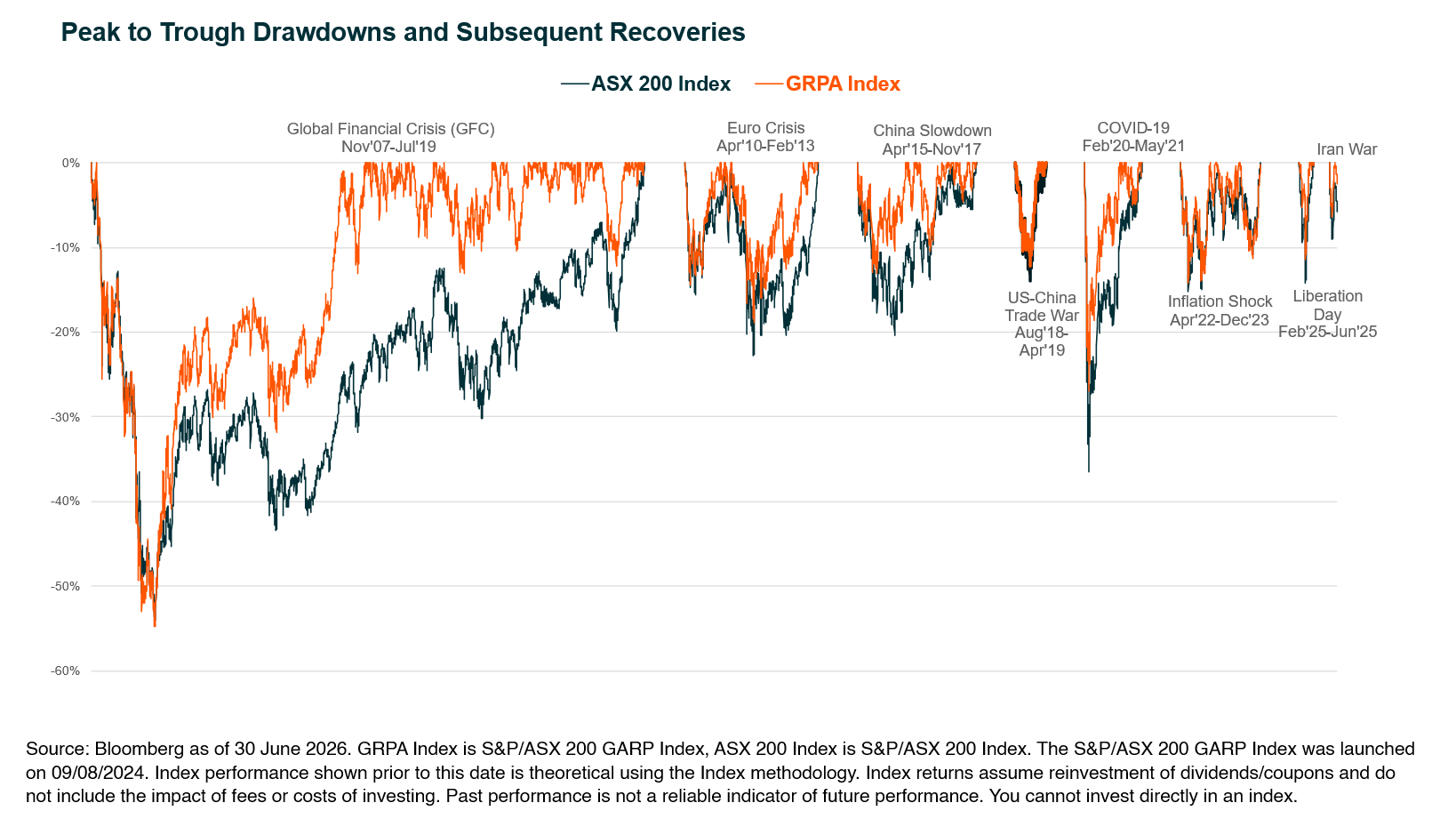
This makes GARP less about making a call on the next market cycle and more about applying a consistent set of investment principles across cycles, with the potential to provide greater resilience through periods of market weakness while participating strongly as markets recover. The historical experience of Australian GARP companies illustrates this dynamic, with the chart below highlighting their historical ability to limit downside during weaker markets while participating strongly and swiftly in subsequent recoveries.
It also provides a practical alternative to continually rotating between individual factors. Instead of deciding whether the portfolio should favour growth or value, GARP seeks companies that exhibit characteristics of both. This can provide a more consistent approach to navigating changing market conditions, without requiring advisers to continually make style or factor rotation decisions.
Turning the GARP Philosophy into a Portfolio
The philosophy may sound straightforward, but applying a GARP framework consistently across an entire share market is considerably harder. An investor building a GARP portfolio manually would need to monitor earnings growth, profitability, leverage and valuations across thousands of companies, while continually reassessing whether each stock still meets the investment criteria. A rules-based index can do this systematically.
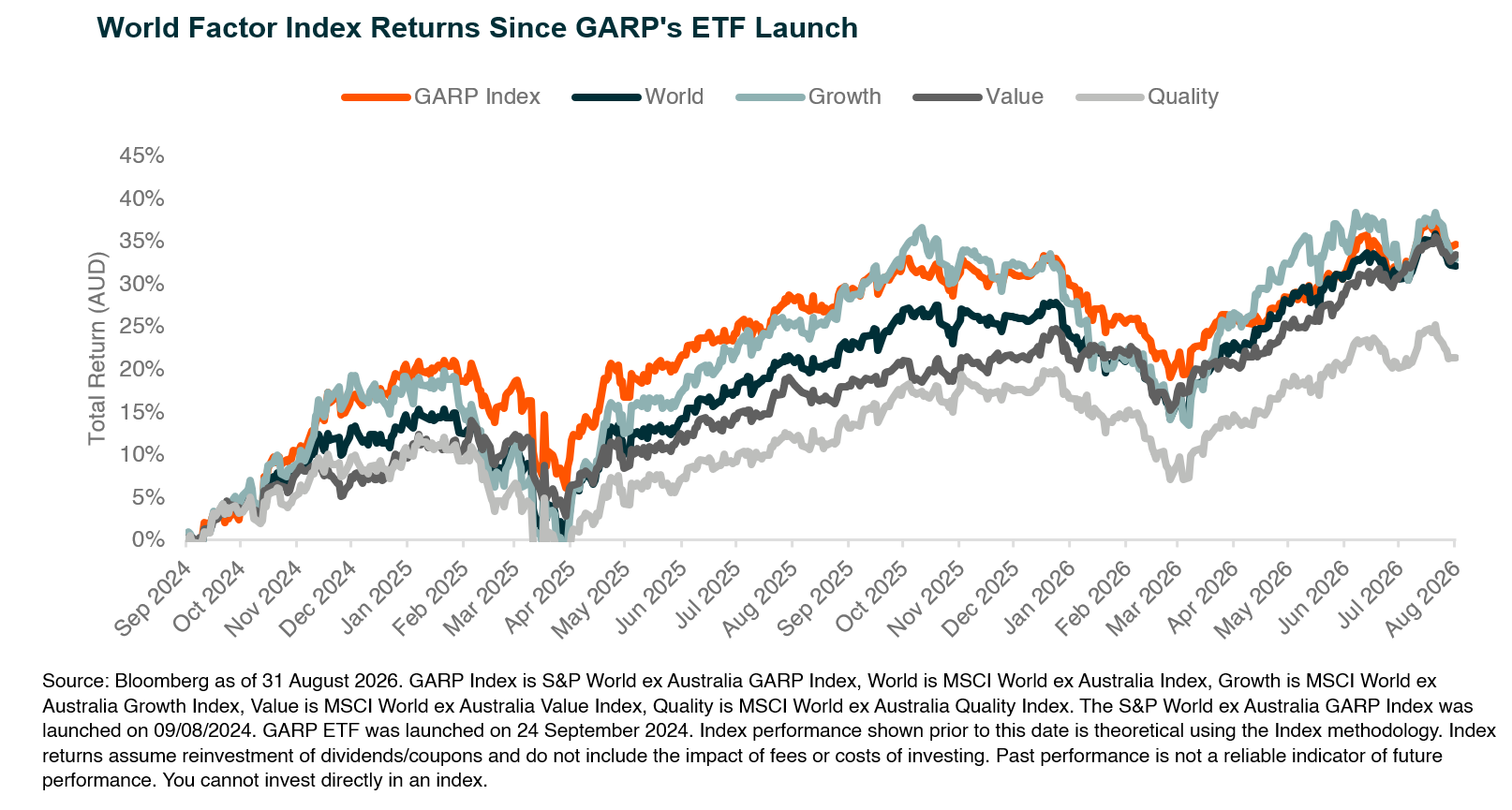
The Global X S&P World ex Australia GARP ETF (GARP) provides exposure to approximately 250 global companies that meet the GARP criteria, combining growth, quality and valuation characteristics. Since launching in September 2024, GARP has demonstrated the potential of the approach in live market conditions, ranking among the stronger-performing factor strategies over the period.
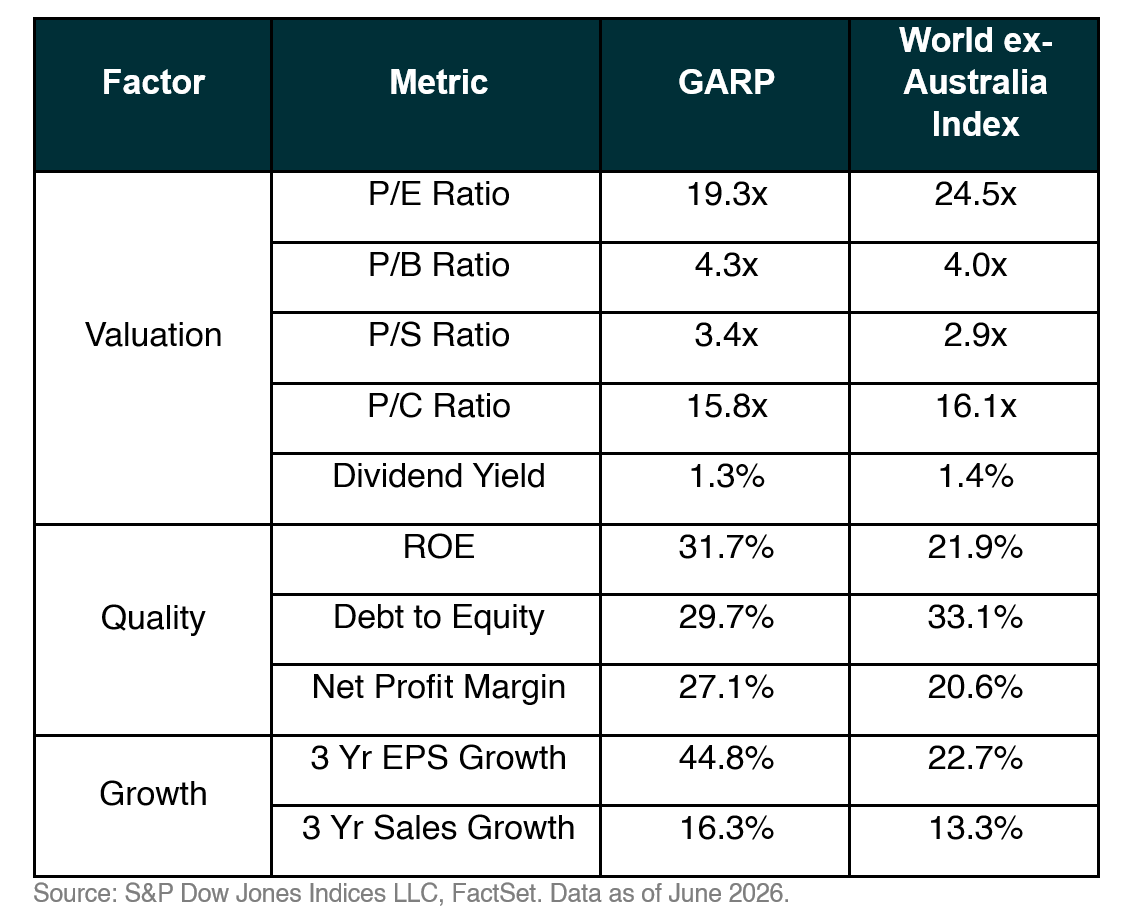
GARP’s systematic, semi-annual rebalancing has also allowed the strategy to adapt as fundamentals and valuations change, capturing emerging opportunities while reducing exposure to businesses where fundamentals deteriorate or valuations become increasingly stretched. The result is a portfolio that maintains a deliberate focus on growth, quality and valuation. The table below illustrates the philosophy in practice. Compared with the broader global market, GARP currently combines stronger earnings and sales growth with higher profitability and lower leverage, while trading on a lower P/E ratio.
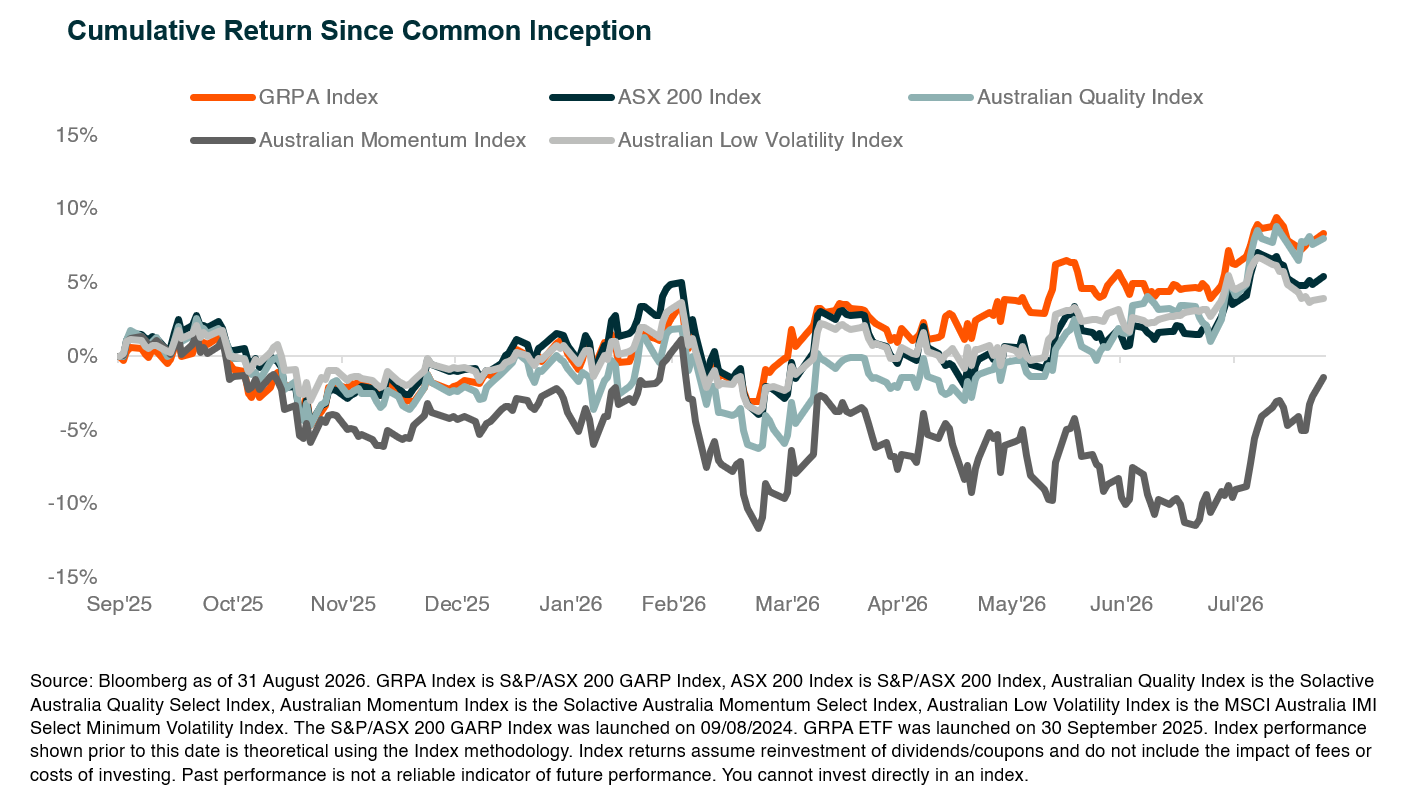
The approach can also be applied closer to home through the Global X S&P Australia GARP ETF (GRPA), which provides exposure to approximately 50 Australian companies selected for their combination of growth, financial strength and reasonable valuations. Like GARP, GRPA applies a systematic approach to identifying companies where these characteristics align, but within the Australian equity market. During the sharp market volatility surrounding the March 2026 Middle East conflict, GRPA was among the better-performing Australian equity ETFs, highlighting the potential resilience that can come from combining growth, quality and valuation disciplines. More broadly, GRPA has been among the stronger-performing factor strategies in Australian equities since the fund was launched in September 2025.
This gives advisers two distinct ways to access the same investment philosophy: GARP for global developed markets excluding Australia, and GRPA for Australian equities. Importantly, the rules-based approach removes the need to continually make subjective decisions about when to rotate between stocks or factors. As companies mature, fundamentals change and valuations move, the index provides a systematic process for refreshing the portfolio. This discipline can help the strategy capture emerging opportunities as companies develop stronger growth and quality characteristics, while reducing exposure to businesses where fundamentals deteriorate or valuations become increasingly stretched.
A Different Lens on the Core
GARP does not need to replace a broad market allocation. Instead, it can bolster an existing core equity portfolio by providing a differentiated lens on the market, selecting companies based on their growth, quality and valuation characteristics rather than simply their size. GARP can complement a broad global equity allocation, while GRPA can provide a similar differentiated approach alongside a traditional Australian equity exposure. For investors, this creates a simple way to add a systematic growth and value discipline to an existing core, without requiring a wholesale change to the portfolio.