Knowing why GARP can be useful is one thing. Knowing how much to allocate, where it fits and how it can complement an existing portfolio is where the investment philosophy becomes practical. For investors, incorporating GARP isn’t meant to overhaul the existing equity allocation in its entirety, but instead can be introduced incrementally alongside a broad market core, providing a differentiated exposure to companies where growth, quality and valuation align.
Start With the Core, Then Build Around it
The simplest way to think about GARP is as a complement to, rather than replacement for, a traditional market-capitalisation allocation. A broad global equity index provides diversified exposure to thousands of companies, with larger companies naturally receiving greater weights. GARP applies a different lens, deliberately selecting companies based on their underlying growth, quality and valuation characteristics.
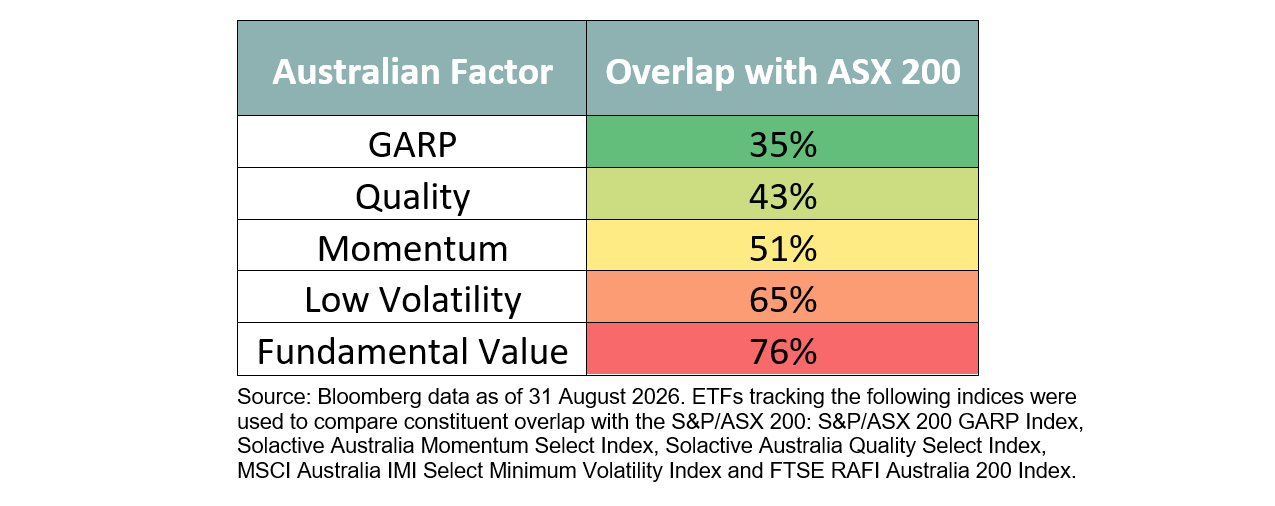
This can create meaningful diversification within an equity portfolio. In Australia, for example, GARP has historically had around 35% constituent overlap with the S&P/ASX 200 Index, compared with higher levels of overlap for a number of other factor approaches. This means investors are not simply adding another version of the same exposure.
Investors should not add another fund simply for the sake of adding another fund. Every portfolio building block should serve a purpose. GARP can therefore be considered where it addresses a specific portfolio need or provides a genuinely differentiated source of returns.
Blending Rather than Replacing
There is no single allocation that will suit every investor, but a blended approach can provide a useful starting point. For example, a portfolio combining 70% broad global equities with 30% global GARP equities index like the one tracked by the Global X S&P World ex Australia GARP ETF (GARP). This theoretical portfolio combination has historically delivered higher returns and a stronger risk-adjusted outcome than a 100% broad market allocation, with the Sharpe ratio increasing from 0.52 to 0.60 while volatility remained broadly unchanged. The improvement was also evident on the downside. Maximum drawdown improved from -42.1% for the broad market to -39.7% for the 70/30 portfolio that incorporated a GARP index approach.
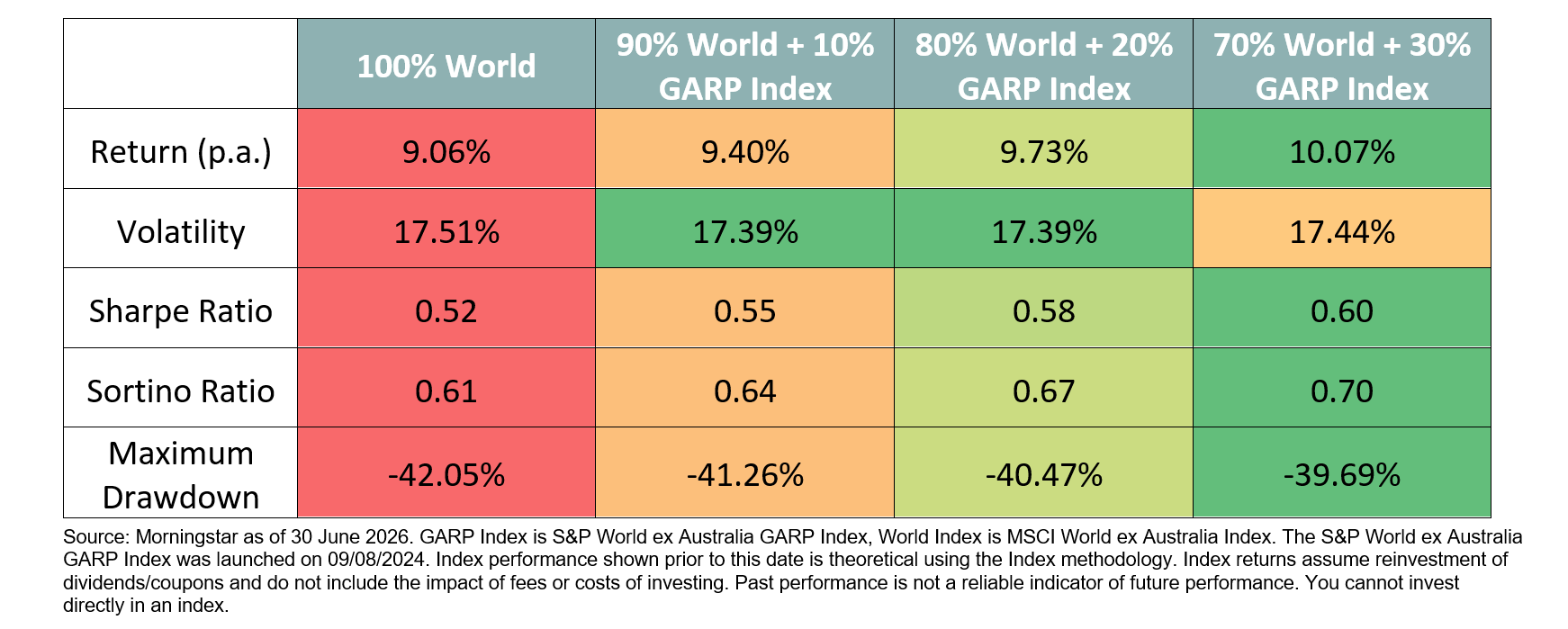
Importantly, this does not mean 30% is the “right” GARP allocation for every portfolio. Rather, it illustrates how a relatively simple factor allocation can change the risk and return characteristics of an existing core. For investors starting with GARP, a smaller allocation may provide a natural entry point. A 90/10 or 80/20 blend can introduce the strategy while maintaining the majority of the existing core exposure, with the allocation increased over time as confidence in the approach grows.
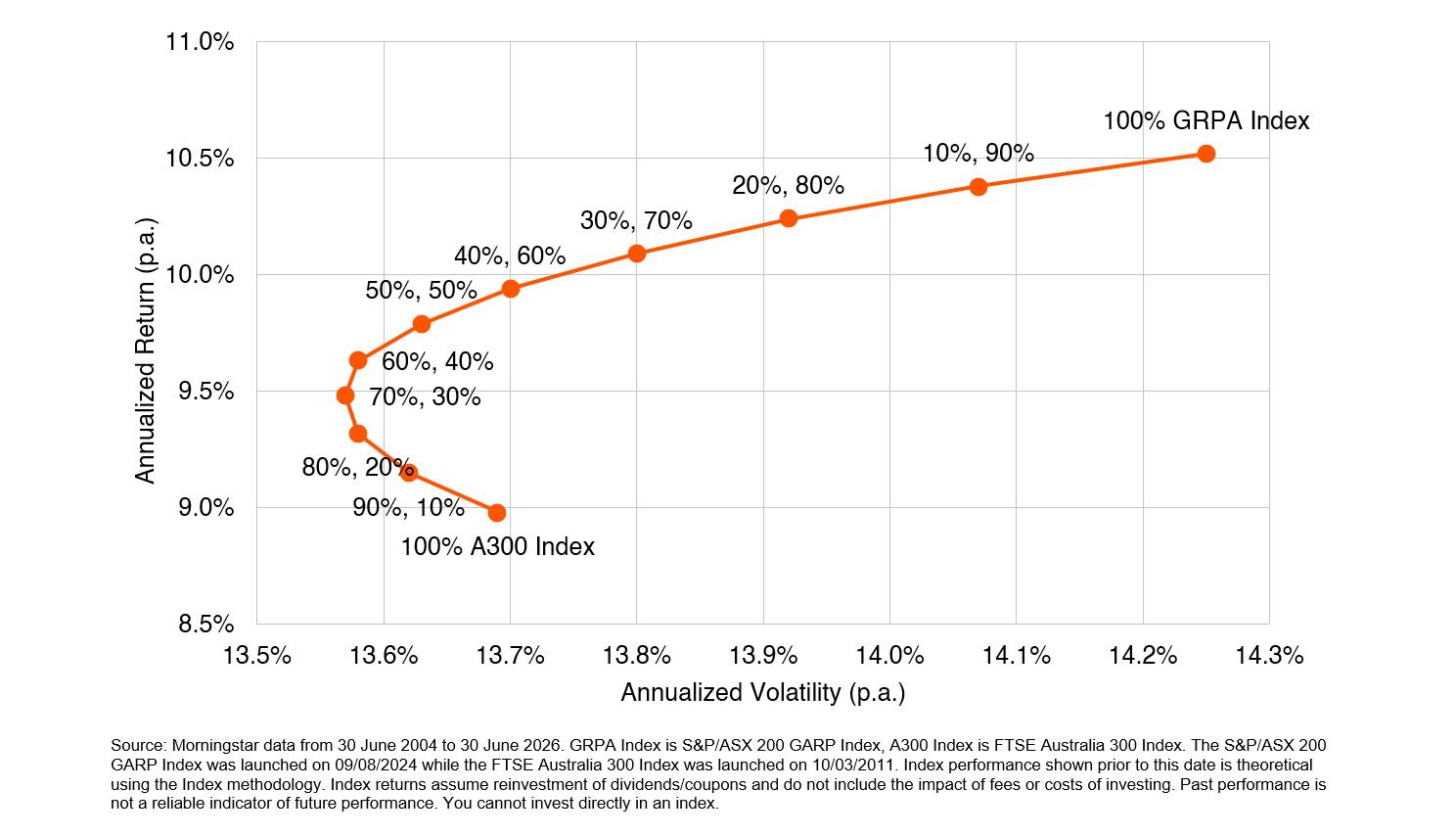
For Australian equities, the same principle can be applied through a GARP approach. An investor could introduce an ETF like the Global X S&P Australia GARP ETF (GRPA) alongside a broad Australian equity allocation, creating a portfolio that combines market-wide exposure with a systematic focus on growth, quality and valuation. An efficient frontier analysis can further illustrate how different allocations between the broad Australia market and an Australian GARP index can historically shift the portfolio’s risk and return characteristics, providing another framework for advisers to consider an appropriate allocation rather than relying on a one-size-fits-all approach.
Keeping Implementation Simple
One of the advantages of GARP as a portfolio building block is that implementation is relatively straightforward. GARP provides global developed-market exposure excluding Australia, while GRPA focuses specifically on Australian equities, allowing advisers to choose the geography that best addresses the portfolio need or use both to apply the same investment philosophy across domestic and international equities.
Both strategies are rules-based and rebalance semi-annually, meaning advisers do not need to continually monitor individual holdings or make discretionary decisions about when to rotate between growth, value or other factors. This makes GARP particularly suited to a strategic allocation rather than a tactical trade - establish the allocation, and allow the systematic methodology to do the ongoing stock selection and rebalancing.
The other practical consideration is cost. GARP and GRPA provide access to their respective factor strategies through ETFs, offering a transparent and typically lower-cost way to implement a systematic factor allocation compared with many actively managed alternatives. Investors should, of course, consider the relevant management costs, spreads, tax implications and the client's existing portfolio when determining whether the strategy is appropriate.
For investors, this provides a practical starting point: begin with the existing core, introduce GARP as a complementary allocation, and determine the appropriate weighting based on the client's objectives, risk tolerance and existing factor exposures.
A Different Lens on the Portfolio
Implementing a GARP framework can potentially help a portfolio benefit from different sources of return and different lenses on the market. If the role of a core portfolio is to provide broad market exposure, perhaps the question advisers should be asking is not what they can replace, but what they can add to make that core work harder. GARP provides one potential answer - a systematic way to bring growth, quality and valuation together in a differentiated portfolio building block.