There is a big difference between saying you want to invest in growth at a reasonable price (GARP) strategy and actually building a portfolio that does it consistently. The challenge is finding businesses where growth, quality and valuation align and then having the discipline to reassess that decision as fundamentals and valuations change. This is exactly the challenge that Global X’s GARP franchise aims to solve. Developed by S&P Dow Jones Indices, the approach uses a systematic, rules-based process to identify companies with attractive growth characteristics, before applying quality and valuation measures to determine which companies ultimately make the portfolio. The result is a transparent rules-based process that seeks to replicate some of the discipline of an active manager, without relying on subjective stock-picking decisions and delivered at a lower cost.
Slicing and Dicing the Investment Universe to Find GARP Companies
The GARP methodology starts with the broader investment universe (such as the global and Australian share market) and applies two sequential screens to progressively narrow the opportunity set.
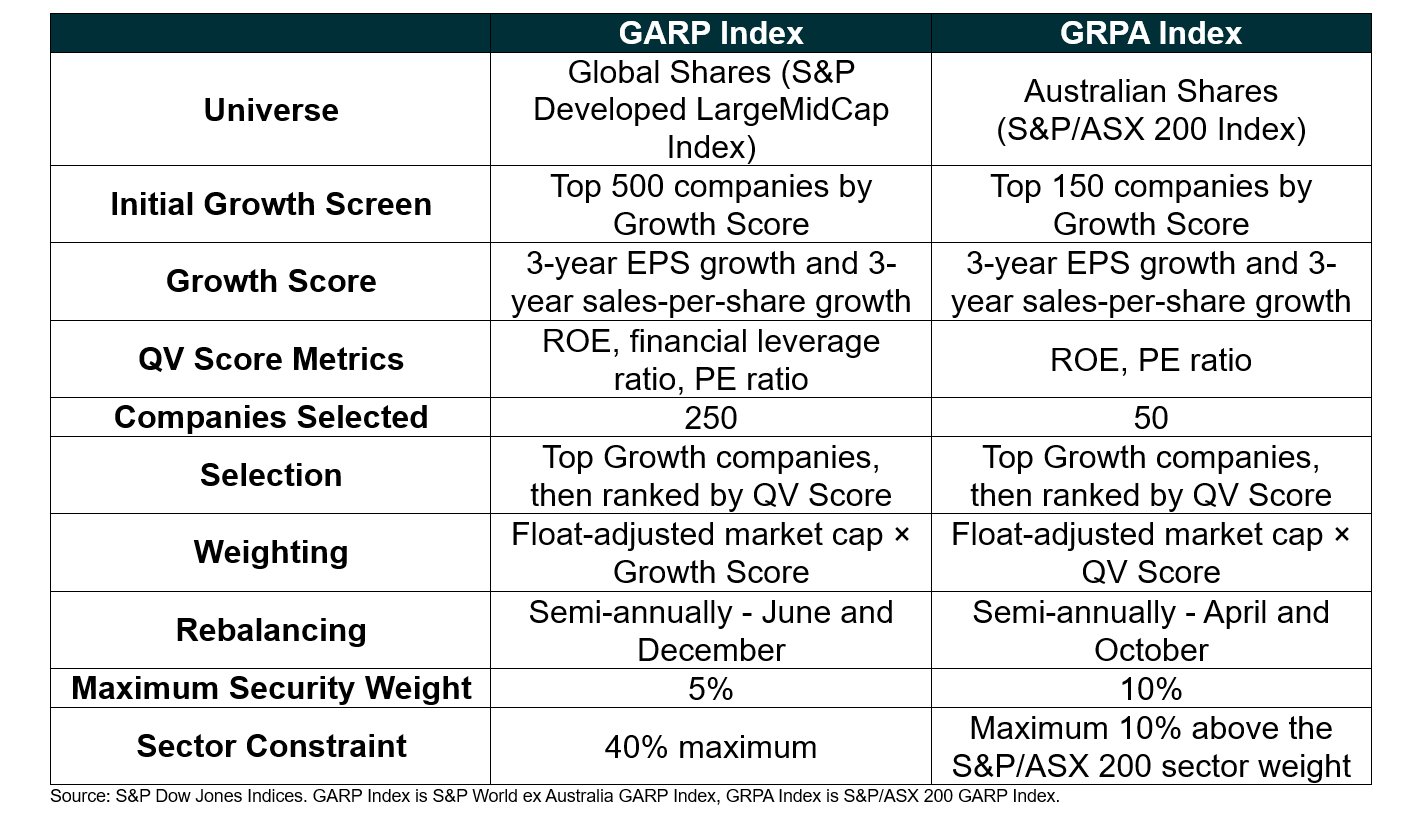
The first asks a simple question: which companies are growing their revenue and earnings? Growth is measured using two fundamental indicators of three-year earnings-per-share (EPS) growth and three-year sales-per-share (SPS) growth. These are combined into a Growth Score, creating a more balanced assessment than relying on either revenue or earnings alone, with the top 500 companies selected on the basis of their Growth Score.
Growth is only the starting point and often what single-factor growth strategies use. GARP goes one step further in the second stage, asking which of those growth companies offer the most attractive combination of quality and value?
This is captured through the Quality & Value (QV) Composite Score. For the global GARP index, the QV score combines return on equity (ROE), financial leverage and price-to-earnings (PE) ratio. ROE and leverage provide insight into the underlying quality and financial strength of a business, while PE ratio provides the valuation discipline.
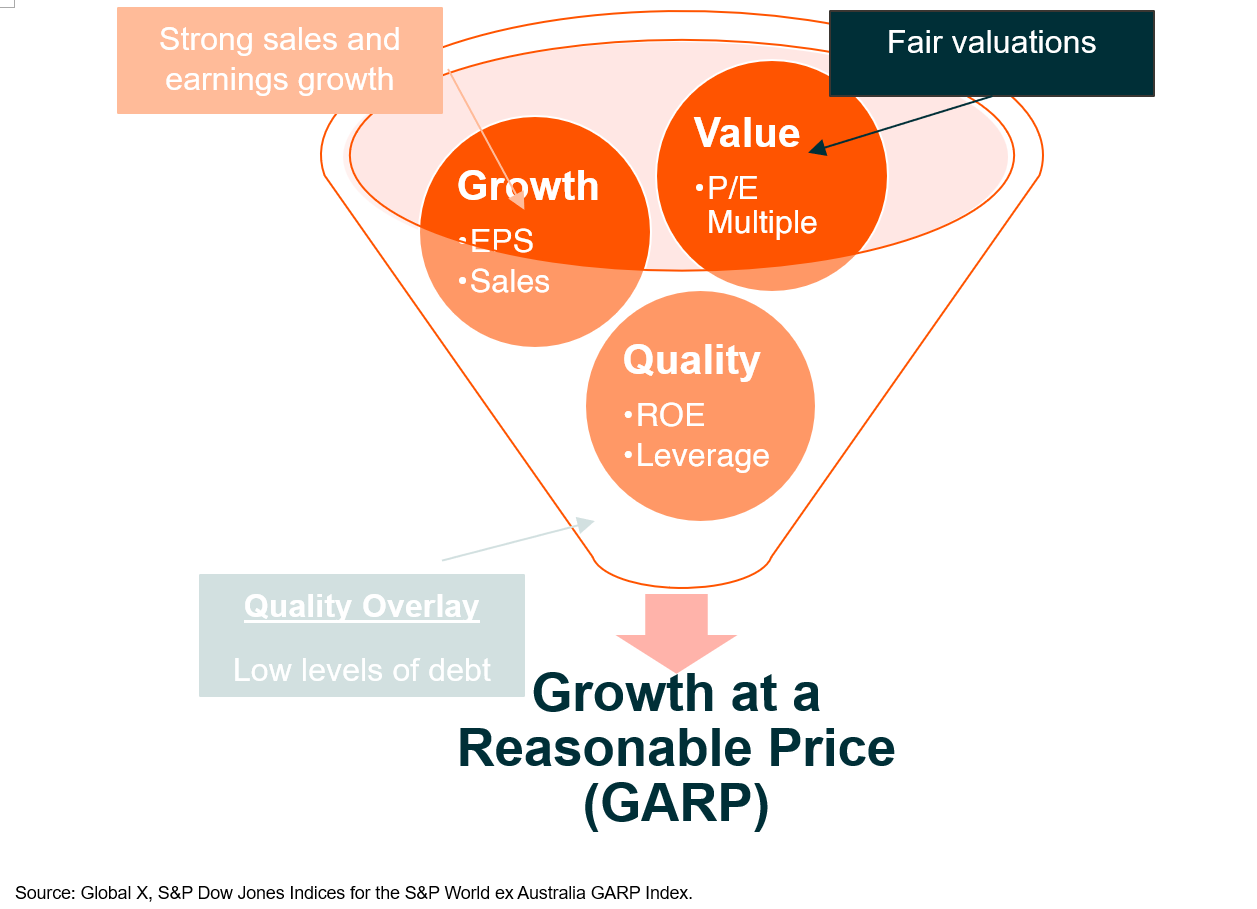
The process deliberately avoids simply buying the fastest-growing companies. Instead, the universe is narrowed to companies with strong growth characteristics, before the QV score determines which 250 of the original 500 companies offer the most attractive combination of quality and valuation. Growth gets a company into the conversation, but quality and valuation help determine whether it ultimately belongs in the portfolio.
Once selected, companies are weighted according to their Growth Score multiplied by their free-float market capitalisation, meaning companies with stronger growth characteristics receive greater weights while maintaining the benefits of a market-capitalisation framework.
Why Australia needs a different approach
While the underlying GARP philosophy is consistent, the methodology is not simply copied from global markets and applied to Australia.
The Australian equity market has a very different composition, with a much greater concentration in Financials and Materials and a more cyclical earnings profile. S&P research found that historical growth characteristics in Australia were less consistently predictive of performance than in some other markets. In other words, simply selecting the companies with the strongest growth did not necessarily produce the best outcomes.
That led to an important adjustment for GRPA. Rather than applying an aggressive growth screen, the S&P/ASX 200 GARP Index starts with the 150 companies with the highest Growth Scores from the S&P/ASX 200, before selecting the 50 companies with the strongest QV Composite Scores.
The QV score also carries greater weight in the Australian methodology. GRPA's QV Composite Score focuses on ROE and PE ratio, while the leverage ratio used in the global methodology is excluded. S&P's research found ROE and PE Ratio to be more effective measures for the Australian market, while leverage can be less meaningful given the significant weight of banks and other financial companies in the index. While growth is used as the initial screen, companies are weighted based on the combination of QV score multiplied by their free-float market capitalisation.
The result is a subtly different interpretation of GARP for Australia. Rather than demanding exceptional growth, GRPA seeks to eliminate the weakest growth companies and then place greater emphasis on finding profitability and reasonable valuations within that remaining universe.
Rebalancing: Where the Methodology Comes to Life
A rules-based strategy is only as useful as its ability to adapt. GARP and GRPA are rebalanced semi-annually, allowing the methodology to reassess companies as earnings, profitability and valuations change. GARP rebalances in June and December, while GRPA rebalances in April and October to align more closely with the timing of the Australian earnings cycle.
The December 2024 GARP rebalance provides a useful example. Tesla, ServiceNow and Costco were removed as their valuations had become increasingly difficult to justify within the framework. The subsequent performance illustrated the potential value of that discipline. Tesla fell more than 50% in the months following its removal, while Uber and BBVA were among the new additions that subsequently performed strongly.
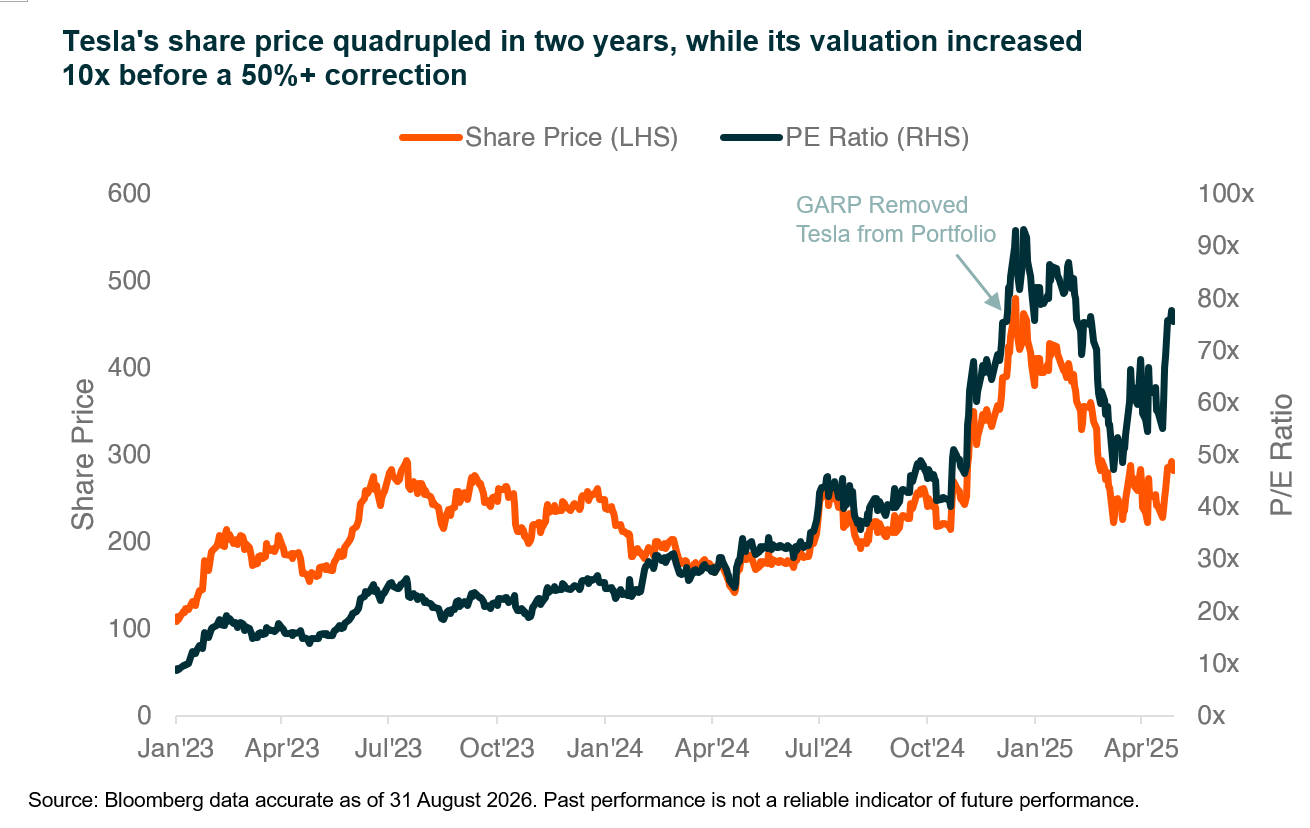
This is not to suggest the methodology predicts individual share-price movements, but rather demonstrates how the rules can systematically reduce exposure when a company's characteristics no longer fit the GARP framework. The December 2025 rebalance added companies including Rolls-Royce, Disney and SoftBank, where improving earnings and quality characteristics were supported by reasonable valuations. At the same time, Visa and General Motors were removed as growth, balance-sheet or valuation characteristics deteriorated.
The methodology can also identify opportunities that may be overlooked by a simple market-capitalisation approach. During 2025, for example, the portfolio increased exposure to Spanish banks and Japanese automakers, where valuations were in the single digits despite these companies retaining strong quality and attractive growth characteristics. This is GARP in action - systematically directing capital towards companies where growth, quality and valuation are better aligned.
A Rules-Based Alternative to Active Management
The GARP methodology sits somewhere between a traditional market-capitalisation index and an active manager. Unlike a traditional index, it deliberately selects companies based on fundamental characteristics rather than simply their size. Unlike an active manager, however, the process does not depend on a portfolio manager deciding which companies are attractive or attempting to time the market. The rules are defined upfront, applied consistently and reviewed on a predetermined schedule. That provides three important attributes for investors: discipline, transparency and repeatability.
While GARP has lagged the broader market so far in 2026, partly reflecting its lower exposure to semiconductor stocks and weaker performance from some financial holdings, short-term factor rotations can obscure the strength of the underlying strategy. Over the longer term, the GARP Index has demonstrated a compelling track record, ranking in the top quartile of its actively managed fund peer group.
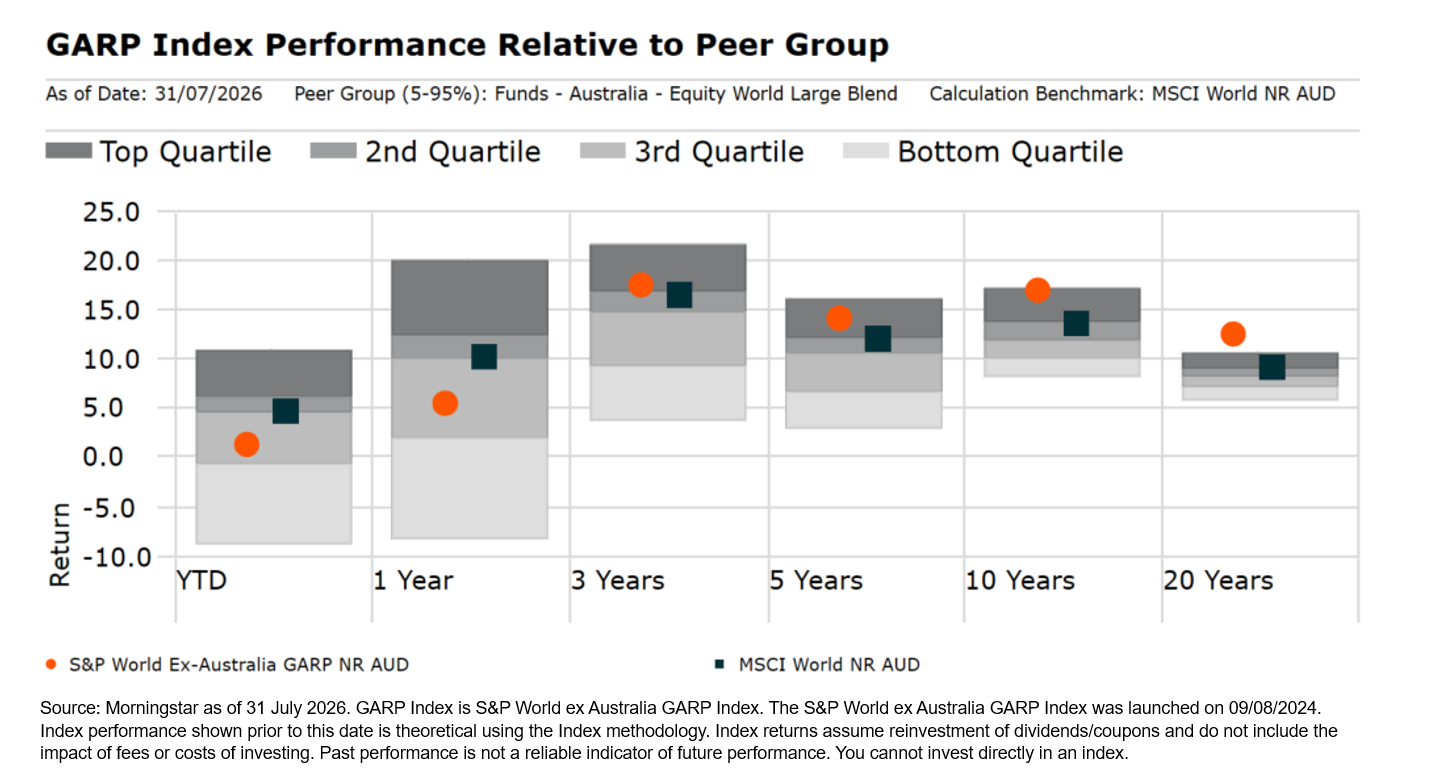
For investors using active managers, it may be worth looking beyond performance against the broad market and asking whether a manager’s returns are simply reflecting a persistent growth, quality or value bias. If an active manager cannot consistently justify the additional fees and manager risk relative to a systematic GARP approach, it is worth asking what additional value investors are actually paying for.
Three Factors. One Framework.
For investors, the ultimate appeal of GARP’s index methodology is its pursuit of factor nirvana - bringing growth, quality and valuation together through a disciplined investment philosophy and a systematic, transparent and repeatable process. The result is an approach that seeks to capture the potential of growth, the strength of quality and the discipline of valuation. Three complementary characteristics brought together in a single investment framework.