Share market investing has rarely offered investors a more interesting mix of opportunity and uncertainty. Earnings remain resilient, structural growth themes such as artificial intelligence continue to attract enormous investment, and expectations for the global economy remain relatively robust. Yet beneath the strength of headline markets sits a growing divide between companies that can justify their valuations through earnings growth and those where investors are simply paying more for the promise of future growth. With many equity markets near record highs, concentration elevated and valuations increasingly dispersed, the question for investors hunting for growth is becoming increasingly focused on how much they should be paying for growth.
The Problem with Growth at Any Cost
The dominance of US mega-cap technology companies over the past decade has made growth investing difficult to argue against. Companies at the forefront of the AI revolution have delivered exceptional earnings growth, while their increasing weight in major global indices has meant investors have benefited simply by owning the market. However, success can create its own problem. As expectations rise, so too does the price investors are willing to pay for them.
Today, investors face a market where valuation dispersion remains significant. The US share market is trading near record highs, while the largest companies continue to account for a substantial share of global equity market capitalisation. Back home in Australia, valuations are sitting towards the upper end of their historical range, highlighting that rich valuations are not confined to global markets.
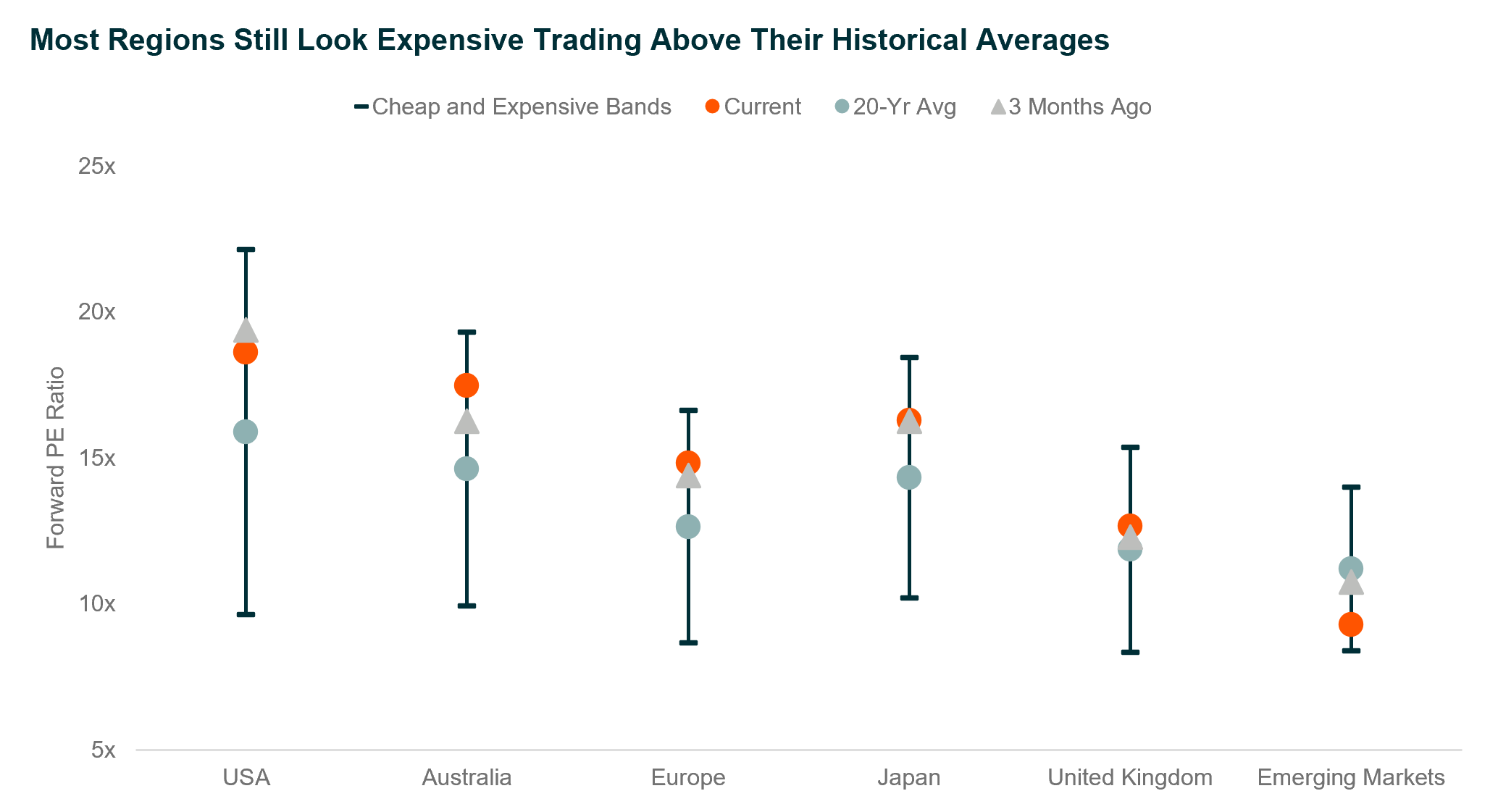
At the same time, earnings growth has helped justify some of the market’s elevated valuations, meaning that investors don’t necessarily need to sell growth names and sit in cash on the sidelines. The challenge is more nuanced. Investors still want exposure to companies capable of compounding earnings, but paying any price for growth can leave portfolios vulnerable when expectations change. A small disappointment in earnings, margins or growth can have an outsized impact when a company’s valuation already assumes near-perfect execution.
The alternative is not necessarily better. Simply moving toward the cheapest value-orientated stocks in the market could introduce a different problem of value traps. A low valuation does not necessarily mean a company is undervalued. Sometimes it reflects declining earnings, weak balance sheets or deteriorating competitive advantages. For portfolio constructors, this creates an uncomfortable choice - pay up for growth, or risk being trapped by value. We believe there is another option.
Finding Growth Without Chasing It
This is where Growth at a Reasonable Price (GARP) can play an important role. Rather than treating growth and value as opposing investment styles, GARP sits at their intersection. The objective is relatively straightforward - identify companies with strong growth characteristics, solid financial strength and reasonable valuations. In practice, however, continuously monitoring thousands of companies to identify where these three characteristics align is no easy task. This is where a systematic, rules-based index approach can help.
The GARP approach combines three characteristics that can be difficult to find together:
- Growth - companies with strong revenue and earnings growth.
- Quality - businesses with solid profitability and financial strength.
- Value - companies where the valuation remains reasonable.
The result can be thought of as a more balanced way to access global growth. Importantly, GARP doesn’t try to predict which investment style will lead the market next. Growth can outperform value for years, while value can enjoy periods of strong recovery. Predicting when the pendulum switches and when rotations will occur is notoriously difficult.
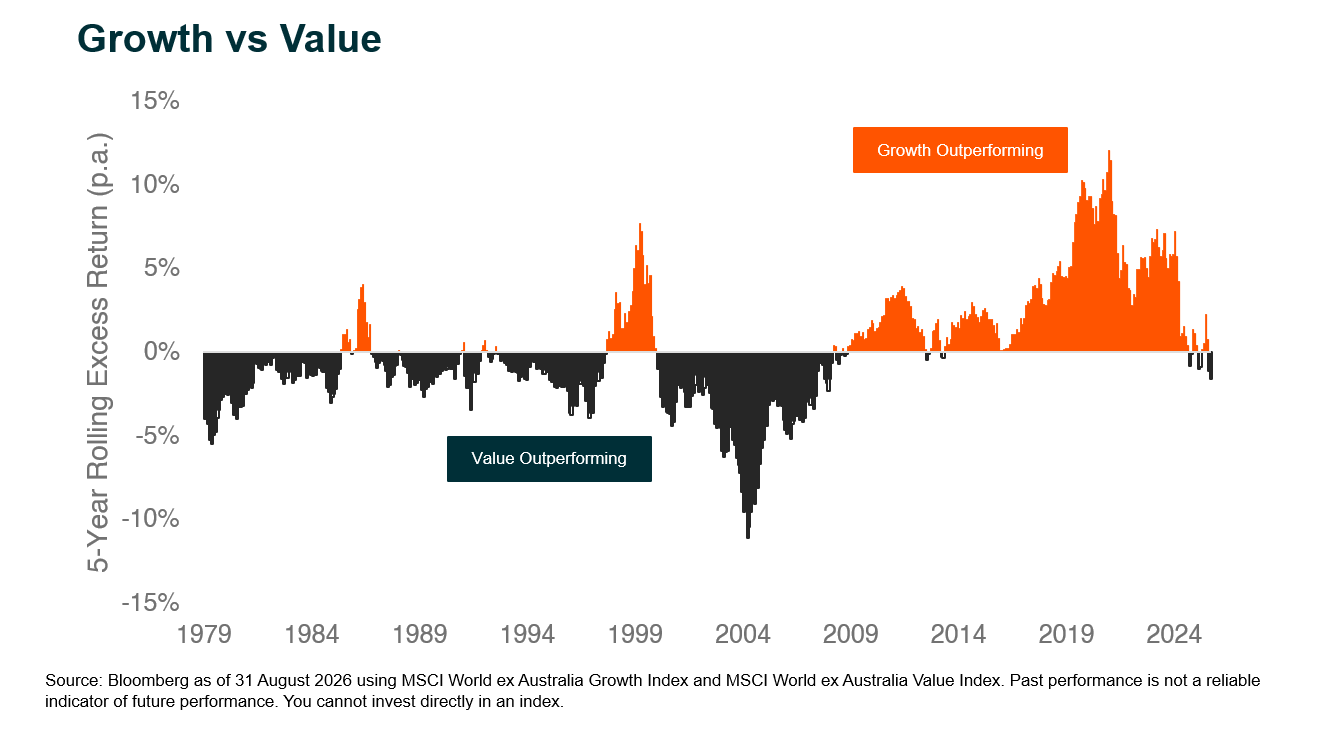
Instead, a rules-based GARP approach continuously evaluates companies against the same criteria, adding businesses where growth, quality and valuation align while removing those where fundamentals deteriorate or valuations become excessive. This discipline can be particularly valuable in a market where yesterday’s winners can quickly become tomorrow’s expensive stocks.
The Case for GARP is More Than Just Valuation
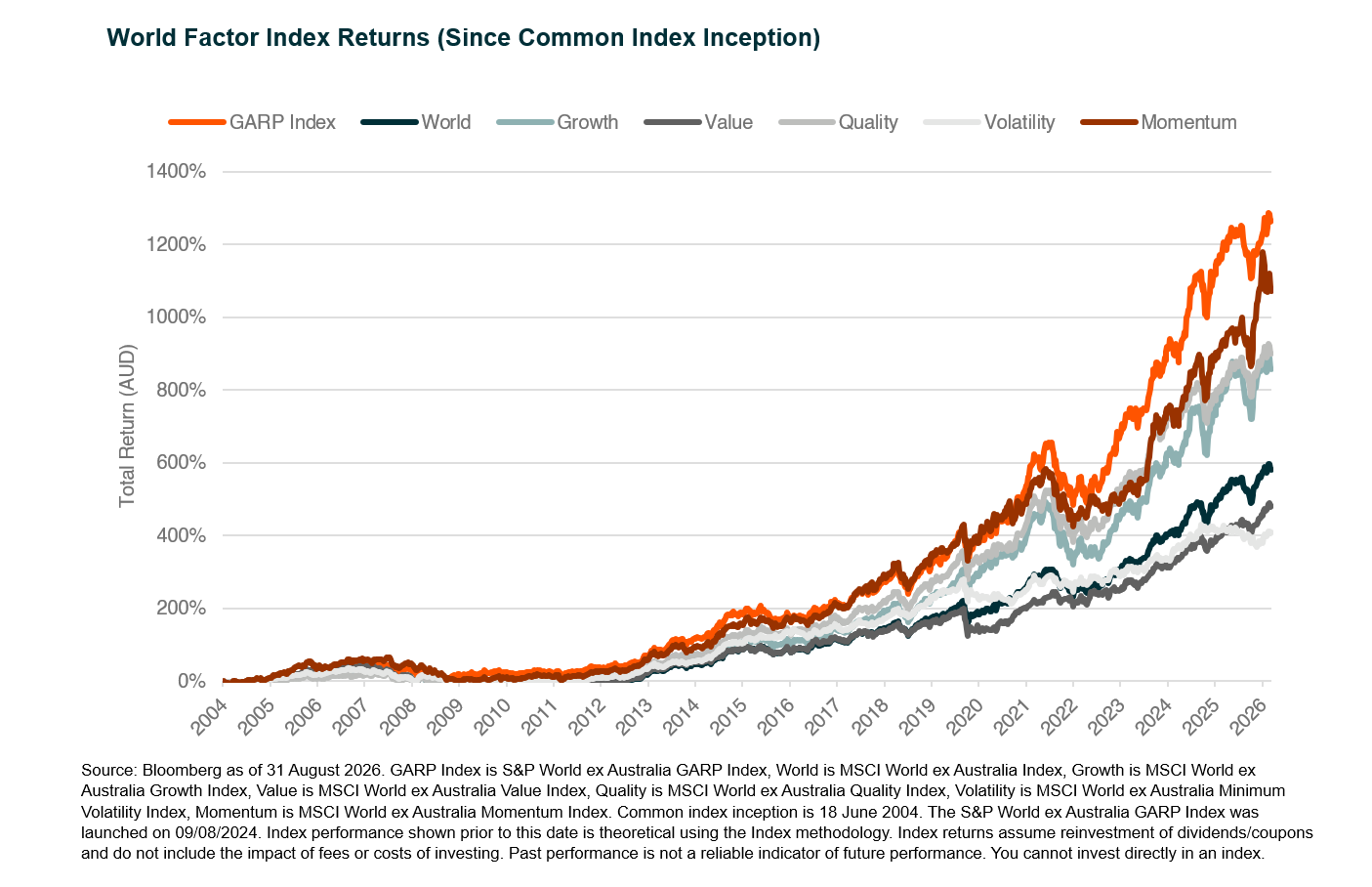
The investment case for any strategy should ultimately come down to what investors receive for the risk they are taking. Historically, a portfolio of global GARP stocks has demonstrated an attractive combination of returns and risk-adjusted performance. Since its June 2004 index inception, the S&P World ex Australia GARP Index has delivered an annualised return of 12.5%, outperforming the broader global share market by over 3% per year. GARP has also been one of the strongest-performing factor strategies over this period, outperforming a range of individual factor index approaches.
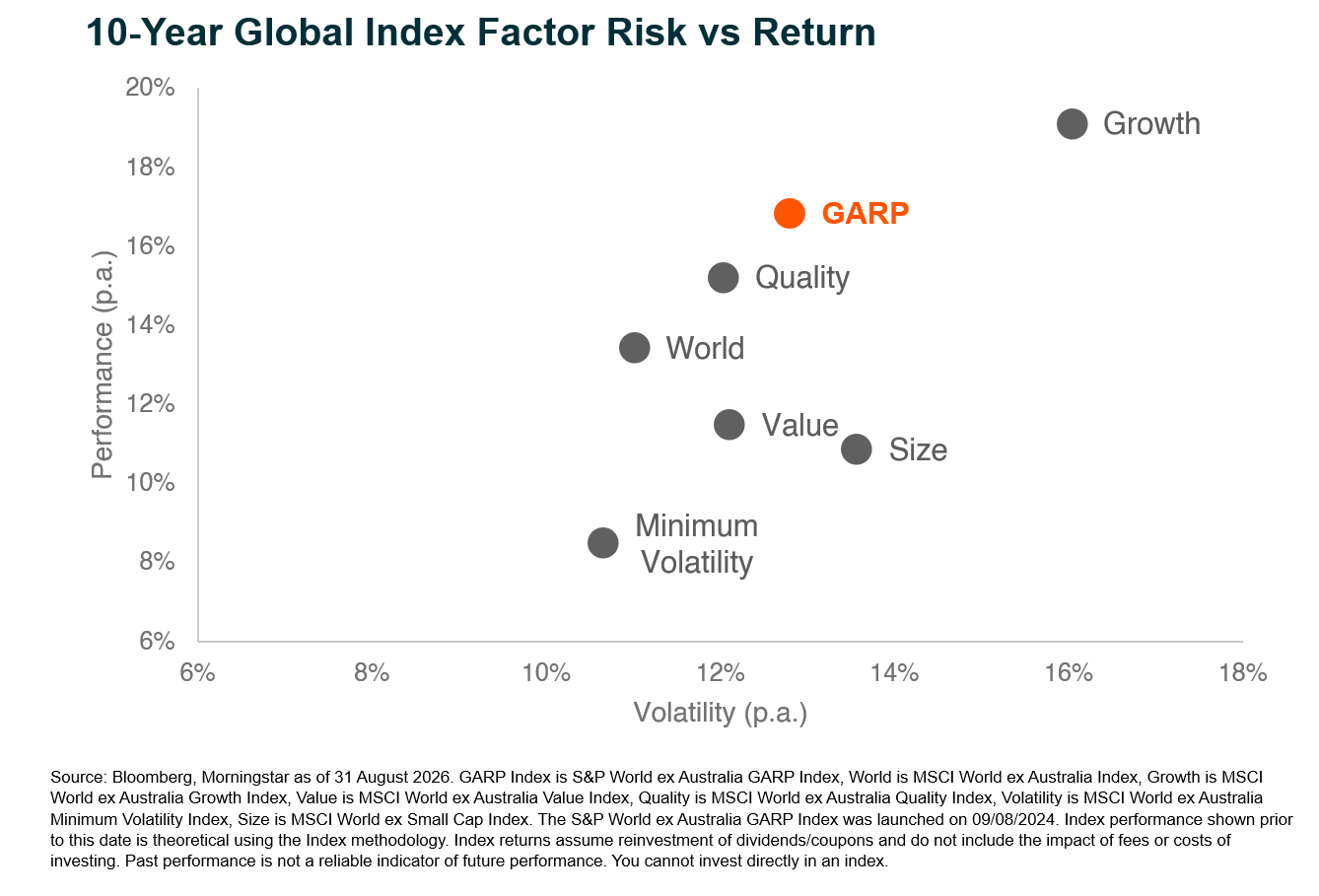
From a risk-adjusted perspective, over the past decade, a GARP strategy has returned very similarly to a pure-growth factor index, but done so with 20% less risk. In other words, investors have historically been able to capture much of the return potential of growth while taking a more measured approach to risk.
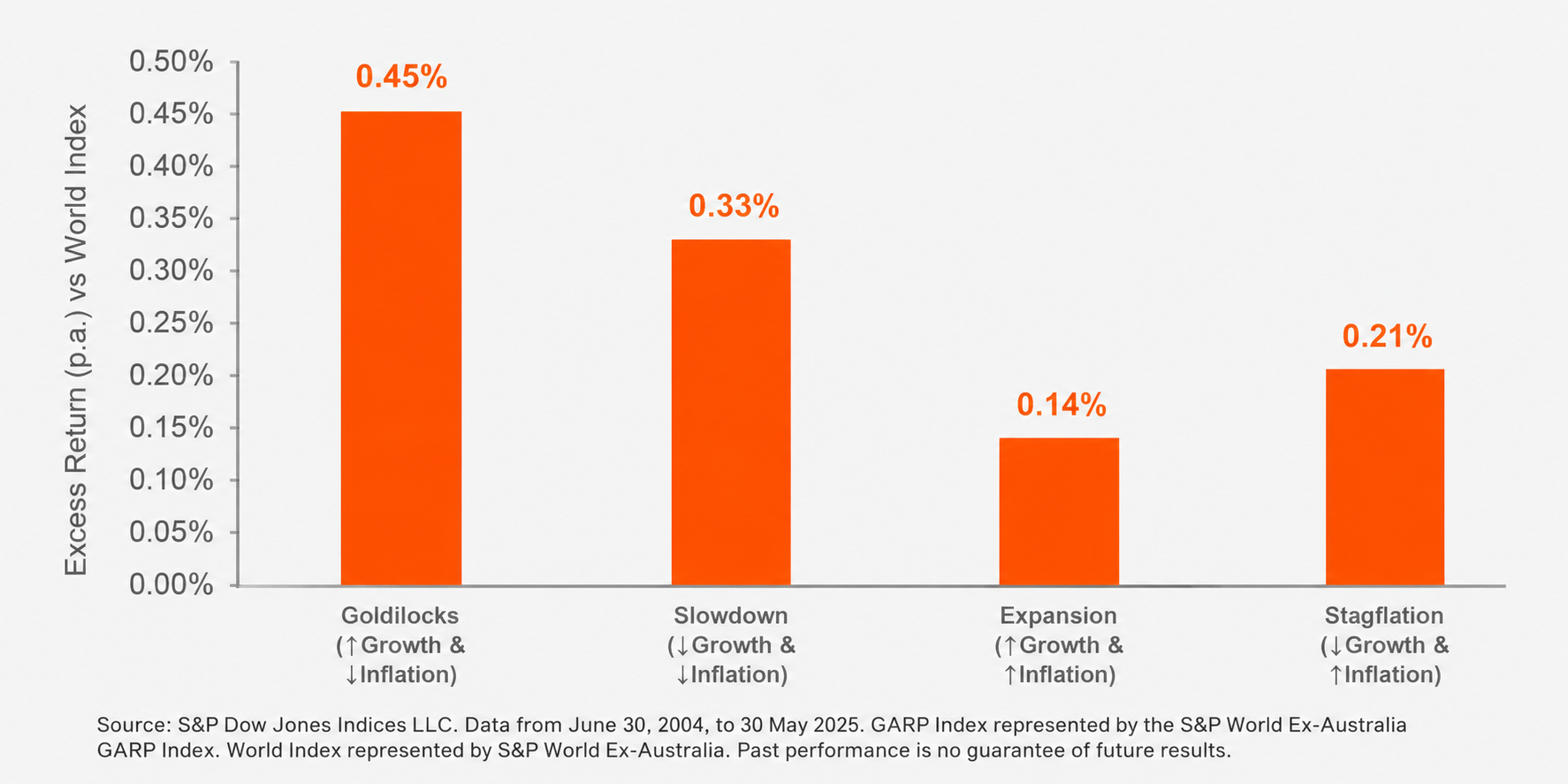
GARP’s historical appeal has also not been confined to a single market macro environment. The strategy has tended to perform more strongly in lower-inflation environments, while maintaining competitive outcomes across broader macroeconomic cycles. This highlights the potential benefit of combining growth, quality and valuation, rather than relying on a single factor or market regime.
Some investors might think diversification means they need to own a greater number of stocks, but we believe investors need to have broader diversification in factors. Investors should only look to add another broad global equity exposure if it can solve a challenge or provide genuine diversification rather than just doubling up on underlying names. GARP can offer a potentially complementary source of global equity exposure while maintaining a deliberate focus on earnings growth, quality and valuation.
Don't Abandon Growth, but Be Selective About it.
The case for GARP today remains focused on having a growth posture while becoming more selective about the price paid for that growth, rather than making drastic decisions by selling growth stocks or making dramatic style rotations. The next phase of the market may continue to reward companies delivering exceptional earnings growth. However, with valuations elevated and market leadership concentrated, the margin for error is becoming increasingly important. As Warren Buffett famously put it, “Price is what you pay. Value is what you get.”
The case for GARP remains as relevant today as ever. In a market where investors still want exposure to sustainable growth but face greater uncertainty around valuations and concentration, GARP provides a disciplined framework for seeking companies where growth, quality and valuation converge. GARP is a potentially powerful strategy that brings together three complementary investment characteristics in a single diversified approach.