In a world where energy security is becoming increasingly critical, it may seem surprising that uranium miners and nuclear engineering firms (as represented by the Global X Uranium ETF) have traded broadly flat year-to-date. As always with the stock market, there are genuine reasons for that underperformance, but in our view the broader nuclear thematic may now be underappreciated by the market.
In this insight piece, we unpack what has weighed on the nuclear and uranium theme this year, before turning to the backdrop that underpins our longer-term outlook for the sector.
Key Takeaways
Uranium mining equities sold off as investors reacted to spot prices falling below long-term contract prices, a dynamic that has historically signalled market tops. In our view, however, current conditions differ in important ways from prior cycles.
Uranium producers are generating their strongest revenues on record, although earnings remain weighed down by elevated capex. Should investment spending normalise, profitability could improve.
Nuclear engineering and construction firms were weighed down by concerns around slowing hyperscaler capex on AI infrastructure, a risk that has since largely receded, while the global nuclear buildout has continued to progress.
Uranium Spot Prices: A Case of Déjà Vu?
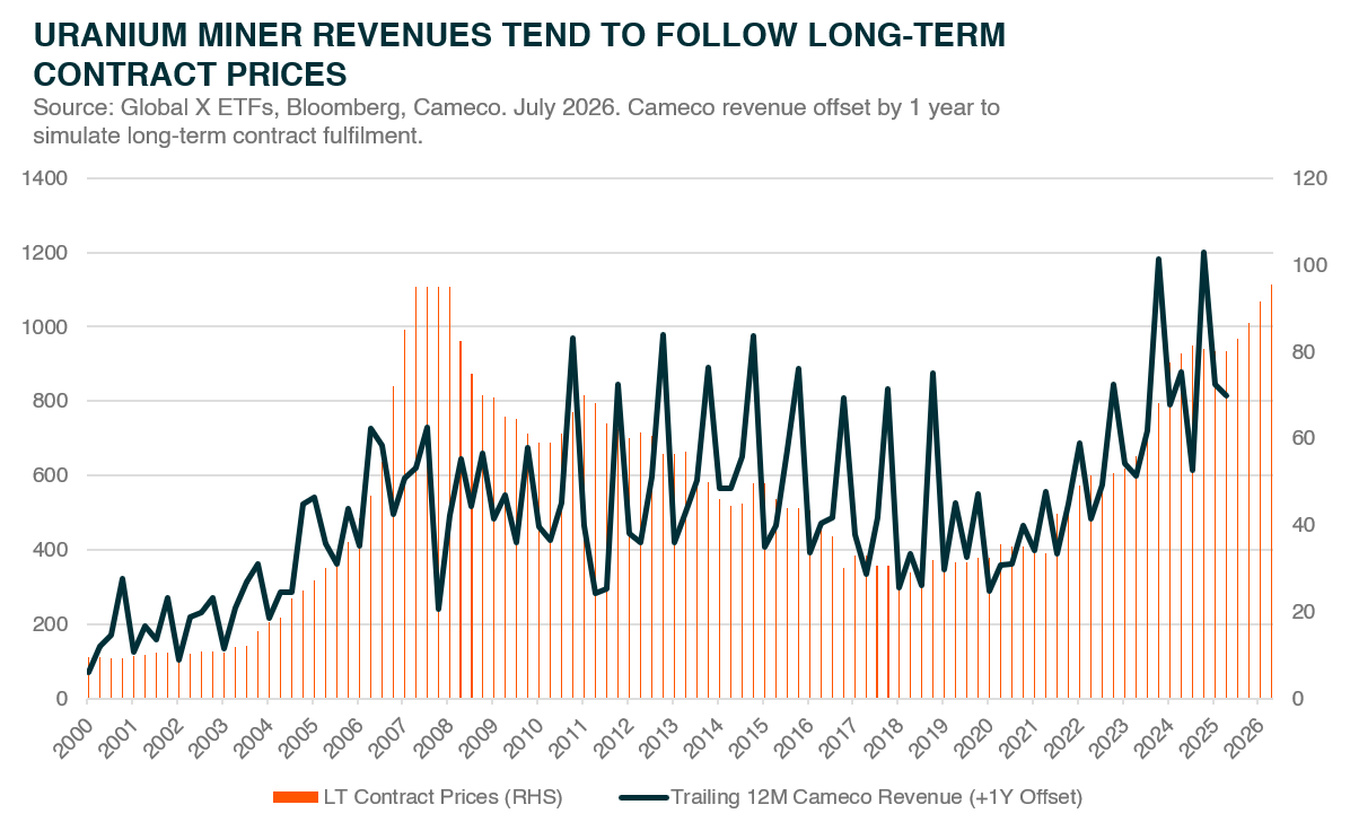
The recent selloff in uranium miners has coincided with a sharp decline in spot uranium prices, though the link between the two is less direct than it first appears. Most commodity producers sell into the spot market, so their revenue moves with the daily price. Uranium works differently. A reactor cannot simply switch fuel suppliers at short notice, so utilities secure their requirements years in advance through long-term contracts, and roughly 80% of supply is sold this way. A miner’s revenue in any given year therefore reflects prices agreed some time ago, not the price quoted today.
That does not make the spot price irrelevant. It remains the market’s most visible real time read on the balance between supply and demand, and it is where speculative money tends to congregate. It is simply better read alongside the long-term contract price than on its own.
On that combined measure, spot has now slipped below the long-term price after an extended period trading above it, and it is this crossover that investors appear to have reacted to. The last time it happened, between 2008 and 2010, it marked the beginning of a decade long decline in uranium prices. The parallel is understandable, and on the surface the two charts look much alike.
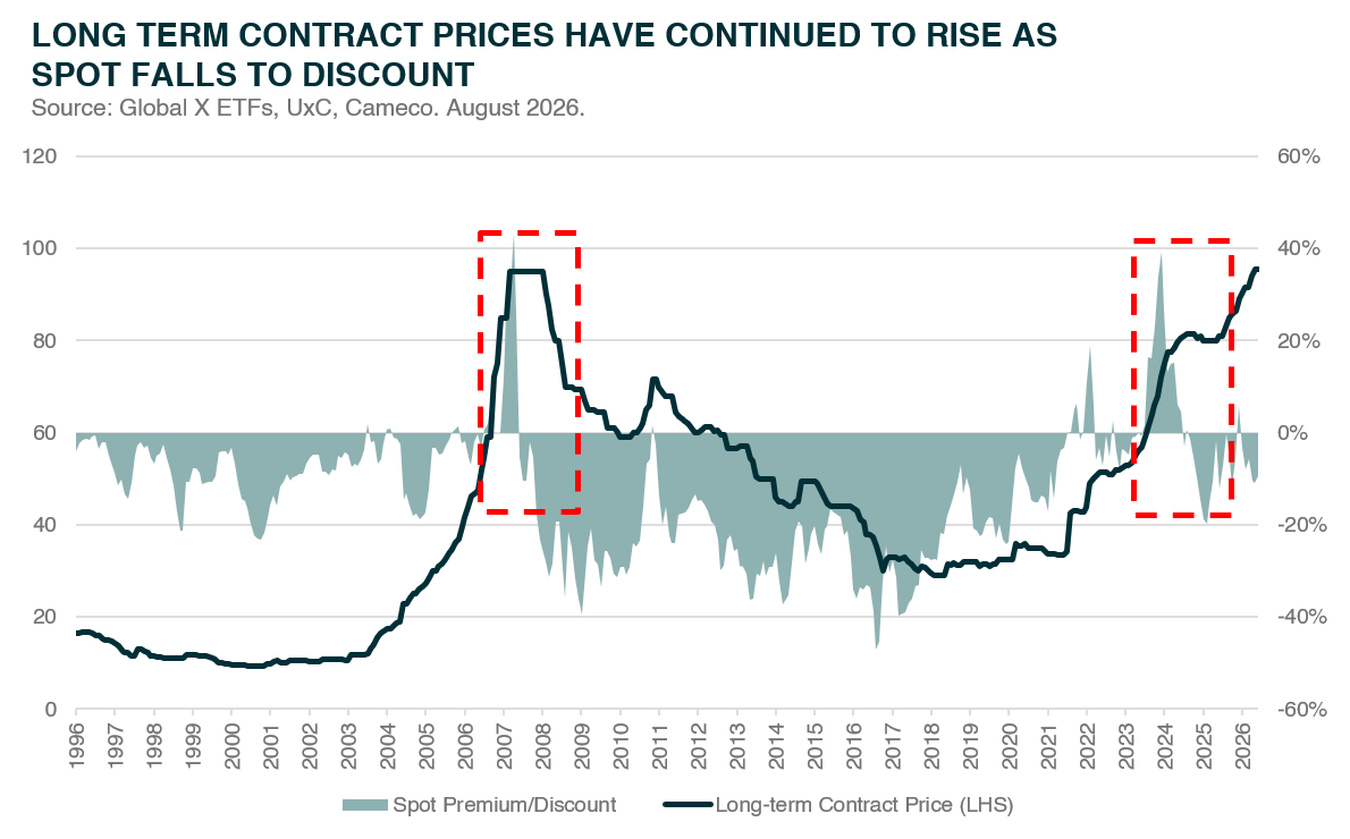
The difference lies in what the long-term price did next. In the earlier episode, weaker spot prices were eventually followed by a collapse in contract pricing, which confirmed that utilities themselves were stepping back and that demand had genuinely deteriorated. This time, long-term prices have continued to rise even as spot has fallen. Utilities are still contracting, and still paying more to do so. To us, that points to speculative capital leaving the spot market rather than to any weakening in the underlying demand picture.
It is also worth remembering that spot should, in theory, trade at a discount to long-term prices. A utility signing a multi-year contract is paying for certainty of supply, and that certainty carries a premium. Viewed that way, the discount is not inherently negative - in fact, it is arguably what one would expect outside of a speculative environment. The premium of the past few years was the anomaly, not the discount that has replaced it.
With contract prices still rising and most volumes not due for delivery until years from now, a meaningful portion of miners’ future revenue is already committed at prices above where the spot market is trading today. That is why we believe the market’s initial reaction may have been more severe than the underlying fundamentals suggest.
Investing for Future Demand
That raises an obvious question. If long-term contract prices are rising, why have uranium miners continued to see negative earnings revisions, itself another contributor to recent underperformance?
The answer is that revenue and earnings have pulled apart. Miners are generating their highest revenues on record, but they are also spending heavily to expand production ahead of the demand they expect to serve. The result is earnings that have stagnated or, in some cases, turned negative despite a healthy top line.
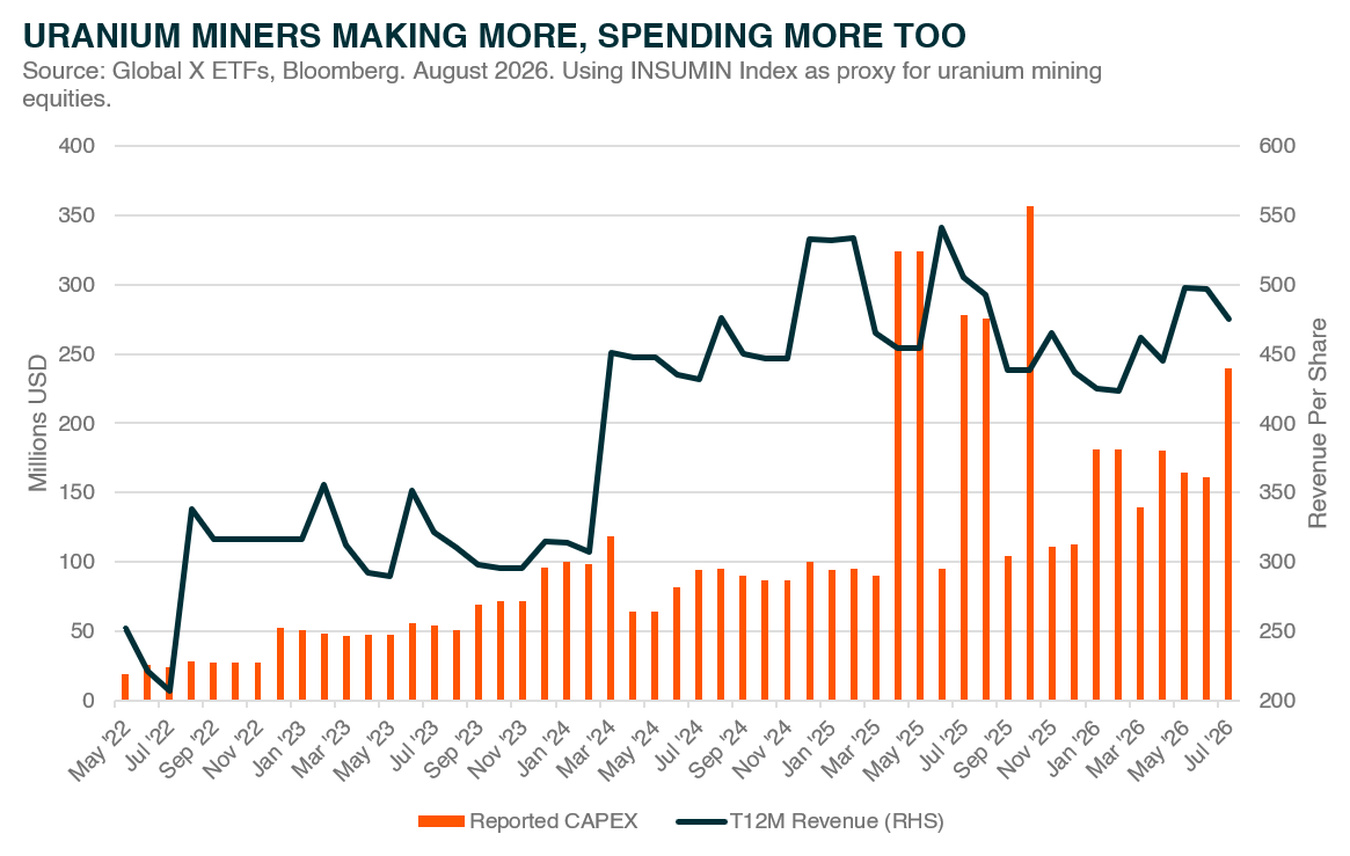
This is a genuine near-term headwind, though one with a natural end point. Mine development is front loaded: the cash goes out during construction, while the production it pays for arrives later and then runs for years. This means that once that spending rolls off, the cost base can dissipate quickly while volumes and contracted prices continue to rise, and each additional dollar of revenue reaches the profit line at a far higher rate than it does today. This is why earnings emerging from a capex cycle can grow considerably faster than revenue and can read as bullish.
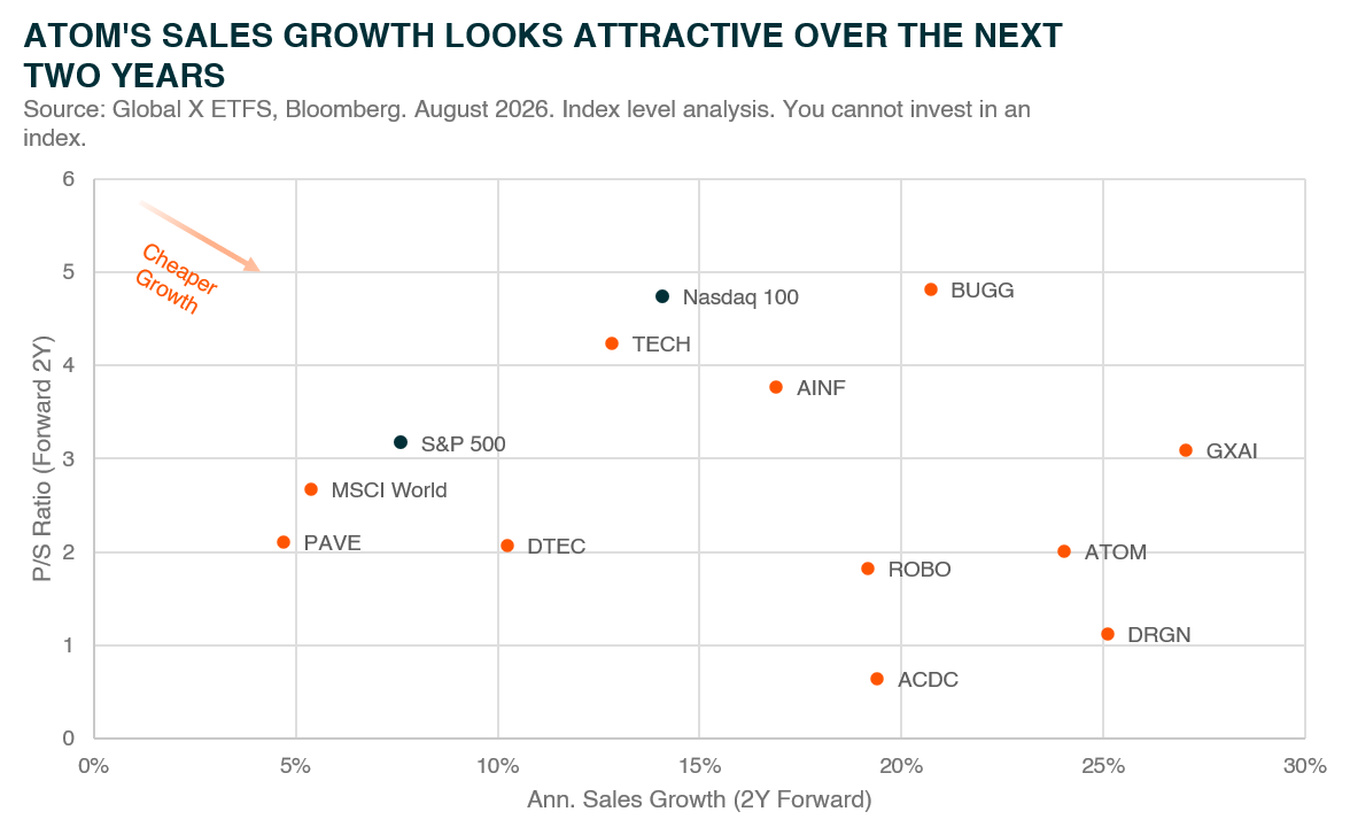
Which leaves the question of how confident one can be that the demand is actually coming.
The rising long-term contract prices discussed above are one of the clearer signals, since utilities are unlikely to lock in higher prices for volumes they do not expect to need. But policy, too, is pointing in the same direction, with several governments signalling a greater appetite for strategic uranium stockpiling, even if the true scale of those programs remains, understandably, opaque.
China has recently offered some of the clearest illustration. It is estimated to have purchased US$5.8 billion of enriched uranium from Russia in 2025, likely a record, with state media reporting imports 758 tonnes higher than the year prior. To put that increment in perspective, the additional volume alone is roughly equivalent to the annual requirements of France’s entire 57-reactor fleet. The US has moved in a similar direction, announcing US$2.7 billion in funding to expand domestic HALEU (High Assay, Low Enriched Uranium)
Nuclear Construction: More Than an AI Story
The final piece of the nuclear theme’s underperformance sits with the nuclear construction exposure, which has become increasingly tethered to the AI infrastructure narrative.
The logic behind that link is reasonable enough. Data centres need enormous quantities of reliable, always on power, and nuclear supplies exactly that, which is why several hyperscalers have signed agreements with reactor operators. Small modular reactors, smaller units built in factories rather than assembled on site, could extend the relationship further as the technology matures.
Our concern is not with the pairing itself but with its timing: these companies have begun to trade as though AI were already the primary driver of their business, when for most of them it is not yet a material one.
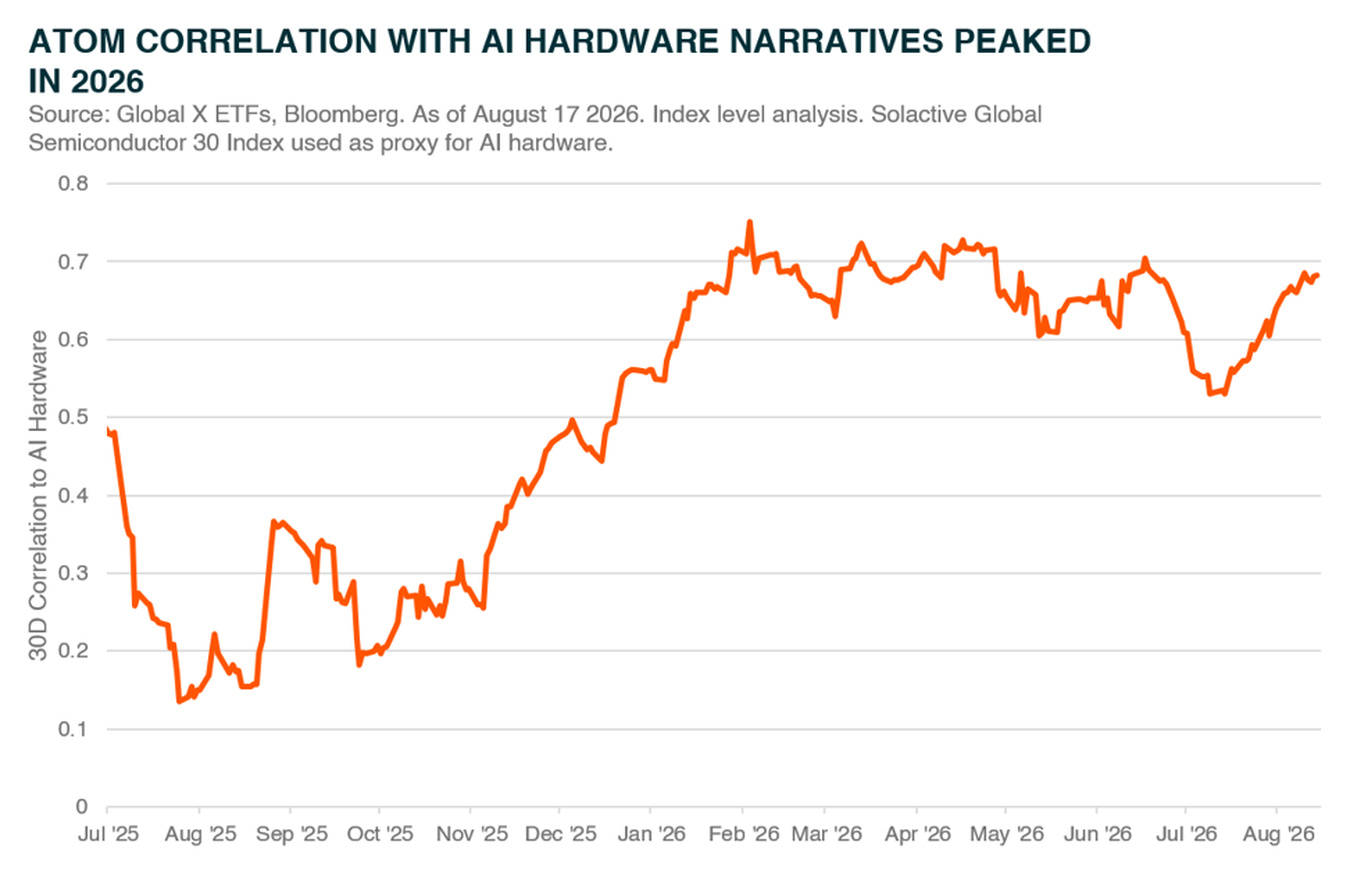
That mattered in June and July, when fears of moderating hyperscaler capex put the AI narrative under pressure and nuclear engineering firms were swept up in the selloff alongside it. Those fears have since largely receded. More to the point, the work these firms actually do is measured in decades rather than quarters. A reactor takes years to permit and build, and the decision to commission one is made by governments and utilities on energy policy grounds, not by technology companies revising their spending plans.
Those policy drivers are, if anything, strengthening. The Russia-Ukraine war and, more recently, the Iran conflict have prompted a global rethink of energy supply chains and far closer scrutiny of energy security. Nuclear sits unusually well in that debate. Once built, a reactor is domestically controllable, its fuel is compact and cheap to store in strategic quantities, and it generates no operational carbon emissions, which allows it to serve energy security and decarbonisation objectives at the same time.
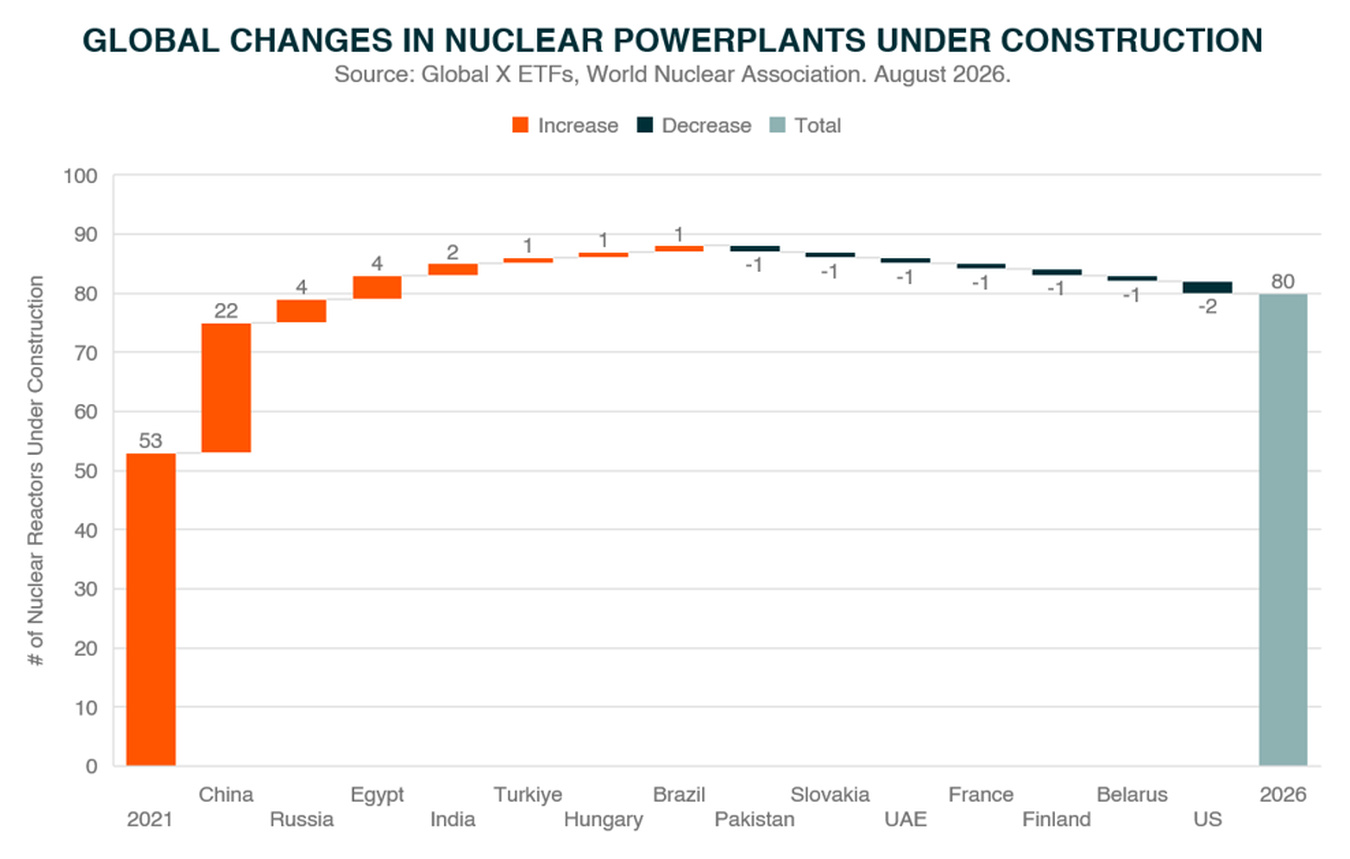
The construction pipeline has continued from strength to strength over the past few years, keenly reflecting that shift. As of 2026, 80 reactors are under construction worldwide, up from 53 in 2021, with a larger cohort still in planning. China again sets the pace, with its latest five-year plan targeting an expansion in domestic nuclear generation capacity from around 70GW to 110GW. These are multi-decade commitments, and they are largely insulated from the sentiment swings that have driven the sector’s share prices this year.
Short Term Wobbles, Long Term Fundamentals
In our view, the uranium and nuclear theme’s underperformance this year reflects a mix of genuine near-term headwinds and market reactions that may have been overdone. Elevated capex has compressed miner profitability, while sentiment has been pressured from two directions at once - weaker spot prices on the mining side and the AI selloff on the construction side. None of that is imagined. What we would question is how much any of it tells you about where the sector is heading.
The signals that do speak to the longer term continue to support a constructive future. Long-term uranium prices are still rising, producers are investing ahead of the demand they expect, governments are treating fuel supply as a strategic priority, and the global buildout continues to progress. On our reading, the market pricing appears to reflect a weaker demand outlook than in the overall broader environment.
With much of the near-term pessimism already reflected in valuations, we believe the structural drivers behind the nuclear thematic remain intact for investors able to look through the current cycle.
Related Fund
ATOM: The Global X Uranium ETF (ASX: ATOM) invests in a broad range of companies involved in uranium mining and the production of nuclear components, including those in extraction, refining, exploration, or manufacturing of equipment for the uranium and nuclear industries.