Markets are generally quite good at pricing in risks they can see coming. It is the ones that are difficult to anticipate, both in timing and magnitude, that tend to cause the greatest disruption. Weather is one such example, and with the developing 2026–27 El Niño potentially shaping up to be one of the strongest in modern history, we think investors may have another risk worth paying attention to.
However, what makes this particular El Niño interesting is not just its potential severity, but also the environment in which it is unfolding. With geopolitical tensions already disrupting global trade, commodity production highly concentrated in a handful of countries, and governments increasingly prioritising domestic interests over free trade, the global supply chain may be considerably less resilient to unexpected shocks than in previous decades. As such, the consequences of a severe El Niño could extend well beyond the weather itself, potentially creating outsized risks for commodity prices and inflation heading into 2027 and beyond.
Key Takeaways
A historically powerful El Niño is raising the stakes for commodity supply. Droughts, floods and shifting rainfall patterns could disrupt production across major agricultural regions, with soft commodities particularly exposed.
Inflation risks extend beyond the commodities themselves. A concentrated disruption to food production can flow through to consumer prices and inflation expectations, with the impact varying substantially between economies.
Resource nationalism could turn local shortages into global shocks. With production concentrated in relatively few countries and trade restrictions more common, an export ban or supply intervention could amplify the effect of an adverse harvest.
What is El Niño and Why Does This Episode Matter?
It is not lost upon us that, for many investors, it may be their first time hearing of the term “El Niño”. As such, to understand why investors should care about this weather phenomenon, let us first explain what El Niño is.
El Niño is an abnormal weather condition that stems from temperature shifts across the Pacific Ocean. Under normal conditions, strong trade winds push warm surface water across the Pacific towards Australia and Indonesia. This helps drive rainfall over the western Pacific, while allowing cold, nutrient-rich water to rise to the surface off the coast of South America. During El Niño, those trade winds weaken, allowing warm water to spread eastwards.
This seemingly modest change in ocean circulation can dramatically alter weather patterns across the world. Regions accustomed to regular rainfall may instead face prolonged droughts, while typically dry regions could see severe flooding. Australia and Southeast Asia, for example, tend to experience hotter and drier conditions, while parts of South America can become considerably wetter.
In general, El Niño events are relatively common and often come and go without causing too much disruption. However, the developing 2026–27 episode could be a different story altogether, with some forecasts suggesting it could rank among the most intense in modern history. An event of this magnitude could amplify the usual shifts in weather patterns, increasing both the likelihood and severity of extreme weather events such as droughts, floods and severe storms across vulnerable regions.
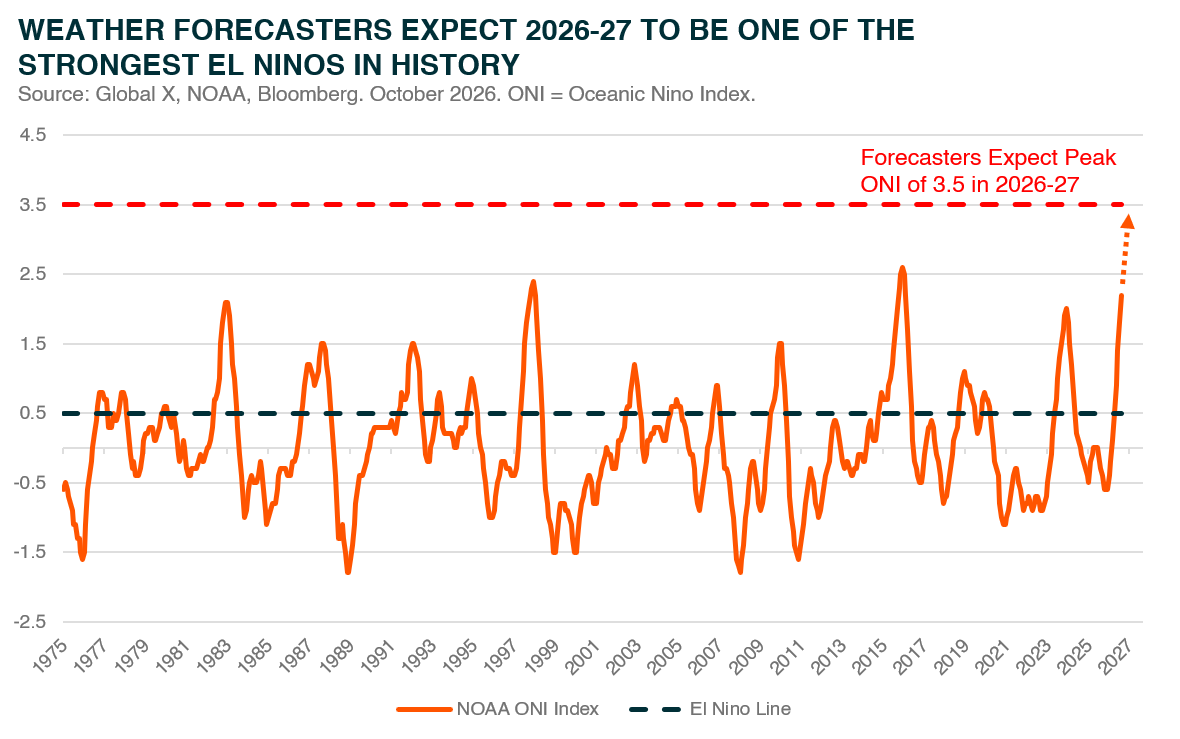
Of course, predicting exactly where and when these disruptions might occur, let alone their severity, is extraordinarily difficult. Weather patterns are influenced by a complex mix of local and global factors, meaning even a powerful El Niño does not guarantee disaster. For investors, the challenge is therefore less about positioning for any single likely outcome, and more about preparing for a wider range of potential outcomes, including some that markets may not be adequately prepared for.
What Has Historically Happened During El Niño?
One way to appreciate the potential consequences is to look at what has happened during previous episodes. The 1982–83 and 1997–98 El Niño events, for example, were associated with severe flooding across parts of Peru and Ecuador, while the latter also coincided with devastating drought and forest fires in Indonesia.2 More recently, the 2015–16 event contributed to widespread agricultural distress in Ethiopia, while the 2023–24 episode exacerbated drought conditions across parts of southern Africa.3 Clearly, when El Niño becomes sufficiently powerful, the consequences can extend well beyond a few unusually warm days.
With these examples in mind, one might assume that the investment implications of an El Niño are rather straightforward: stronger, more severe disruptions = higher commodity prices.
Unfortunately, the historical data paints a considerably messier picture. Certain agricultural commodities, particularly softs such as sugar, coffee and cocoa, are highly sensitive to unfavourable weather conditions and have indeed tended to outperform during El Niño episodes. However, the impact across the broader commodities complex has been far more mixed, with outcomes largely dependent on which producing regions are affected, existing inventory levels, and whether producers elsewhere can make up the shortfall.
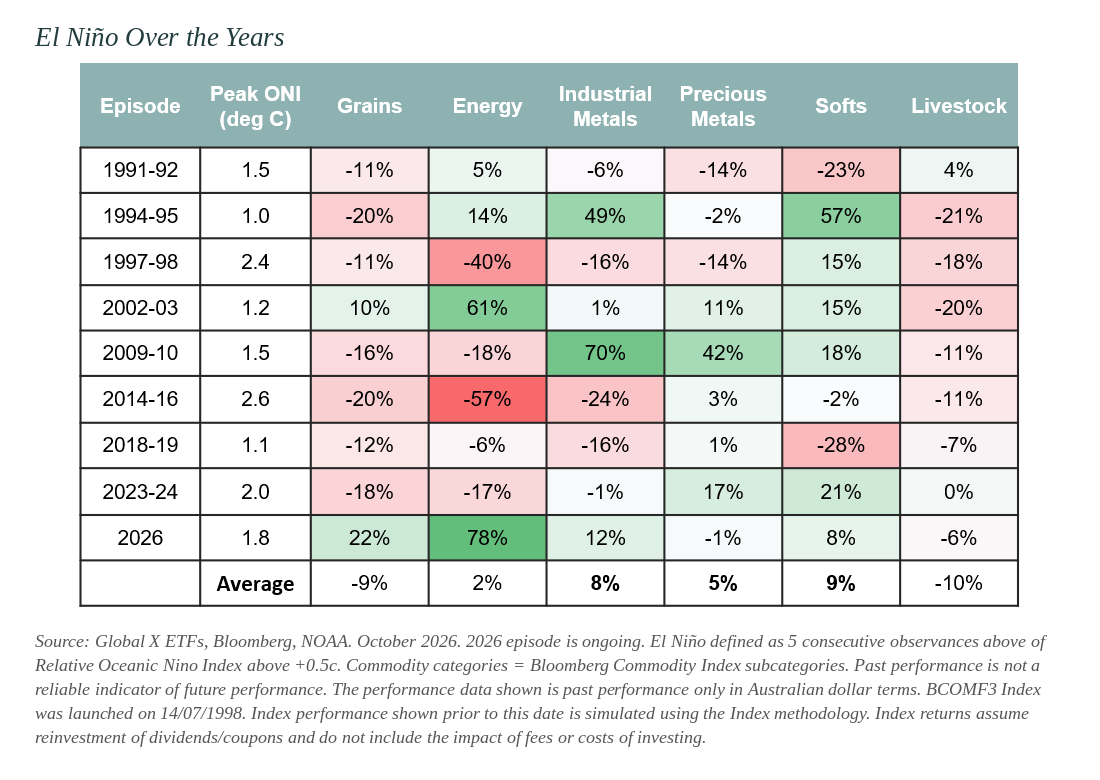
One of the more predictable effects, however, appears to be inflation. This is not particularly surprising. When severe weather constrains the supply of food, agricultural inputs or other essential commodities, businesses and households are left competing for a smaller pool of available goods, pushing prices higher. Meanwhile, more extreme temperatures can also drive greater energy consumption for heating and cooling, adding further upward pressure on energy prices.
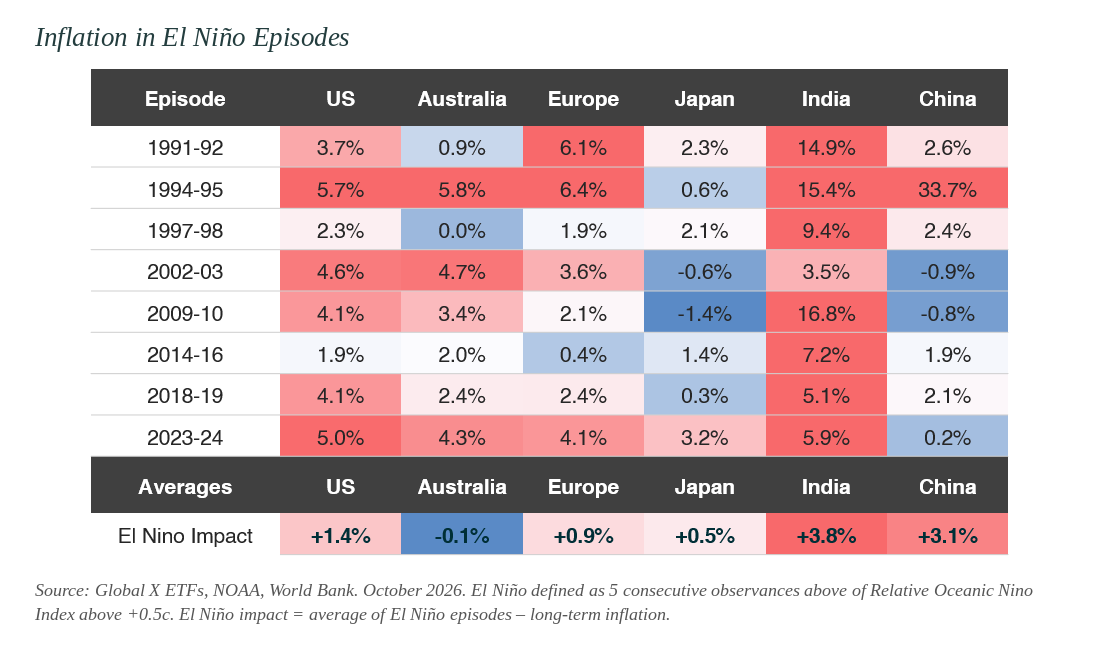
Our analysis of historical El Niño episodes suggests that inflation has tended to run above long-term averages across several major economies, with emerging markets experiencing the most pronounced increases, likely reflecting the greater weighting of food prices in their CPI baskets.
For developed markets, while the direct impact may be smaller, it could nonetheless prove significant if inflation remains stubborn and central banks are forced to consider further monetary tightening. At a time when investors are already acutely sensitive to inflation surprises, El Niño could become yet another variable worth watching.
Another Spanner in the Works: Resource Nationalism
One further factor makes the upcoming El Niño particularly consequential: resource nationalism.
Over the past few years, countries have become increasingly willing to prioritise domestic supply security over international trade, particularly when it comes to essential commodities. This has been reflected in a sharp increase in trade-restricting measures since the pandemic, with governments becoming more comfortable imposing export restrictions, tariffs and other measures.
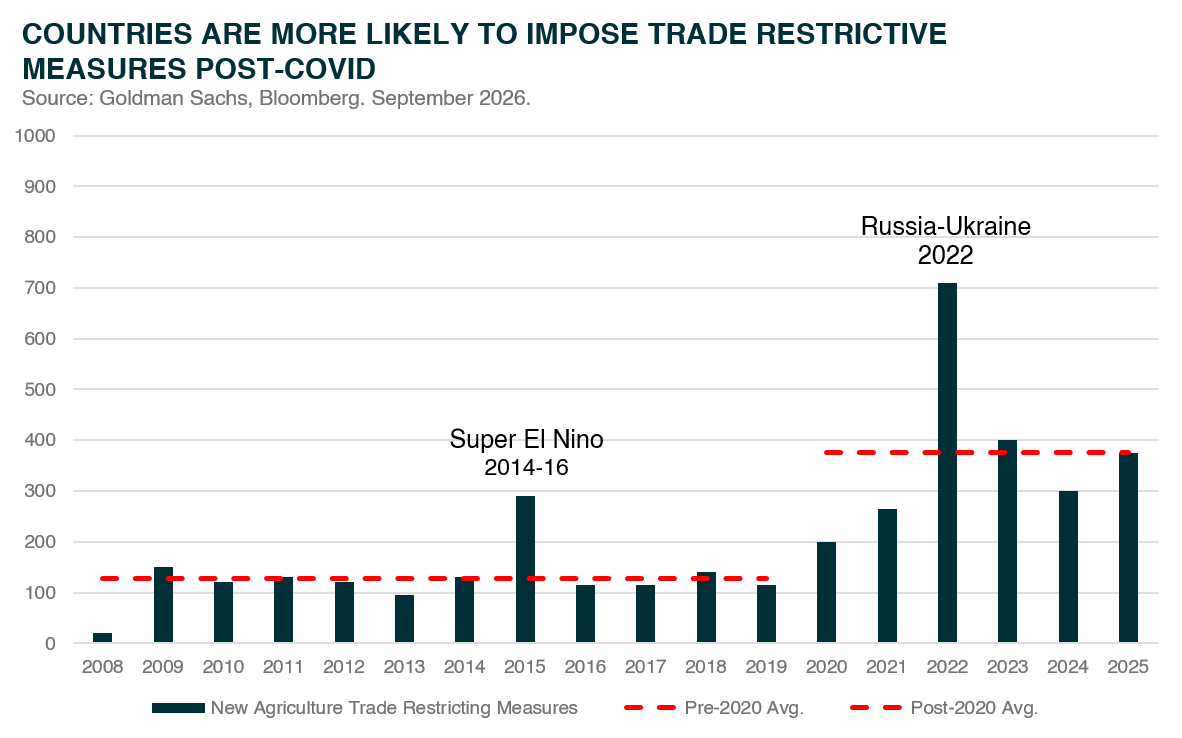
While these policies may make sense from the perspective of individual countries, they can create significant problems for global commodity markets. Under normal circumstances, higher prices would encourage supply from elsewhere to fill the shortfall. However, if other countries respond by restricting exports to protect domestic food security, what began as a localised supply disruption could quickly become a global shortage.
This is particularly concerning given just how concentrated global commodity production has become. From soybeans to aluminium, a relatively small number of countries account for the majority of global supply. Disruptions in just one producing regions can therefore have an outsized impact on prices, especially if trade restrictions prevent other countries from responding.
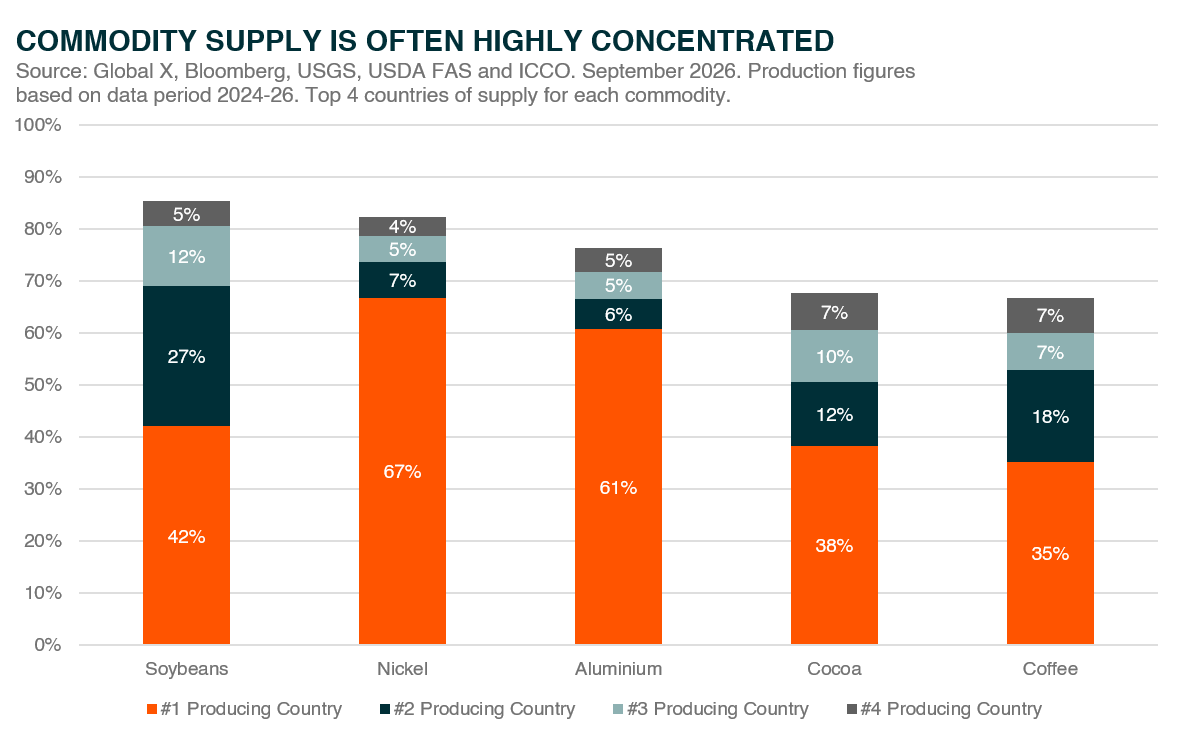
In other words, resource nationalism could act as a force multiplier for the supply disruptions associated with El Niño. Even if the weather itself was no more disruptive than in previous episodes, the global trading environment could make its economic consequences considerably more severe.
What Does This Mean for Investors?
We think the first and most important investment implication of the developing El Niño is not necessarily that commodity prices are destined to rise, but rather that the likelihood of unexpected, and potentially significant, price spikes may be increasing.
While the historical performance of individual commodities during El Niño episodes has been mixed, the combination of more severe weather disruptions, concentrated supply chains and increasingly protectionist trade policies could create an environment where commodity price risks become increasingly asymmetric. In other words, the downside may remain relatively familiar, while the potential for sudden upside surprises becomes considerably more pronounced.
The second consideration is inflation. Over the past few years, investors have become accustomed to thinking about inflation through the lens of central banks, wages and interest rates. But a climate-driven supply shock creates a rather different challenge. It can push the prices of essentials higher without any corresponding improvement in economic growth, potentially leaving policymakers with the unenviable choice of tolerating higher inflation or keeping monetary conditions tighter for longer. As such, we suspect that inflation hedging could once again move closer to the front of investors’ minds.
What Can Investors Do?
Of course, identifying a risk and investing around it are two very different things. We may be reasonably confident that an unusually strong El Niño increases the odds of supply disruptions, but that does not tell us which crop will be affected, where the next drought will occur or when prices might react. Attempting to pick a single winning commodity therefore risks turning a broader macro thesis into a fairly speculative weather forecast.
For investors who share our view, we think a broad-based commodity allocation may be the more sensible approach. An ETF such as the Global X Bloomberg Commodity Complex ETF (ASX: BCOM) spreads exposure across agriculture, energy, industrial metals and precious metals, reducing reliance on any one outcome. It provides investors a way to participate in a wide range of potential commodity upside surprises, while also offering a degree of protection against unexpected inflation.
Another avenue is through the equities of commodity producers. In theory, a sustained increase in commodity prices can translate into higher revenue, earnings and cash flow for producers, particularly where costs do not rise at the same pace. There is an important distinction, however. A mining company or agricultural producer is still an operating business, and could be directly affected by the same disruptions that push its selling prices higher. Company-specific risks, equity-market sentiment and rising operating costs also matter.
Ultimately, the case is not that El Niño makes a commodity rally inevitable. Rather, it is that investors may want to consider whether their portfolios are sufficiently exposed to assets that could benefit when an unexpected supply shock does arrive. Given the combination of climate risk and increasingly interventionist trade policy, we think that question has become more relevant than ever.
Related Fund
BCOM: For those wishing to invest in broad commodities, the Global X Bloomberg Commodity Complex ETF (ASX: BCOM) provides one way of doing so. BCOM tracks the Bloomberg Commodity 3 Month Forward Index, which tracks a basket of global commodity futures weighted by production and liquidity.
Considerations for investing
All investments involve risk. An investment in these funds may be affected by risks related to: Markets, Investment Objective, Index Tracking, Derivatives, ETF Pricing, Liquidity, Currency, Concentration, & Counterparty Risk. The nature and level of risk may vary depending on the fund’s investment strategy and assets. The value of your investment can rise or fall, see the PDS for a full list of risks.