Every time someone uses ChatGPT, streams Netflix, uploads to the cloud or drives an electric vehicle, semiconductors are working behind the scenes.
These tiny chips have become the backbone of the AI economy and one of the most important industries in global markets.
Investors have taken notice. Semiconductor stocks have surged in 2026 as spending on artificial intelligence infrastructure accelerates worldwide.
Soaring stock prices have grabbed the attention of investors across the globe. Yet many investors still view the industry as overly technical and complex to fully understand.
A single AI chip may involve American designers, Taiwanese manufacturing, Dutch lithography equipment, Japanese testing systems and Korean memory suppliers. That complexity can make it difficult for retail investors to identify which companies may ultimately benefit most from long-term AI growth.
It also means the winners may extend far beyond the names dominating headlines today.
Why chips suddenly matter to investors
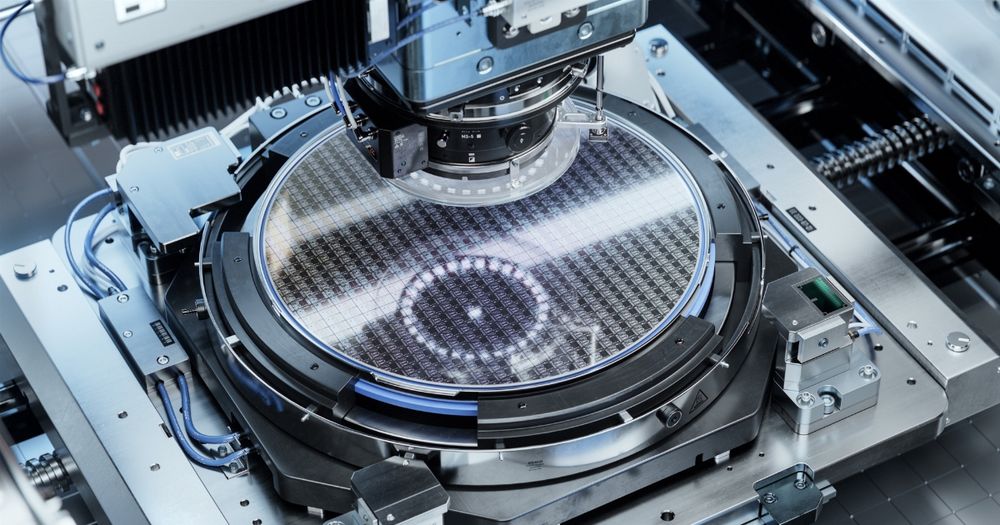
Semiconductors are the “brains” inside modern technology. They process information, store memory and power computation. Without them, AI simply does not exist.
The semiconductor industry sits at the centre of several major structural themes:
As AI adoption accelerates, demand for advanced chips has exploded. Training large AI models requires enormous computing power, which in turn requires increasingly sophisticated semiconductors.
That has created a powerful tailwind for the companies designing chips, manufacturing them and supplying the equipment needed to build them.
Four companies powering the AI boom
One of the reasons semiconductor investing has become so compelling is that the industry contains some of the most strategically important companies in the world.
1. NVIDIA Corporation
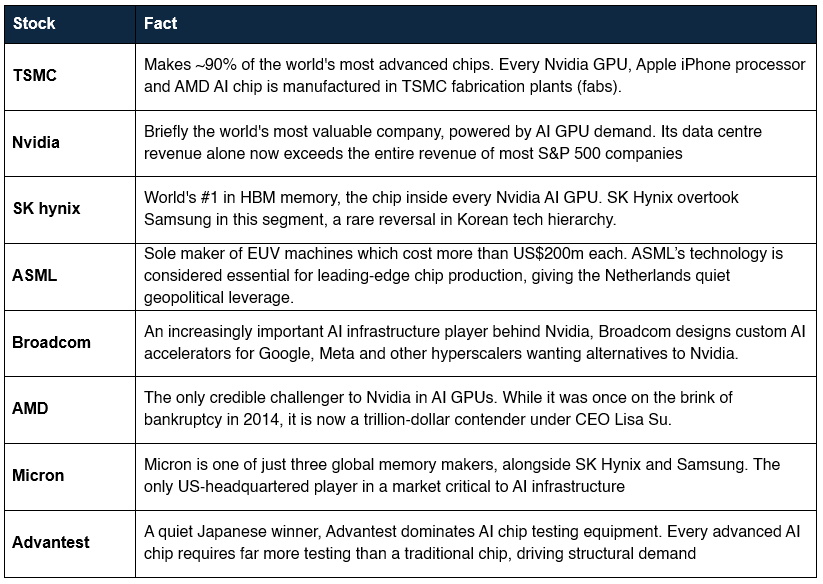
- Nvidia has become the face of the AI revolution. Its graphics processing units (GPUs) are now the standard infrastructure powering advanced AI models. Its data centre division alone now generates more revenue than many entire S&P 500 companies.
2. Taiwan Semiconductor Manufacturing Company (TSMC)
- TSMC manufactures roughly 90% of the world’s most advanced chips. Every leading-edge Nvidia AI chip, Apple iPhone processor and AMD accelerator is produced in TSMC’s fabrication plants in Taiwan. In many ways, TSMC has become a strategically important company in the global technology supply chain.
3. ASML Holding
- ASML occupies a unique position in the semiconductor ecosystem. The company is the sole manufacturer of extreme ultraviolet (EUV) lithography machines, which are essential for producing advanced chips. These machines can cost more than US$200 million each, and without them, cutting-edge semiconductor manufacturing would not be possible.
4. Broadcom Inc.
- Often overshadowed by Nvidia, Broadcom has emerged as a major AI infrastructure beneficiary. The company designs custom AI accelerators for hyperscalers such as Google and Meta, helping diversify the AI ecosystem beyond a single chip supplier.
Why diversification matters
While Nvidia has captured most investor attention, the semiconductor industry is far broader than one company.
AI infrastructure depends on an entire ecosystem:
- Chip designers
- Memory manufacturers
- Semiconductor foundries
- Equipment suppliers
- Testing and packaging companies
For example, SK hynix Inc. has become the global leader in high-bandwidth memory (HBM), a critical component inside Nvidia AI chips.
Meanwhile, Japanese companies like Advantest Corporation and Tokyo Electron Limited play crucial but often overlooked roles in testing and manufacturing advanced semiconductors.
This is one reason ETFs like SEMI may appeal to investors. Rather than relying on a single winner, investors gain exposure across the broader semiconductor value chain.
Not just a US story
Another important feature of the semiconductor market is that it is deeply global.
While many investors associate AI with Silicon Valley, semiconductor leadership is spread across multiple countries:
- Taiwan dominates advanced chip manufacturing
- South Korea leads memory production
- The Netherlands controls critical lithography technology
- Japan remains essential in semiconductor equipment and materials
- The United States leads chip design and AI platforms
What is SEMI?
The Global X Semiconductor ETF (SEMI) provides exposure to 30 of the world’s largest semiconductor companies through the Solactive Global Semiconductor 30 Index.
Rather than trying to pick the next breakout AI winner, the ETF offers diversified exposure across the global semiconductor supply chain.
Importantly, the index focuses on established industry leaders rather than speculative small-cap names. To qualify, companies must meet minimum size and liquidity thresholds, including:
- Free float market capitalisation above US$1 billion for new entrants
- Strong trading liquidity across one-month and six-month periods
- Primary listings in developed markets, including Taiwan and South Korea
The methodology also excludes mainland China A-share listings, helping reduce some of the access and governance concerns associated with local Chinese markets.
The result is a concentrated portfolio of global semiconductor heavyweights, weighted by market capitalisation but capped at 10% per stock to avoid over-concentration.
The opportunity for investors
Semiconductors have become one of the defining investment themes of the decade because they sit at the intersection of AI, automation and digital infrastructure.
That does not mean the sector will move in a straight line. Semiconductor stocks can be volatile, particularly after strong rallies. But the long-term investment case increasingly centres on the idea that chips are no longer cyclical industrial products alone; they are now strategic infrastructure for the digital economy.
For retail investors looking to better understand the AI boom, semiconductors may be one of the clearest places to start. And rather than trying to identify the next individual winner, diversified exposure through vehicles like Global X Semiconductor ETF (SEMI) offers a way to participate in the broader transformation underway across global technology markets.
Semiconductor company guide