Factor investing has moved from the domain of tools used by active managers to being employed in the core of modern portfolio construction in Australia, enabled by the rise of transparent rules-based index ETFs. Yet within an increasingly crowded factor landscape, one approach is sitting in plain sight that investors may be overlooking - Growth at a Reasonable Price (GARP) - offering a balanced way to navigate elevated valuations, shifting cycles and can potentially add genuine diversification to Australian portfolios.
Key Takeaways:
- Factor ETFs now account for roughly one-fifth of the broader equity ETF market in Australia, reflecting a clear shift from active-only implementation to rules-based portfolio construction across growth, value, quality and multi-factor exposures.
- Global equity markets remain expensive relative to long-term averages (based purely on valuation metrics alone), increasing the importance of avoiding overpaying for growth while still maintaining exposure to structural earnings drivers.
- By blending growth, quality and value, GARP provides meaningful diversification across regions and sectors, while its systematic rebalancing process has historically supported strong risk-adjusted returns through different market cycles, and now can be accessed through a currency-hedged vehicle to protect from foreign exchange headwinds.
Rise of Factor ETFs in Australia
Factor investing has continued to gain momentum in Australia as investors increasingly look beyond traditional market-cap weighted exposures in search of more targeted portfolio outcomes. Once considered the domain of active managers, factor strategies can now be accessed through transparent rules-based ETFs at a lower cost. Since the launch of the first factor ETF almost two decades ago in the Australian market, the segment has evolved significantly, expanding beyond single-factor exposures into strategies targeting quality, value, growth, yield, momentum and multi-factor combinations.
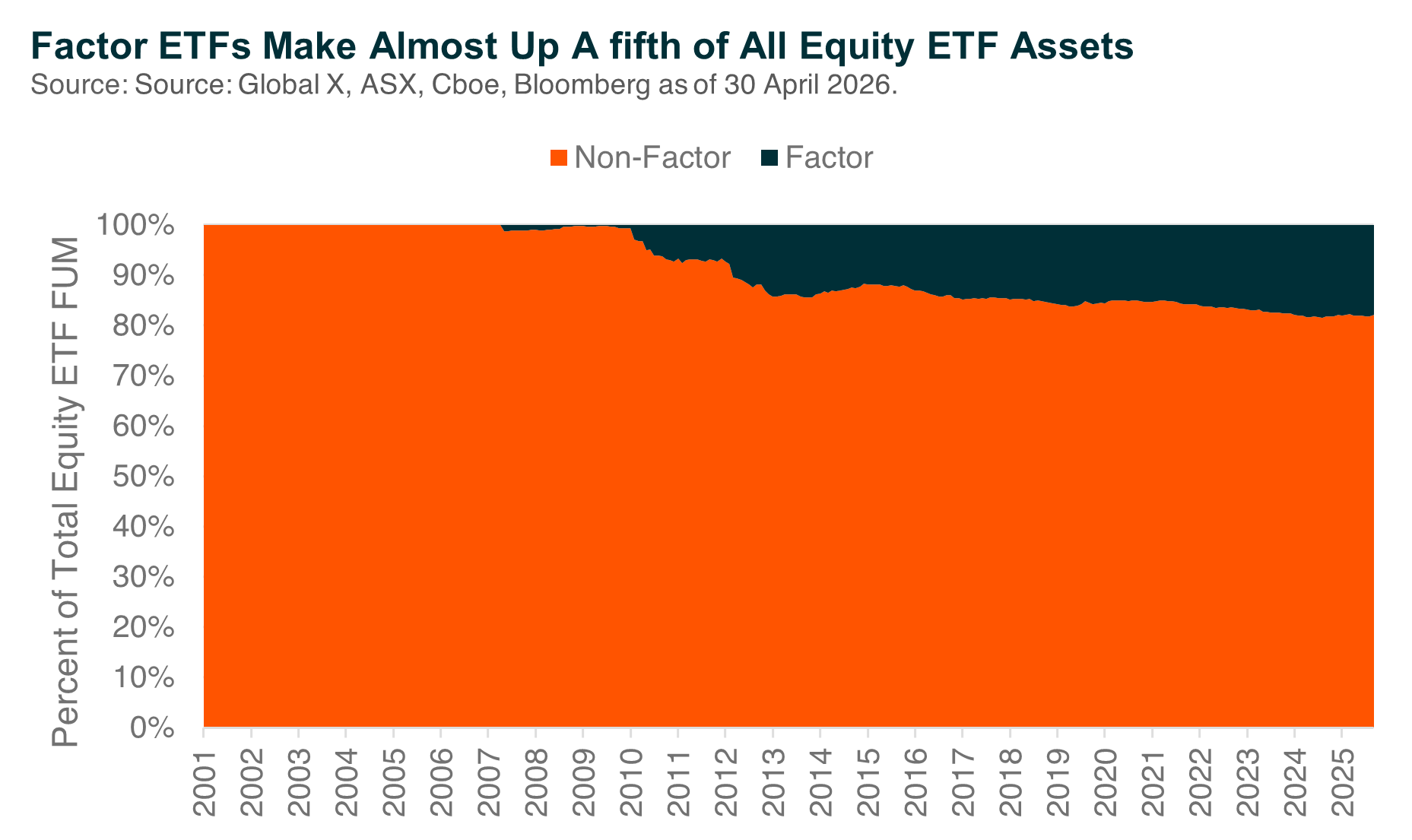
As investors seek to complement simple vanilla equity allocations with more deliberate sources of return and risk management, smart beta ETFs continue to proliferate across the Australian market. This evolution reflects growing demand for more sophisticated portfolio construction tools within a low-cost index framework, and provides just another tool in the arsenal for Australian investors to consider blending into portfolios.
Valuations Still Matter in Expensive Equity Markets
Global equity valuations remain elevated relative to long-term averages, especially across parts of the US market where enthusiasm surrounding artificial intelligence has driven some valuations higher. Historically, higher starting valuations have often translated into lower forward returns, meaning investors should be cognisant that valuation discipline still matters. While valuations have seen some drawdown due to the Middle East conflict, many equity markets still seem somewhat towards the upper end of their expensive valuation band range.
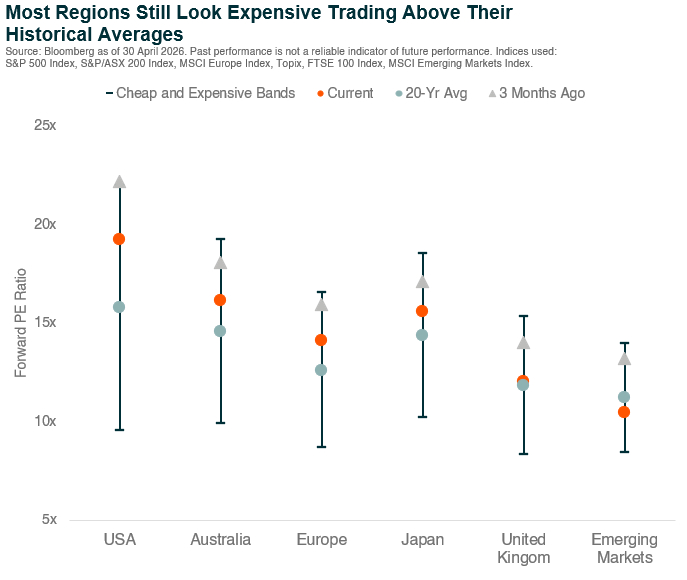
This could pose a thought for investors to pivot to value-based investing. However, abandoning growth entirely is difficult given structural trends in AI and automation. Investors still need compounding earnings exposure, but the key challenge is avoiding overpaying, which is where factor-based ETFs can seek to strike a balance.
Introducing a Growth at a Reasonable Price Framework
It sounds simple enough - just invest in quality companies with growing earnings at a reasonable price. In practice, it is far harder to execute. Earnings expectations shift constantly, macro data and sentiment swings, making it difficult for investors to consistently identify the right entry points and monitor ongoing developments. This is where systematic ETF approaches can help, using a disciplined, rules-based framework that reduces behavioural bias, limits constant portfolio adjustments, and effectively outsources the ongoing complexity of monitoring and decision-making.
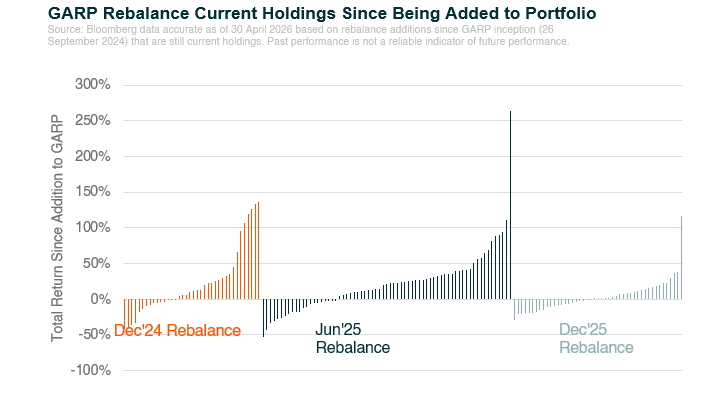
Since GARP’s ETF inception in September 2024, the fund has undergone three separate rebalances in accordance with its rules-based semi-annual rebalance schedule, and on average, the additions have added more positive returns than negative returns. For example, it removed Tesla in December 2024 on valuation concerns and added Spanish banks such as BBVA, before introducing Sumitomo Electric in June 2025 and Fujikura in December 2025. The latter two reflect beneficiaries of the accelerating AI and electrification buildout, supplying critical optical fibre, high-speed connectivity and electrical infrastructure across AI data centres, which were added due to exhibiting strong earnings growth and improving balance sheet quality.
Within the factor landscape, GARP sits in a useful middle ground, blending growth and value characteristics. It typically avoids the higher volatility of pure growth strategies while still delivering stronger earnings momentum than traditional value or low-volatility approaches. Rather than attempting to time factor cycles, a blended exposure such as using a GARP multi-factor may potentially provide more consistent outcomes across changing market regimes.
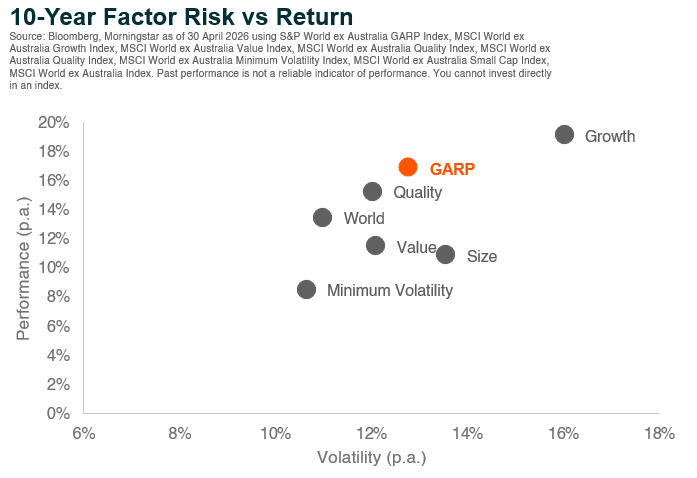
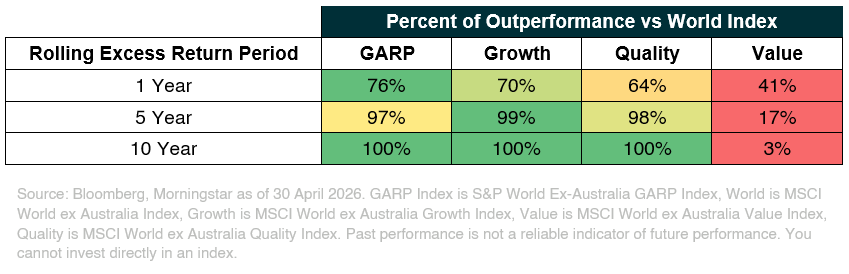
History suggests benefits from a blended factor approach, where combining growth and value characteristics through GARP can help smooth performance across shifting market regimes. While the value factor has recently had its moment in the sun this year, it has not consistently led across cycles, with extended periods of underperformance in prior decades. By diversifying across styles, GARP reduces reliance on any single factor regime. Notably, a global GARP-style exposure has not experienced a decade of rolling underperformance versus the broader market, highlighting its resilience and consistent return profile through time.
The Overlooked Currency Risk in Global Equity Investing
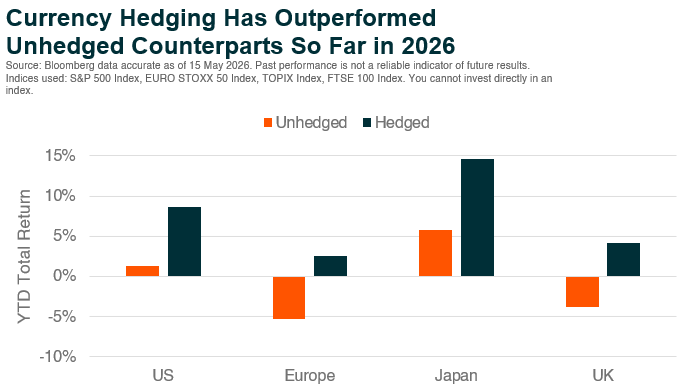
Currency hedging is an important strategic decision for Australian investors. Over the past 10-15 years, unhedged global equity exposure has generally been rewarded, with a weaker AUD boosting offshore returns and making currency risk appear like a tailwind rather than a headwind. However, relying solely on that historical experience can be misleading, as conditions have already shifted in 2026, with hedged exposure outperforming unhedged strategies, with some investors losing up to 80-85% of returns driven purely by foreign exchange moves - a factor that many might consider outside their control.
The AUD has also traded near US$0.73, a four-year high, supported by a relatively hawkish RBA and fiscal dynamics. Looking forward, divergent global interest rate paths and uneven growth trends suggest a more uncertain currency backdrop. In this environment, investors should actively reassess whether they want foreign equity returns amplified or neutralised by currency exposure. Reflecting this shift and the sheer appetite for currency-hedged global equity ETFs, Global X has launched a currency-hedged GARP strategy (GHRP) to provide more currency-controlled factor exposure.
The GARP Advantage
Markets inevitably move through cycles. Growth leadership eventually cools, value re-emerges, and quality rotates in and out of favour. Rather than trying to anticipate these shifts, GARP maintains a balanced exposure to companies with sustainable earnings growth that are not priced at excessive valuations.
This disciplined blend has historically delivered strong outcomes across market environments, with GARP standing out as one of the more consistent performers among single-factor strategies and demonstrating the benefits of combining growth, quality and value within a single framework.
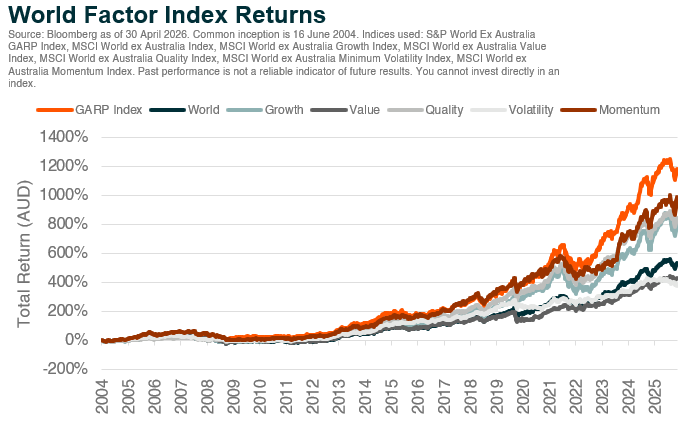
By avoiding reliance on any one style, it has helped smooth returns through different phases of market leadership while maintaining attractive risk-adjusted characteristics. The current GARP portfolio also offers strong diversification benefits for Australian investors, with only around 30% overlap with the broader market, an underweight to US and technology exposure, and a tilt toward sectors such as energy and industrials as well as regions including Japan and Europe.1
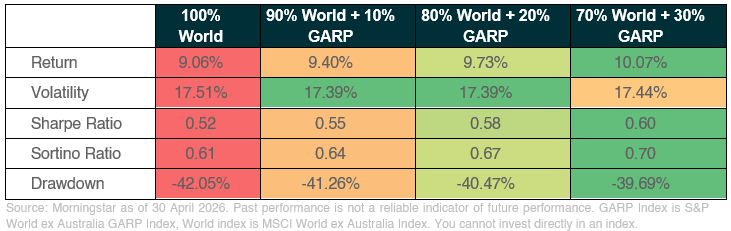
In a market where valuations remain elevated, and investors are often forced to choose between chasing growth or seeking value, GARP offers a more balanced path, capturing compounding earnings without overpaying and demonstrating the power of a blended factor approach. With both global hedged and unhedged versions now available for Australians, investors can dial the strategy to their view, tapping into the full power of GARP in a way that aligns with how they want to capture global growth, manage currency risk, and stay firmly positioned for whatever the market brings next.
Related Funds
GHRP: The Global X S&P World ex Australia GARP (Currency Hedged) ETF provides investors with exposure to global companies with strong earnings growth, solid financial strength, and trading at reasonable valuations, whilst providing a currency hedged overlay.