Exchange Traded Funds (ETFs) have transformed investing, giving everyday Australians access to diversified portfolios that were once only available to large institutions and wealthy investors. Rather than selecting individual shares, bonds or other assets, investors can use ETFs to build an entire investment portfolio through a handful of carefully chosen funds.
For investors seeking simplicity, diversification and cost efficiency, an ETF-only portfolio can potentially provide a practical framework for achieving long-term financial goals.
Why Build a Portfolio with ETFs?
An ETF is a fund that trades on a stock exchange, allowing investors to buy a basket of securities in a single transaction. Depending on the ETF, that basket may contain hundreds or even thousands of underlying investments.
Using ETFs as the foundation of a portfolio offers several advantages:
- Diversification: Gain exposure to a broad range of companies, sectors, countries and asset classes.
- Simplicity: Build and manage a diversified portfolio using just a handful of investments, rather than researching, selecting and monitoring dozens of individual securities.
- Transparency: Most ETFs disclose their holdings regularly, allowing investors to understand what they own.
- Cost efficiency: Many ETFs provide broad market exposure at relatively low management costs compared to traditional actively managed funds.
- Accessibility: Investors can gain exposure to global markets, fixed income, commodities and thematic opportunities through the share market like the ASX.
The result is a portfolio that can be easier to build, monitor and rebalance over time.
Start with Your Investment Objectives
Before selecting ETFs, investors should consider several key questions:
- What is my investment timeframe?
- What level of risk am I comfortable taking?
- Am I investing for growth, income or a combination of both?
- How would I react if markets experienced a significant decline?
The answers will help determine the appropriate asset allocation, which is often considered the most important driver of long-term investment outcomes.
Build a Core Portfolio
A common approach is to establish a "core and satellite" portfolio structure.
The core portfolio forms the foundation and typically contains broad market ETFs designed to provide diversified exposure across major asset classes.
Australian Equities
Australian shares (also known as equities) often form a significant part of local investors' portfolios. Broad Australian equity ETFs can provide exposure to many of the country's largest listed companies across sectors such as financials, healthcare, resources and consumer goods. The Global X Australia 300 ETF (A300) provides investors with cost-effective exposure to the 300 largest Australian companies listed on the ASX. Designed as a core holding, A300 combines broad market coverage and diversification in a single, easy-to-invest ETF.
International Equities
Many investors already have substantial exposure to the Australian economy through employment, property and superannuation. International equity ETFs can help diversify risk by providing exposure to companies across the United States, Europe, Asia and other global markets.
Global equities also offer access to industries that are underrepresented in Australia, including technology and communications. For example, the Global X US 100 ETF (U100) tracks the performance of 100 of the largest innovative companies listed on the US market on either the NASDAQ or NYSE. It focuses on technology and pioneering US companies, providing exposure to sectors with high growth potential, such as technology, consumer goods, and more.
Fixed Income
While shares are typically the primary driver of long-term growth, fixed income (also known as bonds) can help reduce portfolio volatility and provide consistent income.
Bond ETFs can offer exposure to government bonds, corporate bonds or diversified fixed-income portfolios, helping investors balance risk during periods of market uncertainty. Bonds can behave differently to shares and have historically provided a cushion during periods of equity market stress, helping reduce portfolio volatility
Consider Additional Diversification
Once a core allocation has been established, investors may choose to add complementary asset classes.
Commodities and Gold
Commodity ETFs, including gold ETFs, are often used as portfolio diversifiers. Some investors view gold as a potential hedge during periods of market volatility, inflation concerns or geopolitical uncertainty. Gold may help improve portfolio diversification when traditional assets like shares and bonds become more closely correlated.
Thematic Investments
Thematic ETFs provide exposure to long-term structural trends that may shape the future economy.
Examples include:
- Artificial intelligence
- Cybersecurity
- Robotics and automation
- Renewable energy
- Healthcare innovation
While thematic ETFs can offer growth potential, they are generally considered higher-risk investments and may be more suitable as smaller allocations within a diversified portfolio.
An Example ETF Portfolio
Every investor's circumstances are different, but a simple growth ETF portfolio might look something like this:
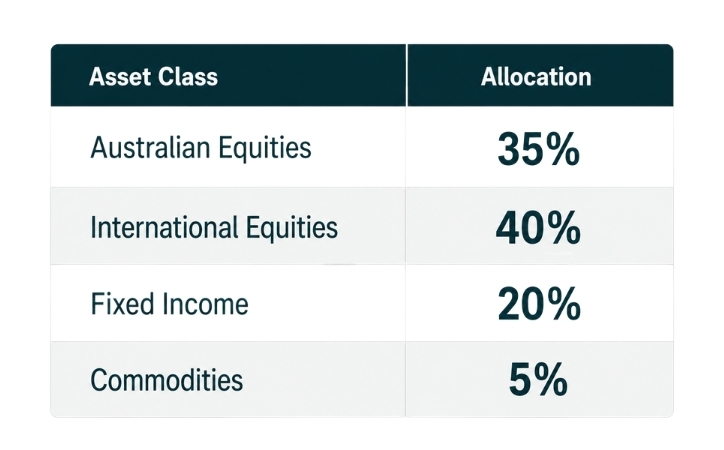
This example is for illustrative purposes only and does not constitute financial advice. The appropriate allocation will depend on an investor's goals, risk tolerance and investment timeframe.
Don't Forget Rebalancing
Over time, market movements can cause a portfolio's asset allocation (i.e. the mix of investments) to drift away from its original target weight.
For example, if equities perform strongly, they may grow to represent a larger portion of the portfolio than intended, which could mean an investor may be taking on more risk than they initially intended to.
Rebalancing involves periodically reviewing and adjusting holdings to maintain the desired asset allocation. Investors commonly rebalance on a time basis (e.g. annually) or when allocations move beyond predetermined thresholds.
This disciplined process can help manage risk and ensure the portfolio remains aligned with long-term objectives.
Focus on the Long Term
One of the biggest challenges investors face is staying invested during periods of market volatility. Attempting to predict short-term market movements can be difficult, even for professional investors.
A diversified ETF portfolio can help investors remain focused on their long-term goals by providing exposure across multiple asset classes, sectors and regions.
Rather than relying on a number of individual stock picks, ETF investors can participate in the growth of broader markets while managing risk through diversification.
As always, investors should consider their personal circumstances and seek professional financial advice where appropriate before making investment decisions.