Following a strong February earnings season, recent market moves in banking stalwarts and evolving policy settings are potentially prompting investors to reassess the outlook for Australian equities. In this environment, income enhancement strategies may become increasingly relevant as a way to help navigate a more uncertain and lower growth backdrop.
Key Takeaways:
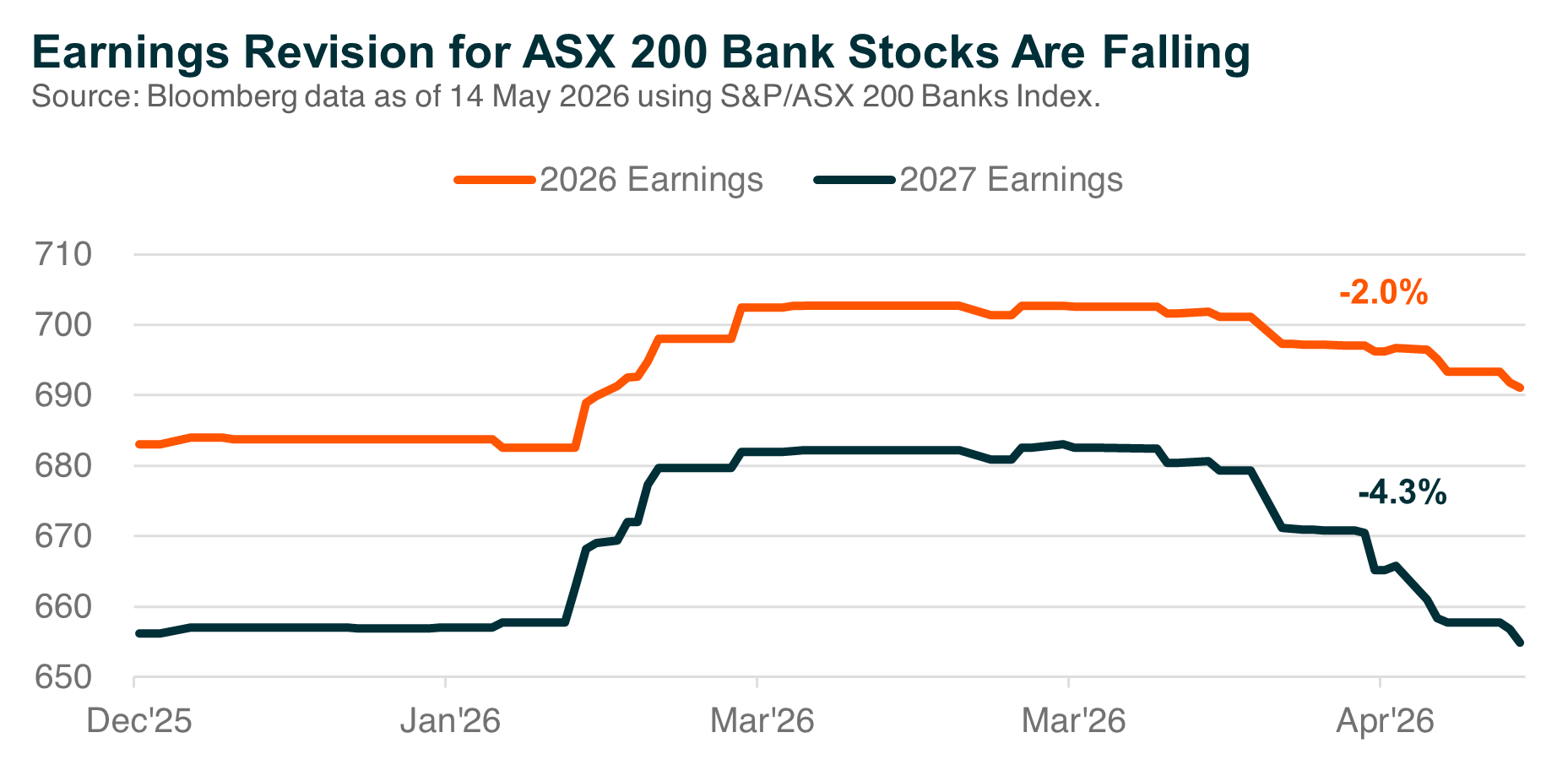
- Earnings revisions for Australian banks are beginning to deteriorate, with stretched valuations, slower credit growth, stagnant net interest margin growth, and rising arrears potentially creating headwinds for a sector that represents nearly a third of the Australian share market.
- The 2026 Federal Budget and proposed capital gains tax reforms may increase the appeal of income-focused strategies, as they potentially become more tax-advantageous, as investors seek more reliable cash flow and real yield amid persistent cost-of-living pressures.
- Covered call strategies have historically performed strongly during sideways or weaker markets, helping enhance portfolio income while reducing volatility, drawdowns and overall market beta relative to traditional Australian equities.
Banks Lose Their Shine as Earnings Risks Begin to Emerge
After a blockbuster earnings season, cracks are beginning to emerge in the Australian banking sector with earnings revisions falling sharply. Commonwealth Bank’s latest trading update flagged rising consumer arrears, higher collective provisioning and a softer macroeconomic backdrop, all of which weighed on sentiment. The share price fell over 10% on 13 May, marking its largest one-day drawdown on record, as investors reassessed earnings expectations and previously stretched valuations. Australian banks already trade at some of the highest valuation multiples globally, leaving little room for disappointment. Rising loan arrears, slowing credit growth, stagnant net interest margin growth, and increasing provisioning for bad debts are beginning to overshadow the benefit of potentially higher net interest margins from a rising interest rate environment. With banks making up close to a third of the Australian share market, weakness across the sector could become a meaningful headwind for the market. In fact, the Australian share market just recorded its second-worst relative monthly performance versus global peers in 30 years.1
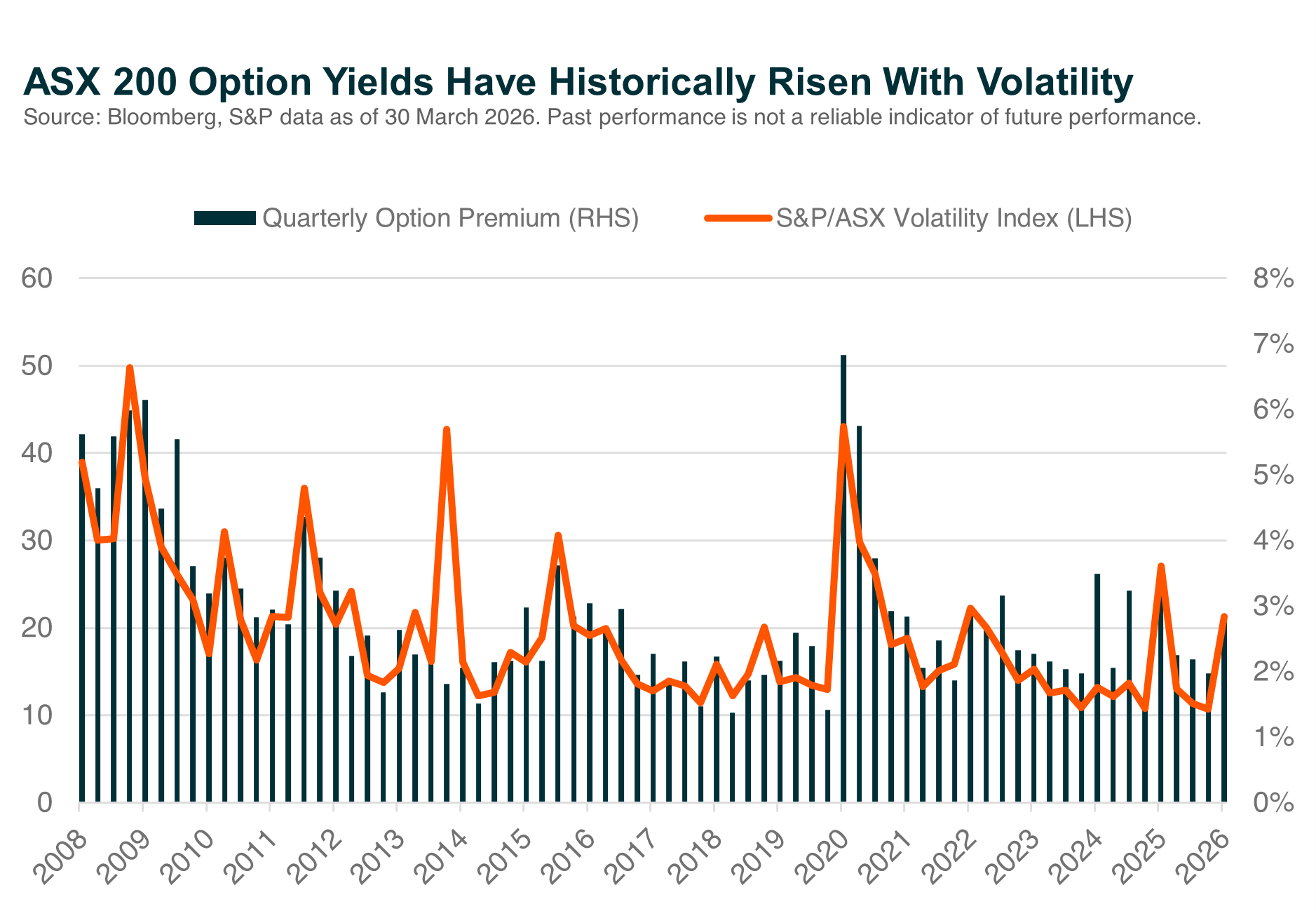
March volatility surged as escalating conflict in the Middle East rattled global markets, pushing the S&P/ASX 200 VIX level to 21, its highest level since Liberation Day. With Australian dividend yields near multi-decade lows outside the COVID-19 pandemic, covered call strategies can provide an alternative income source by harvesting elevated option premiums as investors pay more for market protection and seeking ways to diversify income source streams.
Looking ahead, the remainder of 2026 may be characterised by heightened market volatility as investors navigate ongoing Middle East tensions, US mid-term elections, rapid AI-driven disruption and bond market instability amid elevated yields and persistent inflation pressures. Periods of uncertainty can challenge traditional portfolio construction, particularly for income-focused investors. In this environment, strategies that prioritise diversification of income sources, downside resilience and the ability to monetise elevated volatility may become increasingly valuable within diversified portfolios.
2026 Federal Budget Shifts the Focus Toward Income
The 2026 Federal Budget may mark a turning point for Australian investors, with sweeping capital gains tax reforms potentially reshaping portfolio construction. Proposed changes include replacing the 50% CGT discount with inflation indexation and introducing a minimum 30% tax on capital gains from July 2027. As a result, investors may increasingly gravitate toward income-producing assets, where distributions are taxed at marginal tax rates and are not captured by the proposed capital gains tax floor. The timing is notable. Real wages have now declined for two consecutive quarters, while inflation and cost-of-living pressures remain elevated. In this environment, income-focused strategies such as covered calls may become increasingly attractive for investors seeking real yield, portfolio resilience and more consistent cash flow in a potentially slower-growth economic backdrop.
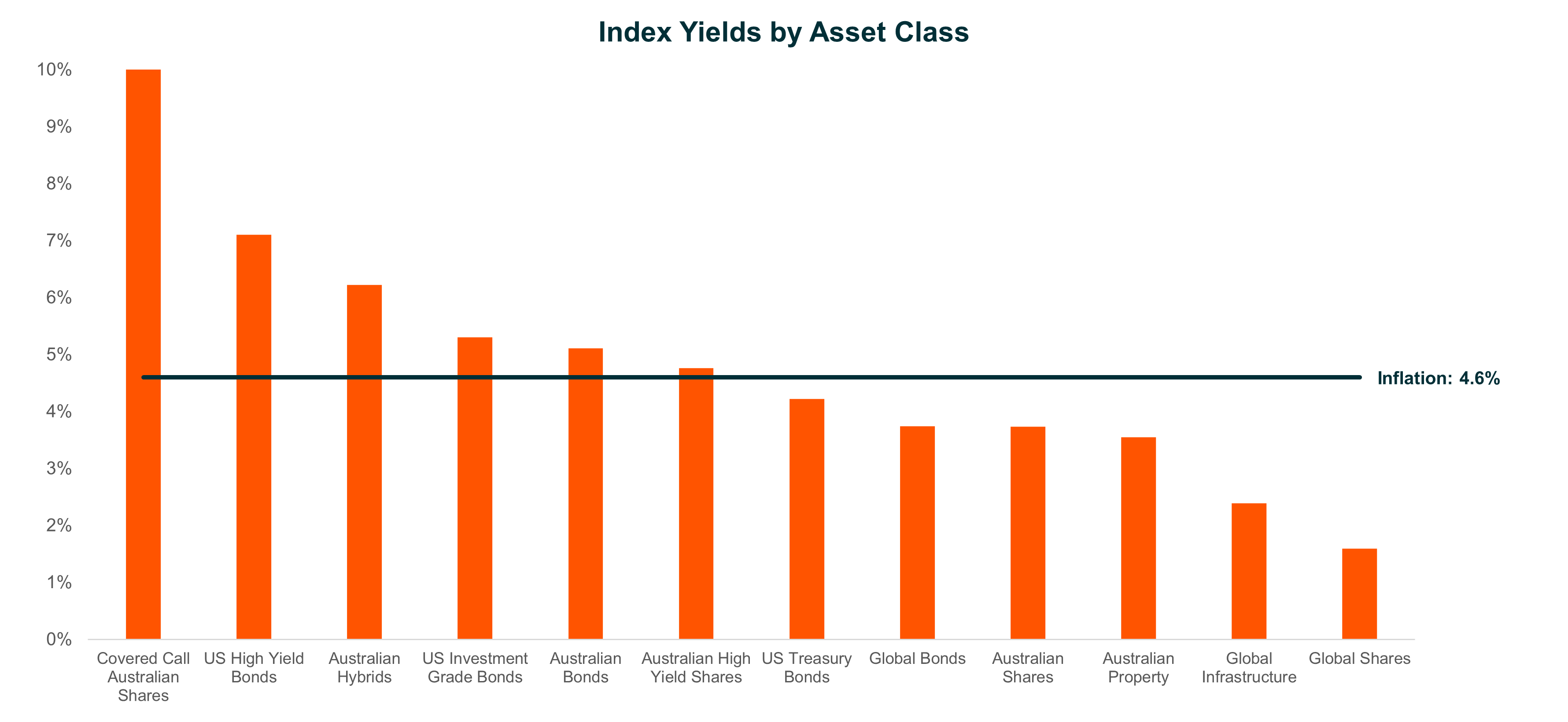
High-dividend equities may regain favour as investors prioritise dependable income over capital growth in a potentially higher-tax environment. Australian shares have long benefited from a strong dividend culture and franking credits, but reliable cash distributions could become even more attractive if capital gains lose some of their tax advantages. Companies with sustainable dividends may increasingly be viewed as core holdings for investors seeking resilient after-tax income, which can be accessed through an ETF like the Global X S&P/ASX 200 High Dividend ETF (ZYAU). At the same time, higher bond yields have improved the appeal of bank debt. With subordinated and senior bank bonds offering attractive carry, and hybrid securities still having a few more years before they are completely phased out, investors may question whether taking full equity risk remains necessary as earnings face pressure from slower growth, tighter margins and downgrades. Rather than avoiding banks entirely, investors may increasingly look to the other side of their balance sheets with ETFs like the Global X Australian Bank Credit ETF (BANK), currently offering a yield of 6% p.a.2
Blending Covered Calls into Portfolios
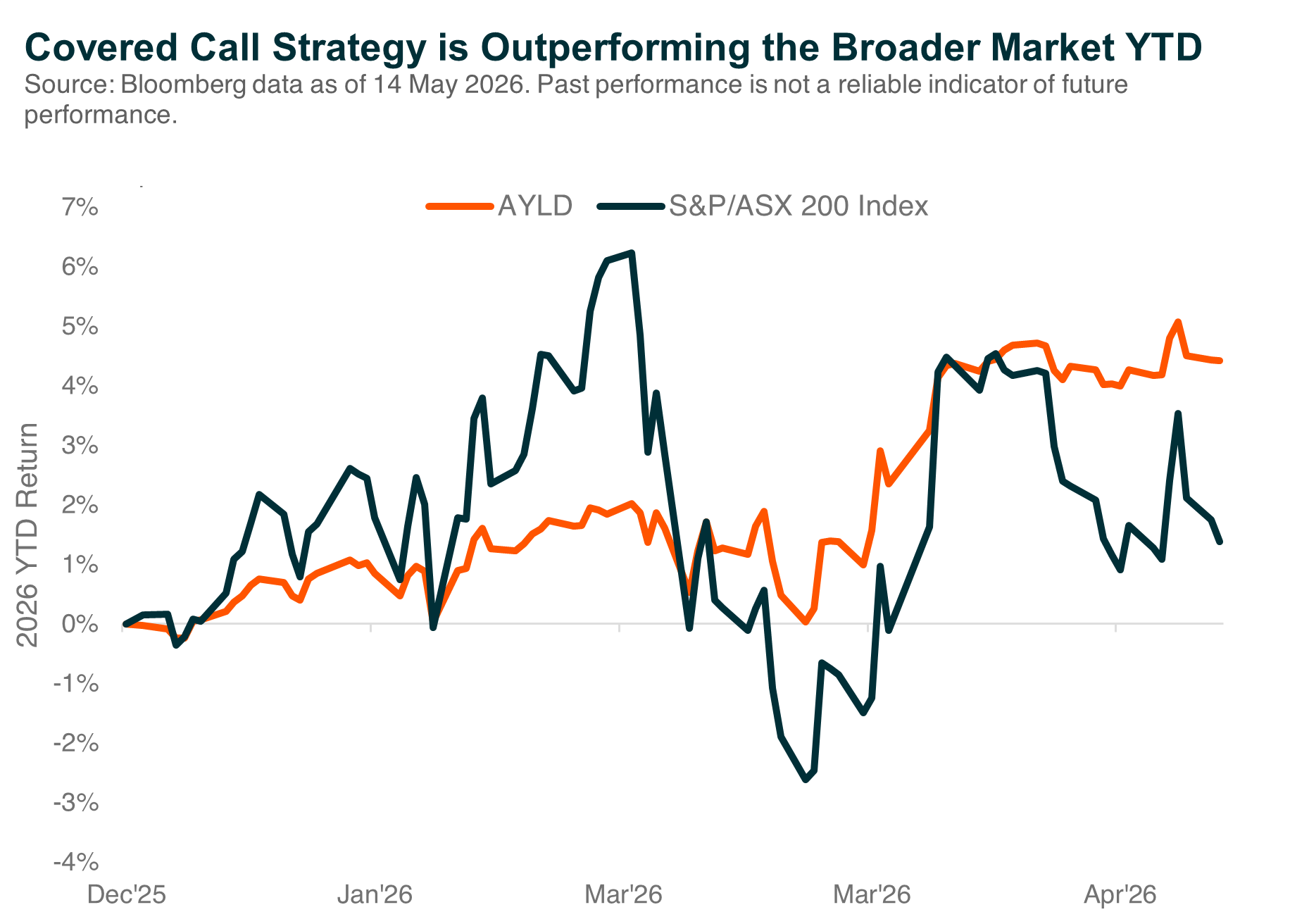
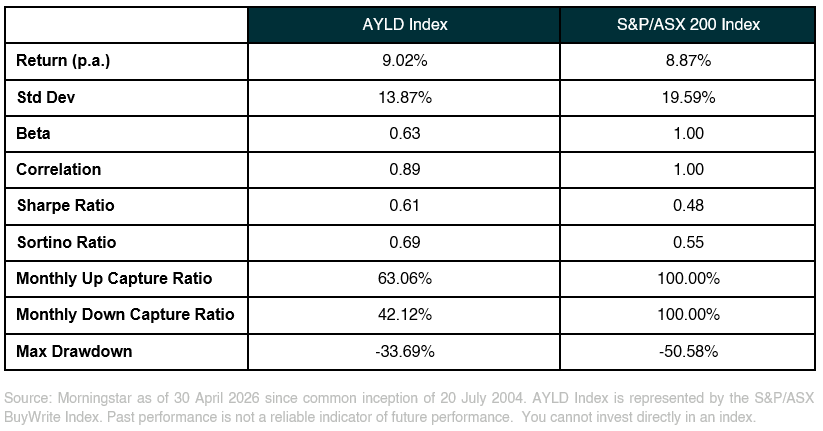
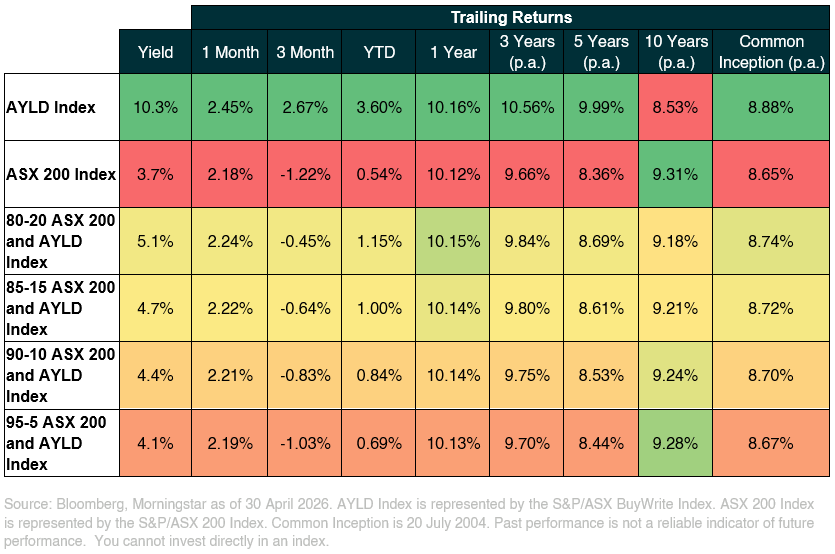
So far in 2026, The Global X S&P/ASX 200 Covered Call Complex ETF (AYLD) has outperformed the broader Australian share market by over 3%, reinforcing the role covered calls can play during sideways or falling markets. Historically, introducing covered call strategies has helped enhance risk-adjusted returns by increasing portfolio income, reducing downside drawdowns and lowering overall portfolio volatility by taking a third less risk than the broader market.
A Changing Market Calls for a Different Approach
Despite resilience in commodity prices, several headwinds may challenge the outlook for Australian equities over the year ahead. A still-hawkish central bank, persistent inflation pressures, structurally large fiscal deficits following the Federal Budget and the Australian market’s limited exposure to the global AI growth thematic may weigh on returns. With Australian banks and miners dominating the local market, investors remain heavily concentrated in cyclical sectors at a time when expectations are becoming more uncertain. In this environment, dependable income and downside resilience may become increasingly important portfolio considerations, whether through dividend-paying equities, bank debt or option-income strategies. Covered call strategies offer investors a way to potentially enhance yield, reduce portfolio volatility and monetise periods of elevated market uncertainty, while remaining invested in the equity market.
Related Funds
- BANK: The Global X Australian Bank ETF (ASX: BANK) invests in a diversified portfolio of Australian banking debt across the full capital structure, comprising fixed and floating-rate bonds, senior and subordinated debt, and hybrid securities.
- ZYAU: The Global X S&P/ASX 200 High Dividend ETF (ZYAU) invests in 50 high-dividend stocks from the S&P/ASX 200 Index.
- AYLD: The Global X S&P/ASX 200 Covered Call Complex ETF (AYLD) writes call options on the S&P/ASX 200 Index, saving investors the time and potential expense of doing so individually.