Battery technology and lithium stocks have had a rollercoaster year, rising more than 40% at one point during the Iran War before sliding back toward flat year-to-date performance by the end of Q3. To us, this wide range in price action reflects the numerous, and often conflicting, narratives currently surrounding the battery technology industry, which may have encouraged investors to favour “cleaner”, less convoluted thematic opportunities elsewhere.
However, as we enter the final quarter of the year, we believe sentiment toward battery technology and lithium has become overly negative. With several of the industry’s structural demand drivers remaining intact, the disconnect between fundamentals and investor sentiment could represent an increasingly attractive opportunity for investors with longer time horizons.
Key Takeaways
- Battery technology equities have leaned heavily on the lithium price for direction in 2026, allowing a single commodity to drive the whole theme even though the fundamentals of miners and battery makers are increasingly different.
- Three concerns have weighed on sentiment: weaker new energy vehicle (NEV) sales in China, a suspension of new battery plant construction, and fears of a slower AI datacentre buildout. We see each of these risks as valid, but increasingly overstated.
- The underlying picture may be turning: battery electric vehicle sales in China have returned to growth while exports rise, consolidation among battery makers could support margins, and datacentre development is broadening geographically.
Lost in the Storm
Battery technology investors have had to navigate an unusually mixed set of signals over the past year. On one hand, the theme continues to benefit from powerful long term growth drivers and, at times, from highly supportive catalysts such as the petrol price shock that followed the Iran War. On the other, a run of negative headlines about China, industry capacity and the durability of AI-related demand has repeatedly challenged sentiment.
We believe this uncertainty has produced two main responses. Some investors have simply rotated toward themes with a clearer near term narrative, such as hard assets or AI hardware. Others have increasingly relied on the lithium price as a shortcut for valuing the whole battery technology complex, even though a higher lithium price is revenue for a miner and an input cost for a battery manufacturer. As the chart below shows, the theme has moved in step with that one commodity for most of 2026.
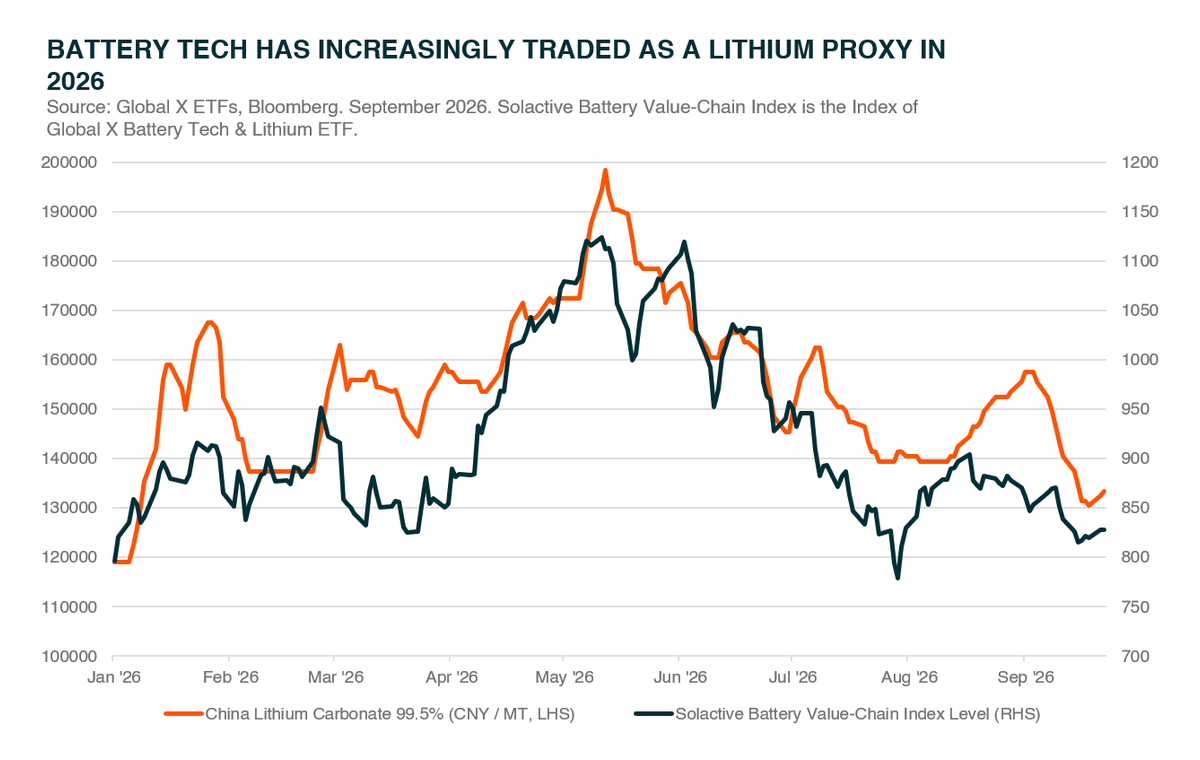
The result has been an unusual year for the index, which rose by around 40% in the first half only to give back nearly all of those gains by the end of the third quarter as the lithium price retreated. In our view, a round trip of that size is difficult to reconcile with end demand over the same period, which includes rising adoption of electric vehicles outside China and continued growth in the AI datacentre buildout.
Below, we examine the three developments that have weighed most heavily on sentiment and explain why we believe their impact on the broader theme is smaller than the market reaction implies.
Concern 1: Domestic NEV Sales Have Slowed in China
The first of these is the apparent “collapse” in sales of new energy vehicles (NEVs) within China’s domestic market, even as adoption has accelerated across much of the rest of the world. We do not dispute that Chinese sales have slowed, but the picture looks considerably less negative once the weakness is broken into its parts.
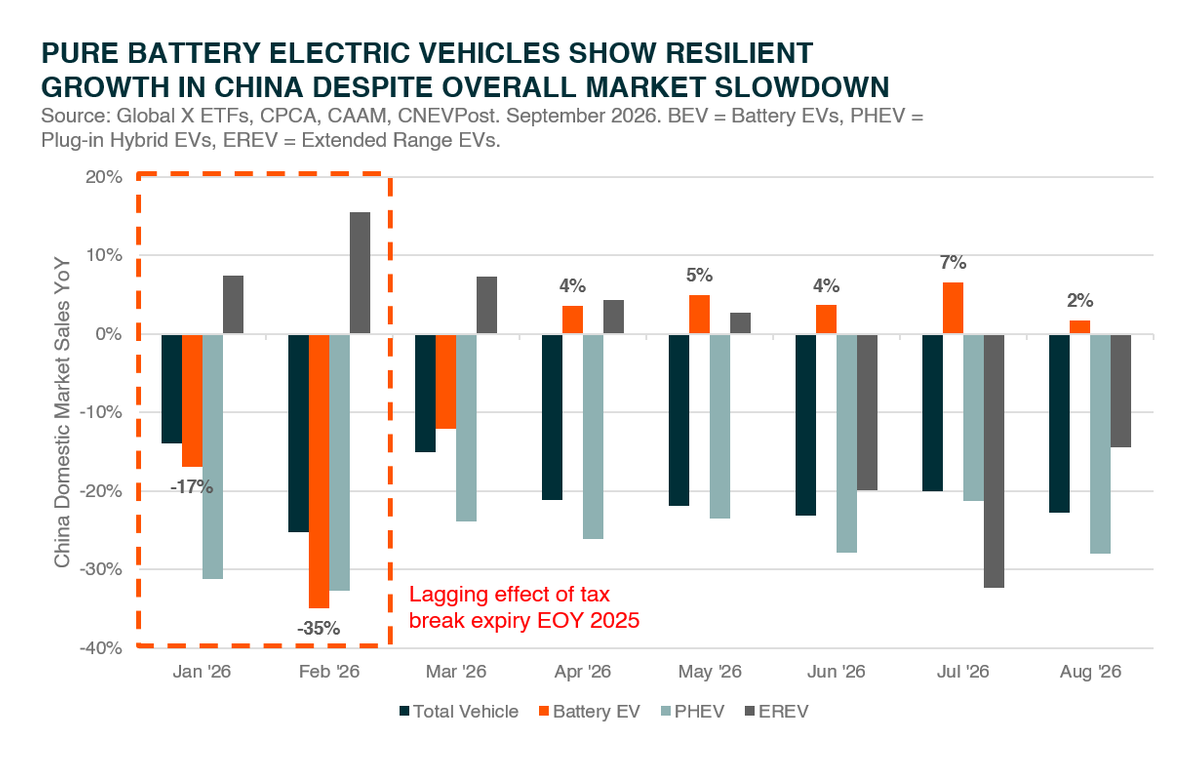
The first part of the explanation is timing, because Chinese tax concessions on NEV purchases expired at the end of 2025 just as private vehicle purchases were slowing more broadly. That likely pulled purchases forward into last year and left a gap in the first two months of 2026, when sales of pure battery electric vehicles (BEVs) fell 17% and 35% year on year.
Interestingly, since April, BEV sales have grown year on year in every month by between 2% and 7%, even though the overall vehicle market has continued to contract. This pattern is consistent with higher petrol prices since the Iran War steering buyers toward fully electric vehicles. It matters for lithium because a BEV carries a much larger battery pack than most hybrids, so a market that shifts its preference toward pure BEVs over time is, in our view, a positive for lithium demand in the long term.
Global EV adoption has also helped soften this domestic slowdown. China is the world’s largest NEV market, so weakness at home is meaningful, but Chinese manufacturers are selling a growing share of their vehicles abroad. Domestic NEV sales are down around 10% year on year for the year to August 2026, while exports have risen by more than 120% over the same period, and on our forecasts the combined total suggests another year of growth for China’s NEV industry in 2026.
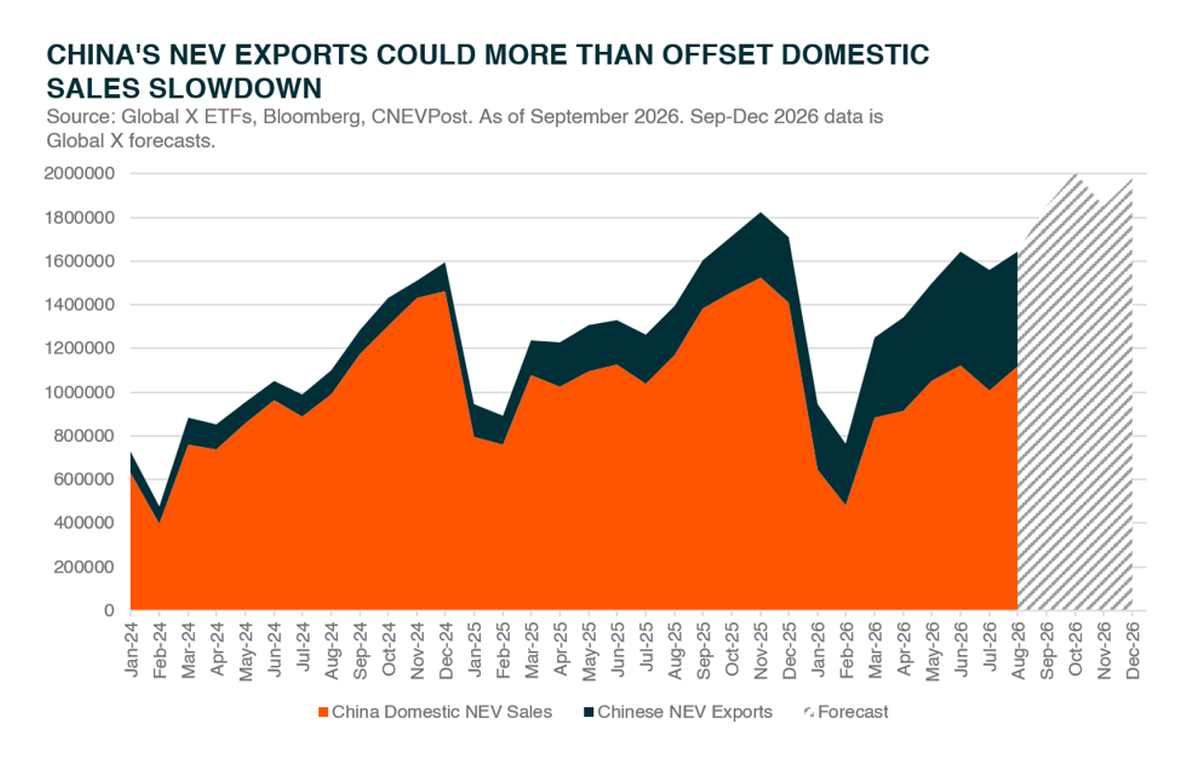
Forecasts are not guaranteed, and undue reliance should not be placed on them. This information is based on views reasonably held by Global X as at 25/09/2026.
None of this makes the picture perfect, but it is equally far from catastrophic. Total volumes still look set to grow, the mix is shifting toward the vehicles that carry the largest batteries, and Chinese manufacturers are capturing more of their growth overseas, all of which are incremental improvements that in our view are barely reflected in current market sentiment.
Concern 2: Suspended Battery Manufacturing Plant Development
The second concern is around recent news that Chinese regulators have suspended construction of new battery manufacturing projects pending a year end review of industry capacity. Markets have largely read the move as a negative for the battery industry and, by extension, for lithium demand. We think that reading confuses the capacity to make batteries with the demand for them, and that it may prove short sighted.
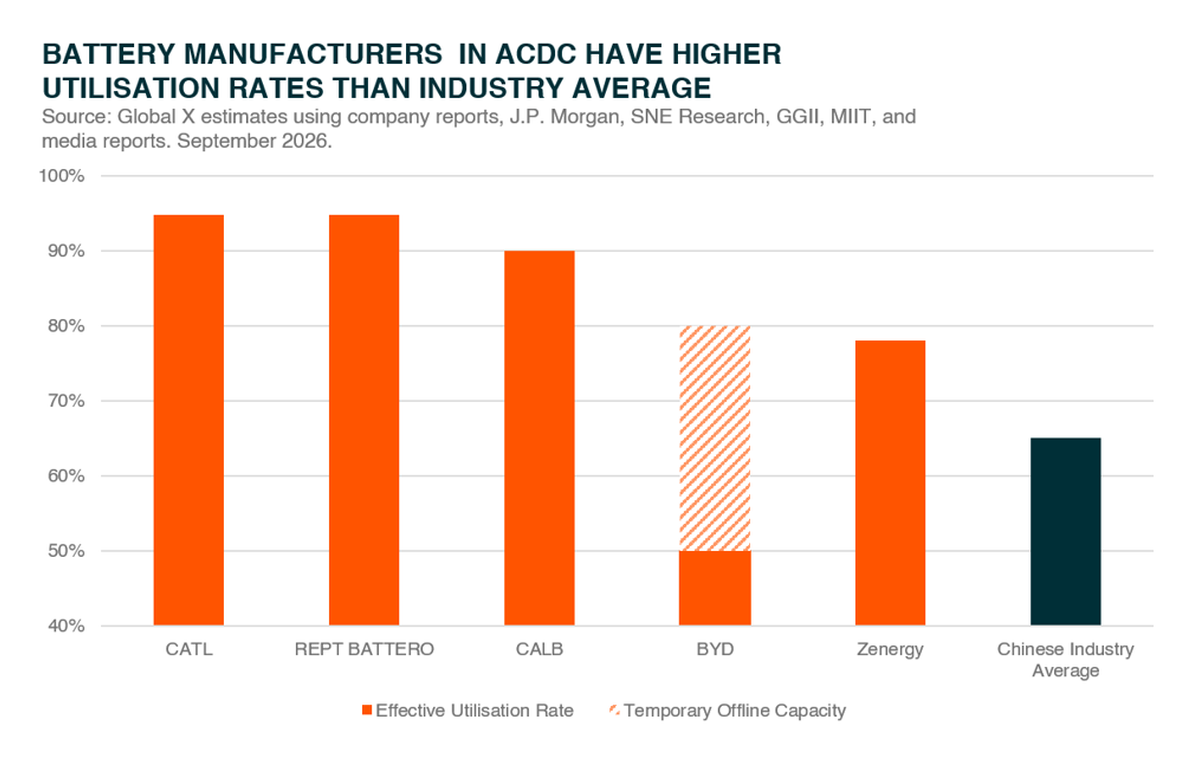
Analysts report the Chinese battery industry as running at an average utilisation rate of around 65%. With a third of existing capacity idle, output is limited by demand rather than by the number of factories. What idle capacity does though, is damage profitability, because producers running well below capacity tend to cut prices to keep their lines busy, feeding the price competition that Chinese policymakers call involution. According to media reports, the review is placing significant weight on utilisation, likely favouring expansions from companies with high utilisation and genuine demand while rejecting less efficient projects. Although temporarily disruptive, a policy of this kind could ultimately catalyse healthier industry consolidation by removing weaker players, encouraging more rational pricing and improving margins for the leaders.
Our analysis of the Chinese battery manufacturers held in ACDC shows that most operate well above the industry average, with CATL, REPT Battero and CALB at around 90% or higher. BYD is the exception, with a lower effective rate that reflects capacity which is temporarily offline. If the review does reward utilisation as reported, we believe these companies are more likely to emerge as beneficiaries of the change than as casualties of it.
Concern 3: AI Safety Concerns Slowing Datacentre Buildout
The final concern relates to AI datacentres, which are increasingly paired with ESS (Energy Storage Systems) for backup power and to smooth electricity supply, making their construction a growing source of battery demand alongside electric vehicles. The worry is that safety concerns raised by leading AI labs such as Anthropic and OpenAI could slow the datacentre buildout and, in turn, weaken demand for ESS. Here we see a disconnect between the market narrative and what is actually happening in the industry.
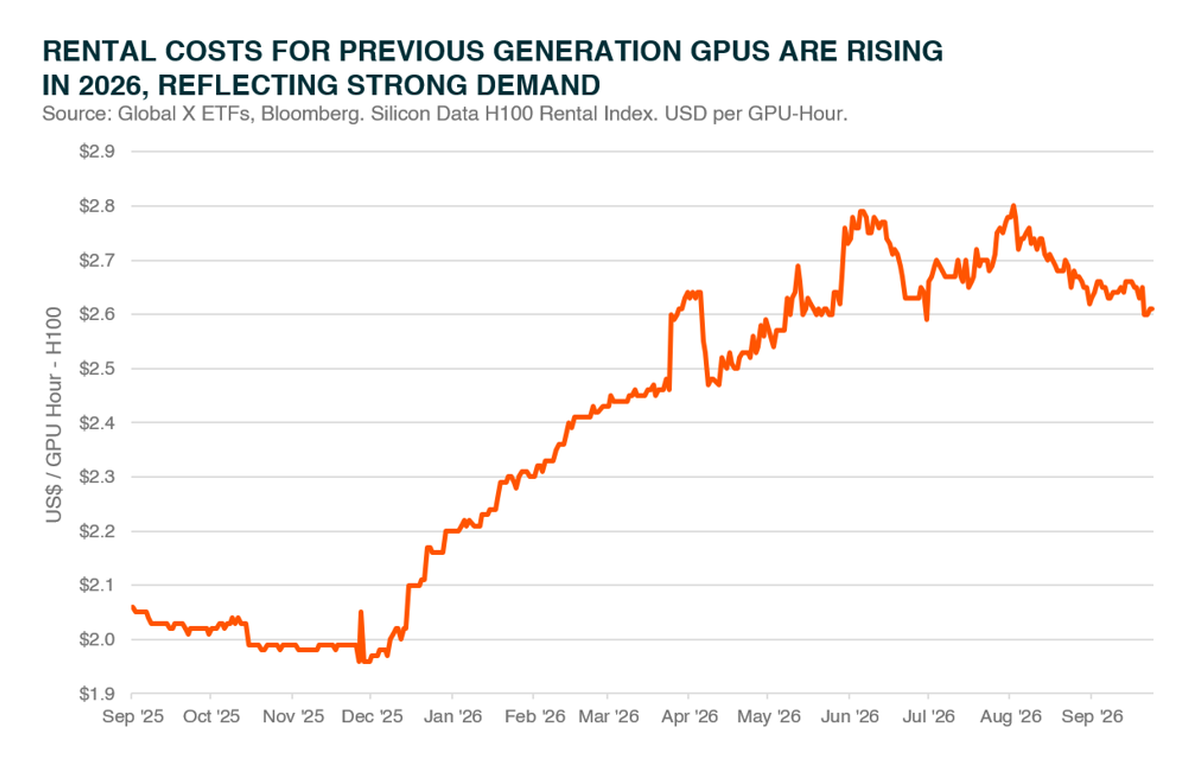
While the safety debate is a valid one, it concerns development at the frontier and has limited direct bearing on current datacentre demand. Datacentre demand today is driven by the use of models that already exist, and demand for those consumer and commercial models already far exceeds the computing capacity available to run them. The clearest evidence is the cost of renting older graphics processing units (GPUs), the chips on which these models run. If computing power were plentiful, previous generation GPUs would become cheaper to rent as newer ones arrived. Instead, the rental cost of one such chip, Nvidia’s H100, has risen from around US$2.00 per hour late last year to around US$2.60 per hour in September. From this perspective, the hyperscalers building these datacentres have little reason to slow construction materially because of concerns about frontier models that are not yet widely available and may never be.
The political pushback against datacentre development, particularly in the US, is the more legitimate concern. What tempers it, in our view, is that future capacity is becoming more geographically diversified. China is emerging as a major source of new development, with Alibaba announcing on 22 September plans to build 20GW of datacentre capacity by 2032, equivalent to almost 70% of China’s current capacity and roughly 15% of the planned global buildout as of 2026.1
Conclusion: When the Storm Passes
Taken together, the three concerns suggest that battery technology has not lost its growth story in 2026 so much as its clarity. When a theme is pulled in several directions at once, investors tend either to step away or to reach for the simplest signal available, and in our view this has left the sector trading more on noise than on the direction of its fundamentals.
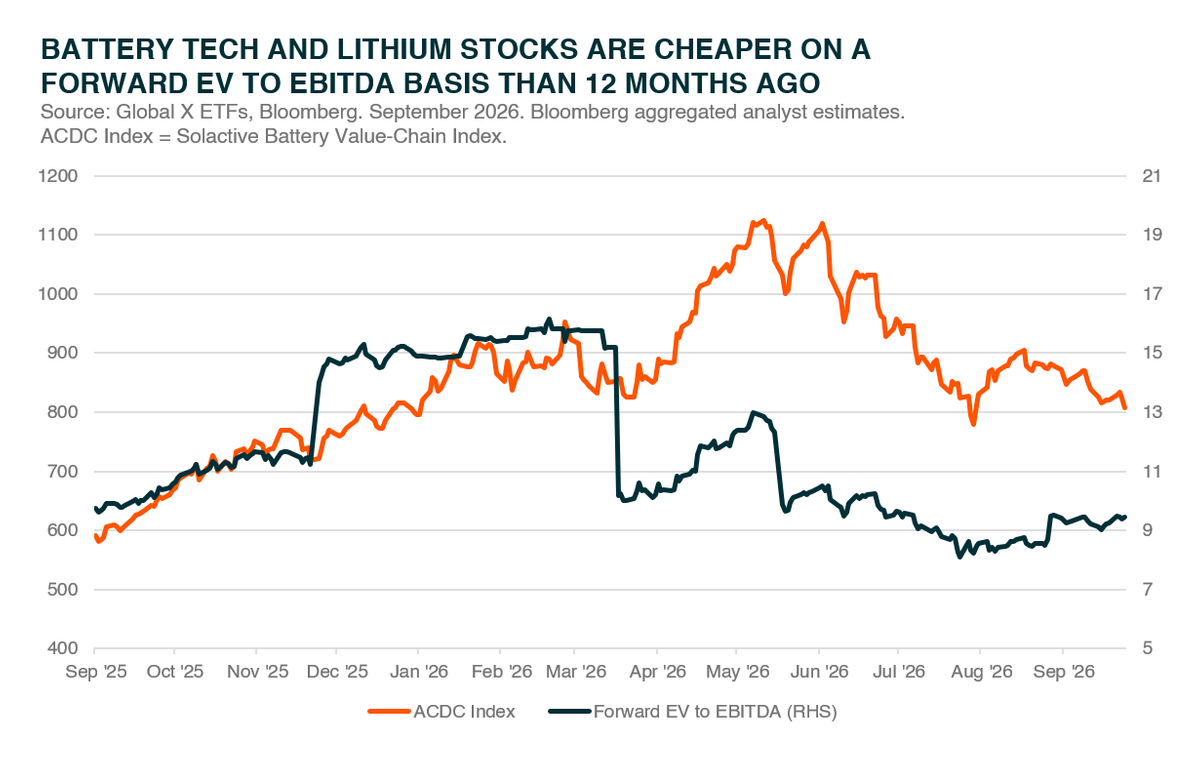
On the evidence as it stands, we believe the retreat in battery technology equities since May reflects a falling lithium price and a run of headlines more than any deterioration in demand for batteries. The index remains roughly 20% higher than 12 months ago, yet its forward enterprise value-to-EBITDA multiple is lower. This suggests earnings expectations have risen faster than prices, meaning investors may now be paying less for stronger-performing companies.
Risks to the thesis include: A further slow down in EV demand, persistent battery manufacturing overcapacity, weaker lithium prices or delays to datacentre investment.
Related Fund
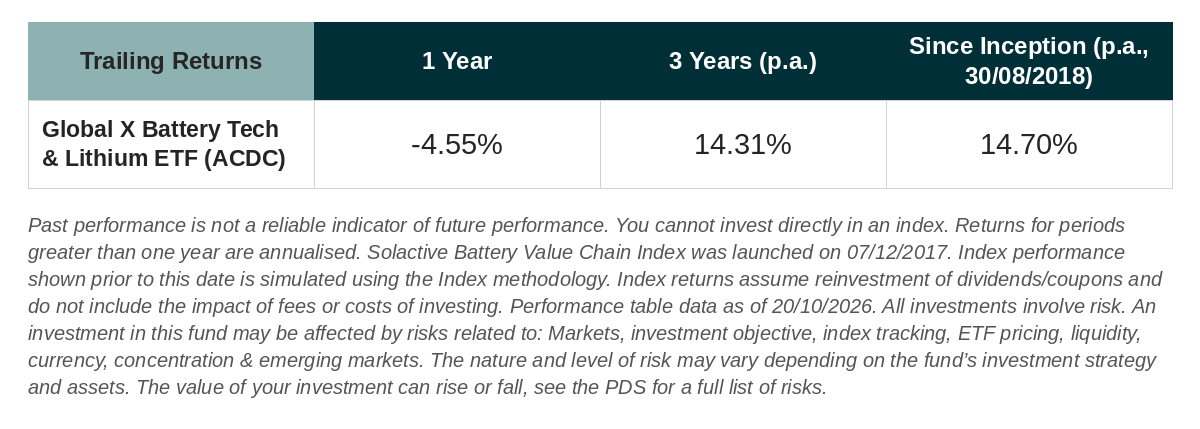
ACDC: The Global X Battery Tech & Lithium ETF (ACDC) offers investors exposure to global companies developing electro-chemical storage technology and mining companies producing battery-grade lithium.