China's rise over the past few decades has moved through distinct phases, each built on a different source of advantage. The first was manufacturing dominance, where labour cost, scale, and industrial skill let China become the world's factory. The second was the EV and battery era, where control of the upstream supply chain and sheer production scale let Chinese manufacturers under-price global competitors on cost per kilowatt hour and win share directly. Both phases shared a common mechanism. China built the cheapest capacity in the world and exported the surplus.
The third phase looks different, and the difference matters for how the opportunity should be priced. China does not have a cost advantage in AI compute. Export restrictions have kept it a step behind on raw silicon, and the compute gap in dollar terms is not closing, it is arguably widening as US hyperscaler capital expenditure continues to outpace China's by a wide margin. What China has instead is an efficiency advantage, the ability to extract more model intelligence per dollar of compute than the constraint would suggest is possible, then deploy that intelligence into the real economy faster than competitors can match1. That is a different kind of edge to the first two phases, and it is now showing up in places that can be measured rather than merely argued.
This piece sets out the case for China 3.0 across three areas where the evidence is now concrete. The pace of chip self-sufficiency, the shift from diffusing value to capturing it, and the underlying dominance in rare earth processing and energy buildout that supports the whole stack. A broader set of investable expressions of this shift, spanning the semiconductor supply chain and humanoid robotics specifically, forms the next layer of this thesis and will be addressed separately.
Key Takeaways
- China's AI edge is algorithmic and system-level rather than cost-based, closing the effective performance gap through architecture innovation and packaging even as the absolute compute capex gap versus the US continues to widen.
- Chinese AI labs are beginning to answer the value capture question directly, with overseas revenue exposure and rising API pricing power replacing the assumption that open-weight models simply diffuse value to others.
- Rare earth processing and energy buildout remain the least contested parts of the thesis, dominance that is already established rather than aspirational, and one that underwrites the rest of the stack regardless of how the chip race evolves.
Closing the Gap That Matters
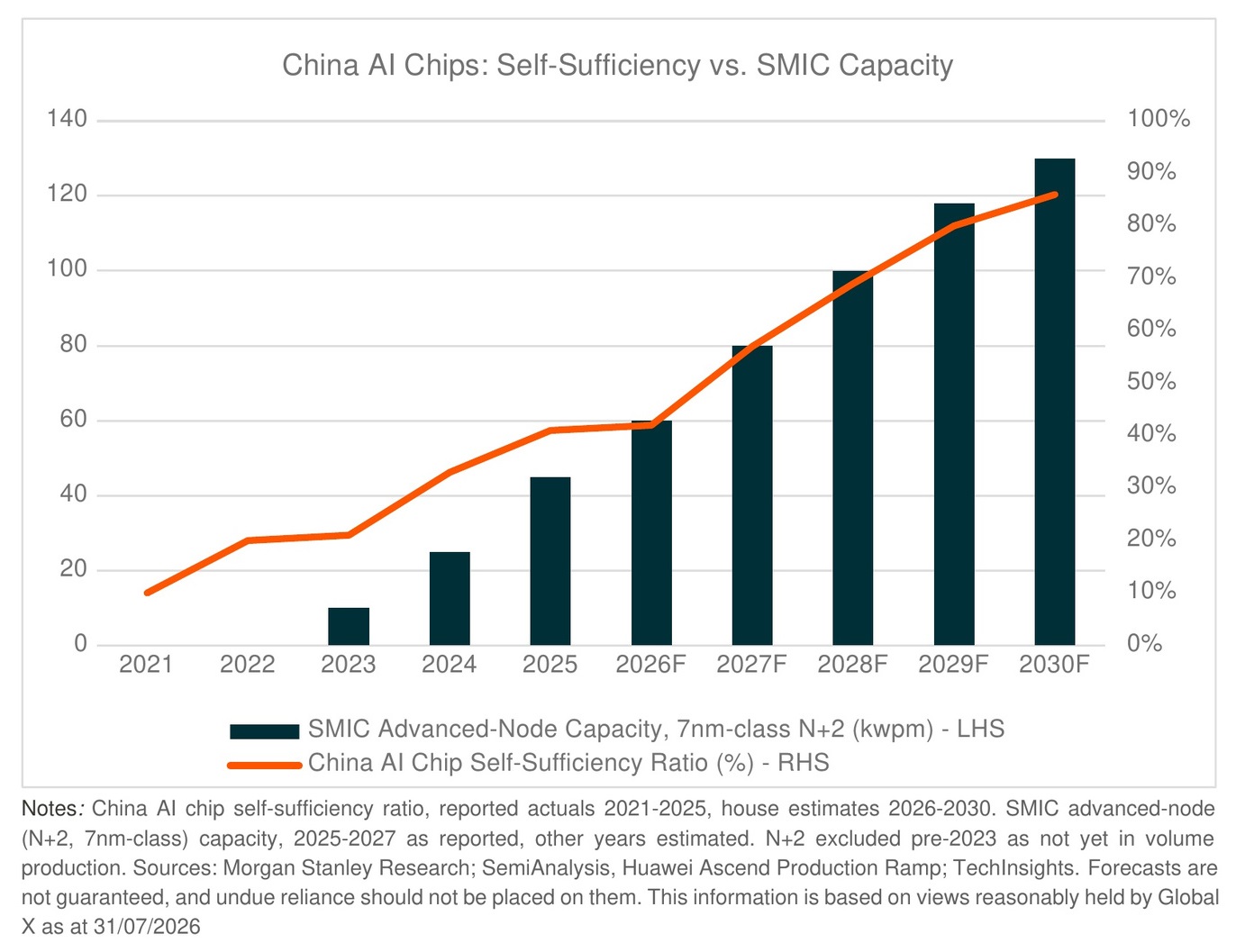
China's semiconductor self-sufficiency ratio, the share of domestic AI chip demand met by domestic production rather than imports, for AI chips is expected to move from roughly 41% in 2025 toward an estimated 86% by 2030, a trajectory built on Semiconductor Manufacturing International Corporation (SMIC)2, China's largest and most advanced domestic foundry, and a widening bench of domestic accelerator vendors. That climb is not being driven by China closing the leading-edge gap. Domestic silicon still lags US chips by roughly two process generations, and the binding constraint, lithography, has no credible domestic alternative at the frontier.
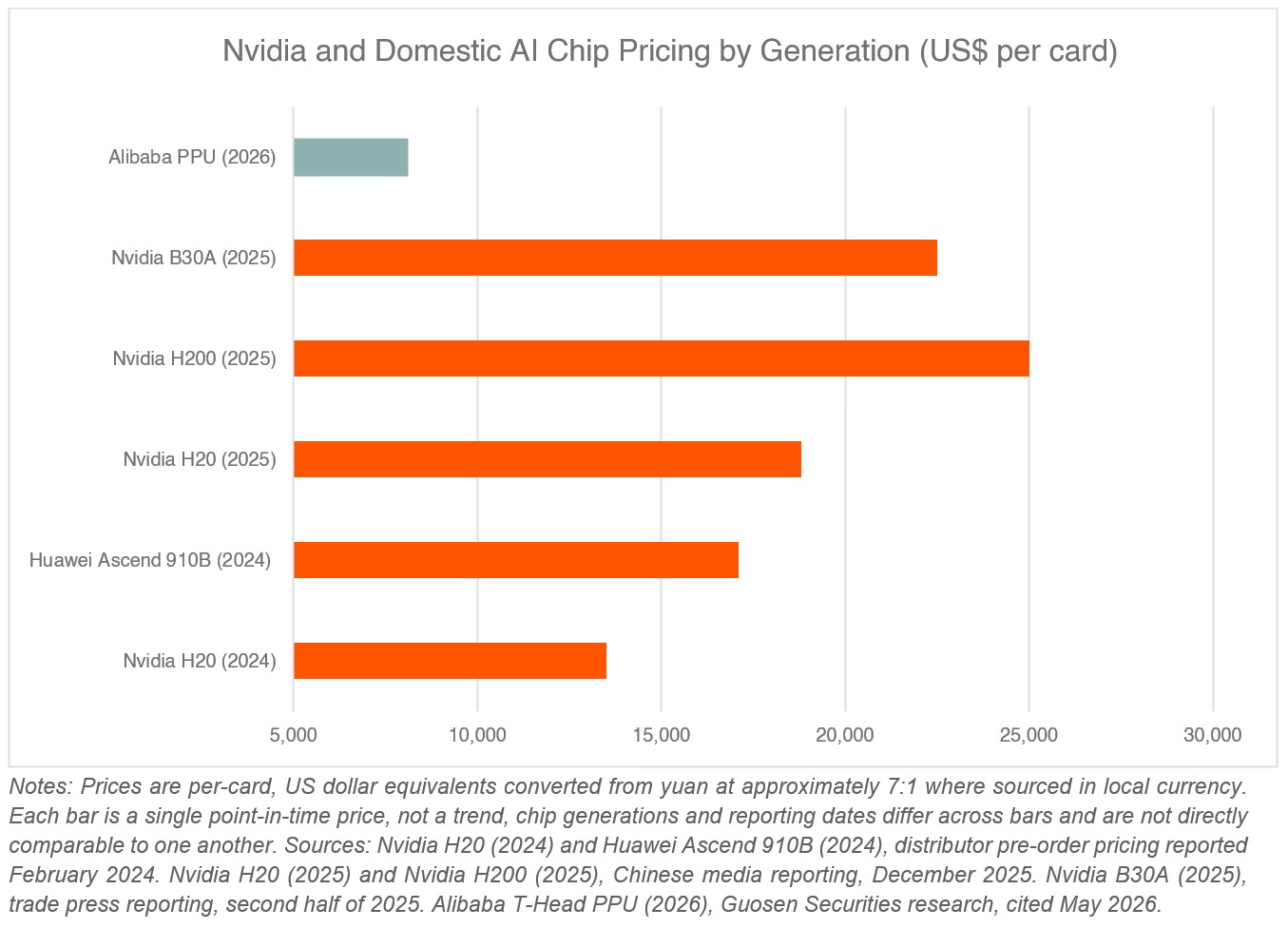
What is driving it instead is that the leading edge has stopped being the metric that decides competitiveness. System-level design is doing the work that raw chip performance can no longer do alone. Package more compute dies into a single chip if one die isn't powerful enough. Build larger racks and clusters if one chip isn't sufficient. Expand foundry capacity if a single fab can't meet demand. Huawei's CloudMatrix SuperPod is the clearest expression of this approach in production. At the system level, CloudMatrix already delivers roughly double the throughput of Nvidia's GB200 NVL72 rack, achieved through nearly five times the accelerator count rather than any advantage in individual chip performance.3 Domestic chip pricing is reinforcing the same shift. Alibaba's T-Head Parallel Processing Unit, built on a domestic 7nm process, is priced roughly 40% below Nvidia's China-market H204, giving Chinese buyers a cost advantage on hardware even where a performance gap remains. China is not closing the compute gap in the way the market expects. It is making the gap less relevant to the outcome that matters, cost per unit of useful intelligence delivered.
From Diffusion to Capture
The open question hanging over China’s AI sector has always been whether the country’s AI capability would translate into captured economic value or simply diffuse globally through open-weight models that other markets adopt for free. Early evidence suggests the answer is more constructive than the bear case assumed. MiniMax, one of China's leading AI labs, now derives over 70% of its revenue from overseas markets5, a direct signal that Chinese AI companies are competing and winning share internationally rather than only serving the domestic market others can freely copy from.
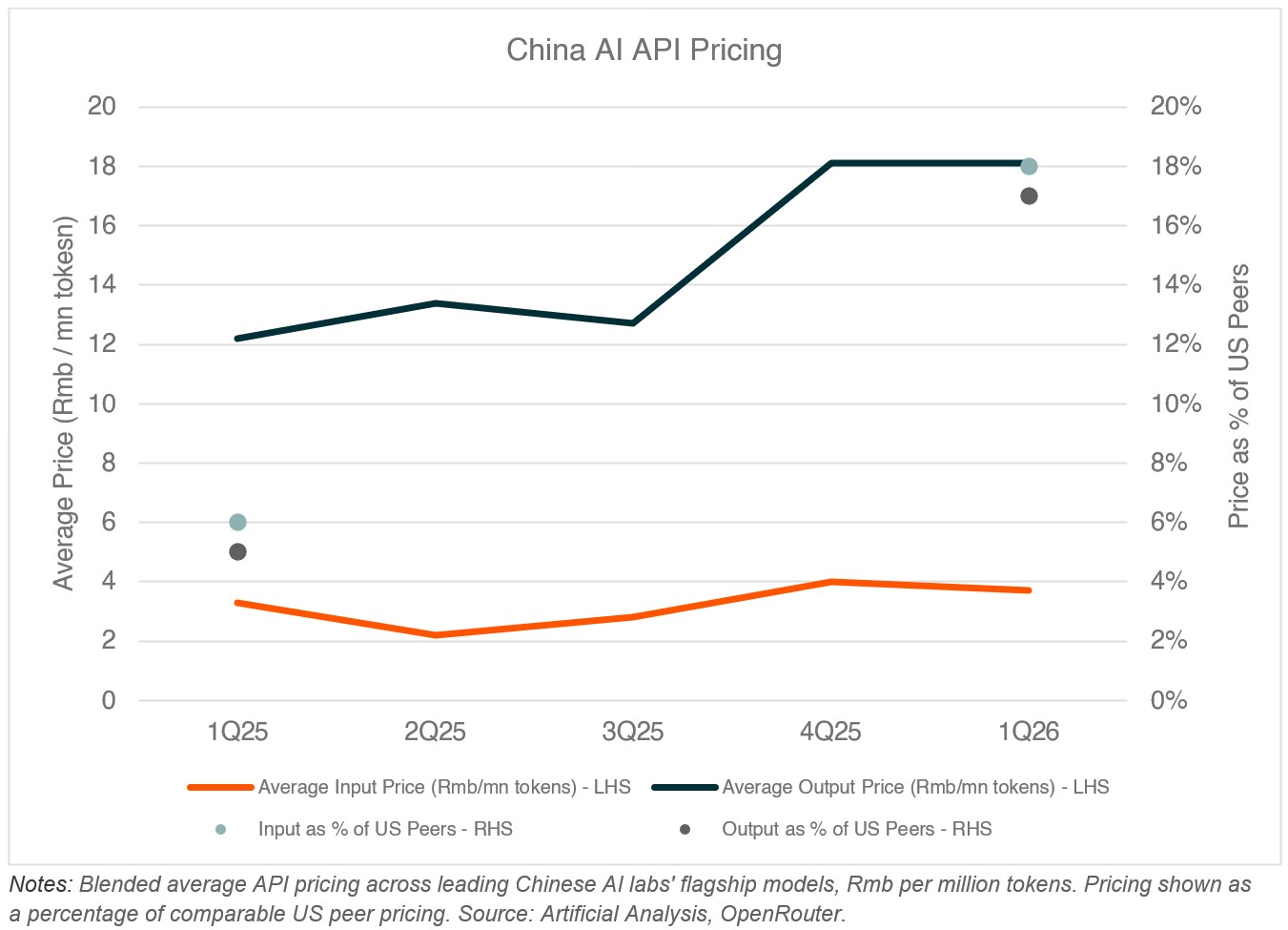
Pricing behaviour reinforces the same point. After a prolonged price war that saw Chinese labs cut API pricing by 70-90% through 2024, leading players including Alibaba, ByteDance, Tencent, MiniMax, and Z.ai have raised prices on new flagship models since the third quarter of last year, with average input pricing up roughly 80% and output pricing up around 36% over that period. Z.ai’s pricing has more than tripled across successive model releases. This is not a return to cost-plus competition, it reflects rising confidence that model intelligence itself commands a premium customers are willing to pay, the first sign that China’s AI sector is shifting from a commoditised cost story toward a monetisation story. It remains early, and concentrated in a small number of labs, but it is the clearest evidence yet that China's AI dominance can be captured rather than only diffused6.
The Edge Already Won
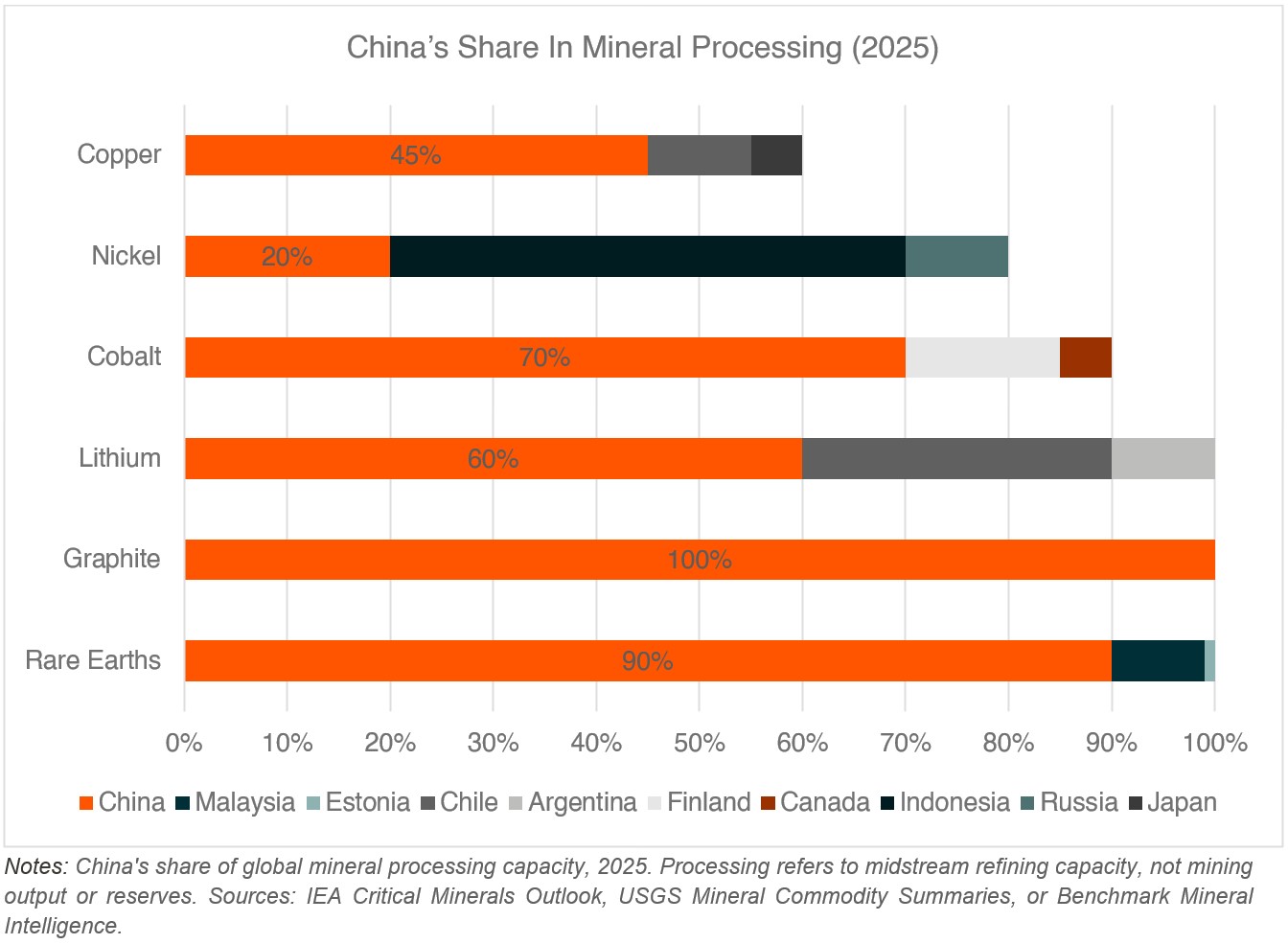
Where the chip debate is genuinely contested, the rare earth and energy layer of the thesis is not. China controls roughly 85-90% of global rare earth processing capacity, a dominance built on refining infrastructure rather than reserves alone, and one that gives China leverage over the rest of the world’s advanced manufacturing and defence supply chains independent of how the semiconductor race plays out7.
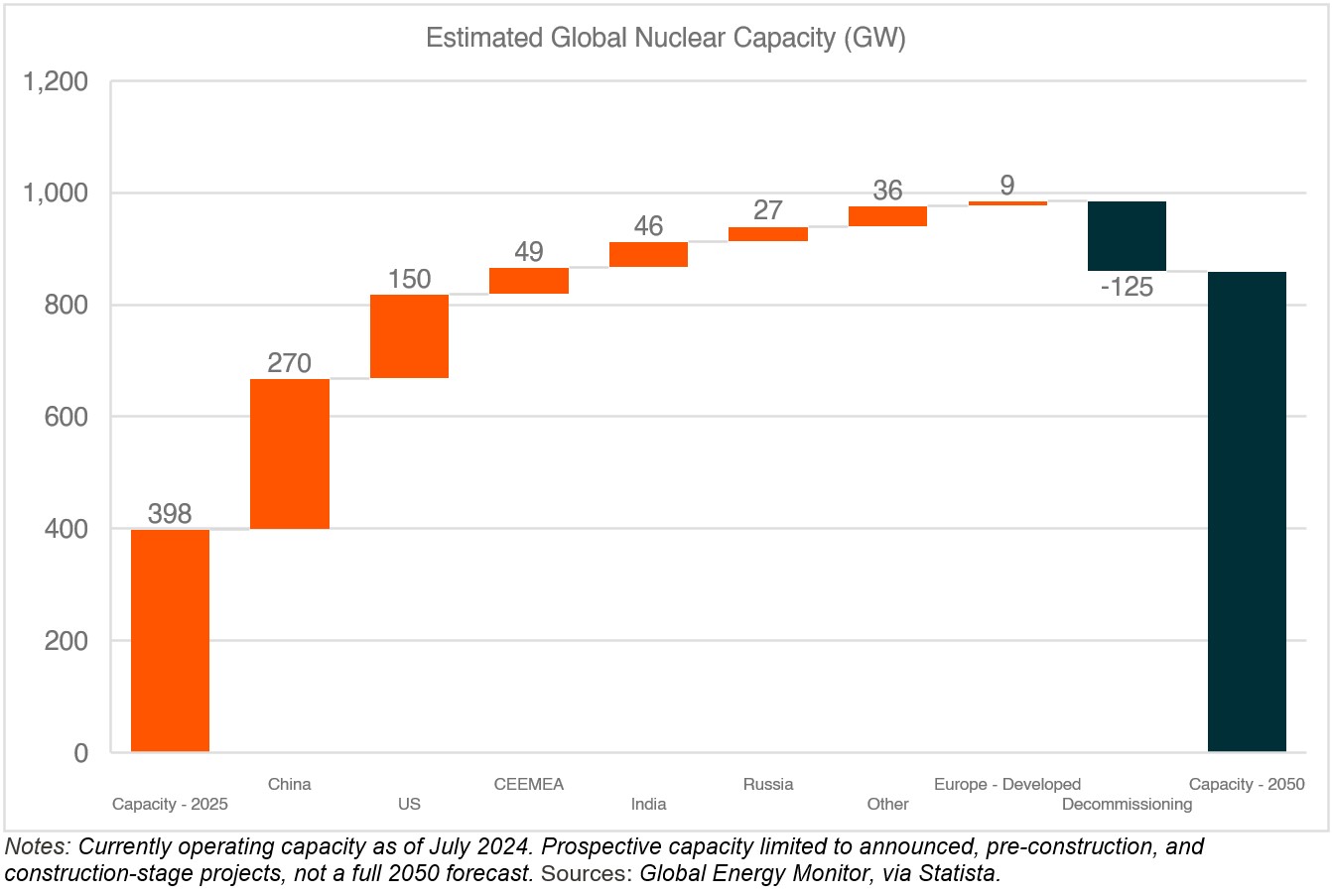
The same applies to energy. China’s data centre power buildout and nuclear commissioning schedule are running at a pace no other market can currently match. Of the roughly 460 GW of net new nuclear capacity expected globally between 2025 and 2050, China accounts for roughly 270 GW of it, nearly double the next largest contributor, the United States at 150 GW, and more than the rest of the world’s regional additions combined. This is a structural advantage given that power, not compute, is increasingly the binding constraint on AI infrastructure buildout globally. This is the part of the China 3.0 thesis that requires the least interpretation. It is already true, it does not depend on a future technology breakthrough to be realised, and it underwrites the viability of everything else in the stack, from chip fabrication to data centre expansion to the humanoid and robotics buildout that represents the next chapter of this story.
Accessing New Tang Dynasty for China Tech
The Tang Dynasty was China’s high point, the era when it led the world in trade, technology, and culture. It didn’t win by matching rivals head for head. It won by building a system so far ahead on execution that the rest of the world came to it. China’s AI sector is running the same playbook. It doesn’t need to out-spend the US on compute to win this decade, it needs to keep extracting more from every dollar it does spend, and keep that value onshore. That shift is already underway, and the market has barely begun to price it.
The Global X China Tech ETF (DRGN) provides exposure to platforms, model developers, and infrastructure names turning China’s efficiency edge into earnings. Investors who identify this shift early may be better positioned as the implications of China’s AI development become more widely reflected in market pricing.
Considerations for investing in DRGN
As with all investments, an investment in DRGN has risks - see the PDS for more information. This fund may expose investors to currency risk, sector risk, concentration risk, and/or market risk. Different investment strategies carry different risks, depending on the assets that make up the strategy. The value of your investment may fall, you may receive back less than your original investment.