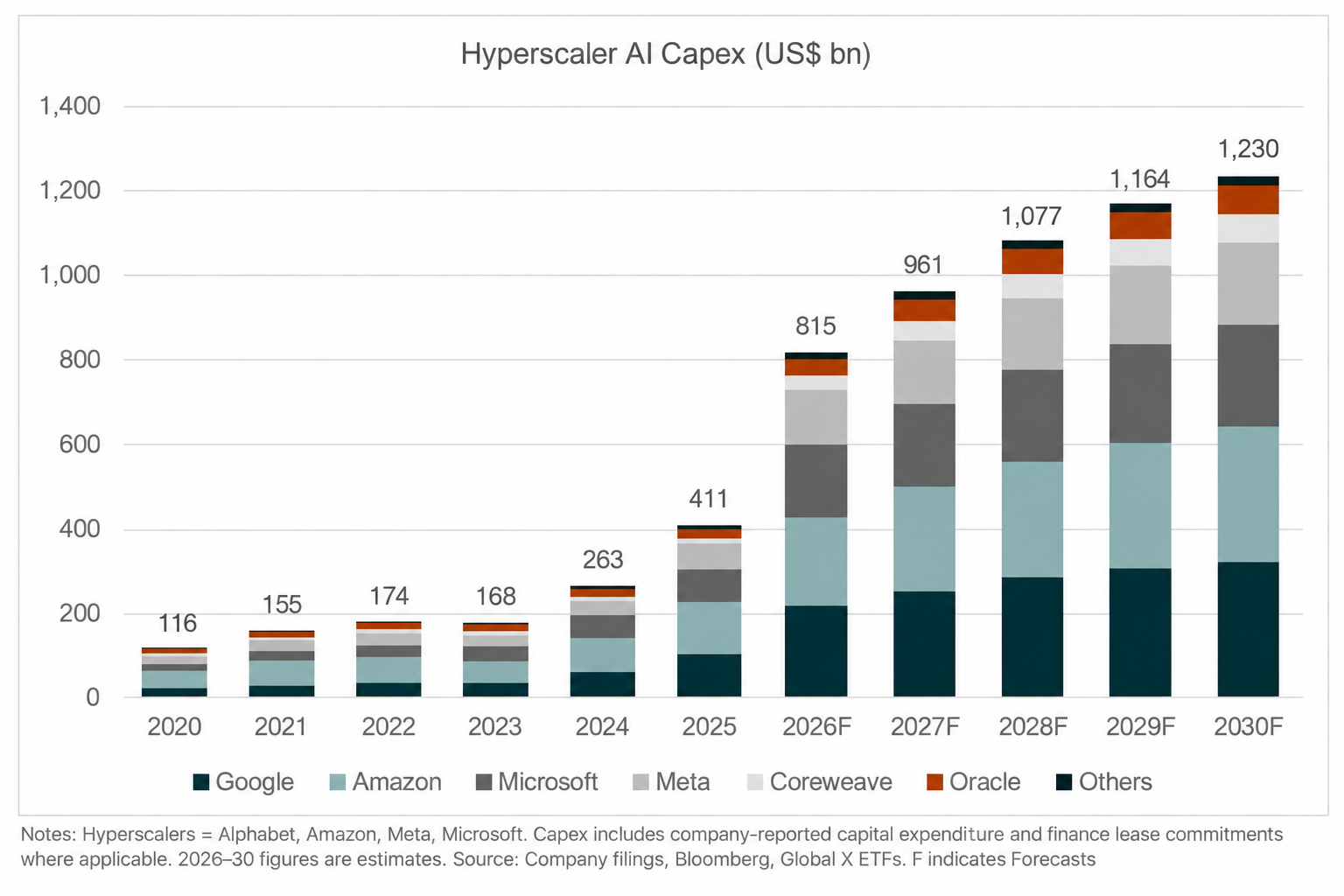
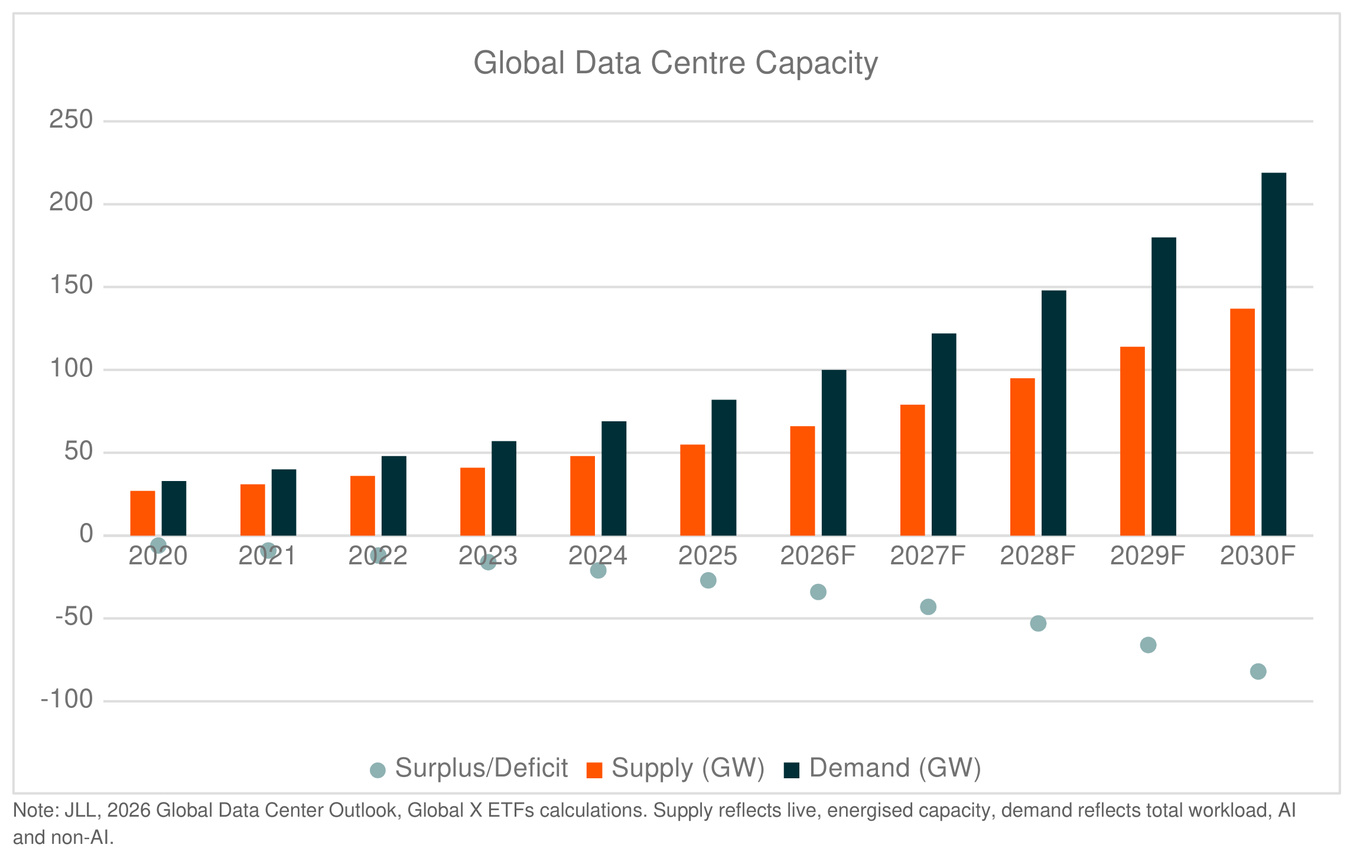
For the past two years the AI trade has been told as a chip story. It is now also a materials, energy and industrial story. Physical AI, power, land, cooling, electrical systems, now accounts for 40% of hyperscaler capex1, a share that has scaled alongside a capex base that has grown from US$116bn in 2020 to an estimated US$1 trillion by 2030, and the investable exposure is broadening with it. Data centre demand has outrun supply every year since 2020, and the deficit is forecast to keep widening through 2030 even as compute capacity itself continues to scale. Copper demand tied to that build is on track to almost triple by 20302, a reminder that the data centre has to be built, physically, with land, power, cooling and materials, well before a single chip runs inside it.
The sovereign capital thesis we laid out in The Security Premium identified a world in which governments are no longer asking which supplier is cheapest but which supply chains they can control and what it costs to own strategic capacity rather than rent it from the global market. AI infrastructure sits at the layer of that thesis where capital intensity has quietly detached from the chip, and the shift is no longer theoretical. Governments and sovereign wealth funds are now funding the physical build directly rather than waiting for the hyperscalers to do it alone, and that take-up is happening faster than the market has priced.
Key Takeaways
- Hyperscaler AI capex is on track to rise from roughly US$116bn in 2020 to more than US$1 trillion by 2030, and physical infrastructure now accounts for around 40% of that spend alongside it3.
- Data centre power demand has outrun supply every year since 2020, and the shortfall is forecast to keep widening through 2030, turning capacity into a structural holding rather than a cyclical trade4.
- Governments and sovereign wealth funds committed more than US$100bn combined to national compute and AI infrastructure programs in 2026 alone, treating the physical layer as a security asset rather than a private sector cost.
The Physical Cost of Intelligence Now Matches the Chip
Hyperscaler AI capital expenditure has moved from a rounding error to one of the largest capital cycles in corporate history. Spend has grown from roughly US$116bn in 2020 to an estimated US$1,091bn by 2030, expanding almost every year through the forecast period. What has changed is not just the size of the number but its composition. Physical AI, the land, power generation, shell and construction, cooling, and electrical systems required to house and run compute, now makes up around 40% of total AI spending, alongside the 60% spent on compute itself.
That is a meaningful shift in where value and risk sit. A GPU can be replaced by a faster GPU within a product cycle. A grid connection, a cooling system, or a hyperscale site cannot be built or replaced on the same timeline, and the companies supplying the power generation equipment, electrical systems, and cooling infrastructure behind that build capture a durable, repeat stream of revenue from every hyperscale project regardless of which model or chip architecture eventually leads. This is a picks and shovels exposure to the buildout, and it mirrors the same dynamic that reshaped defence and domestic manufacturing after 2020, when governments concluded that securing physical capacity mattered more than buying the cheapest input in the moment5.
A Structural Deficit That Governments Are Now Funding Directly
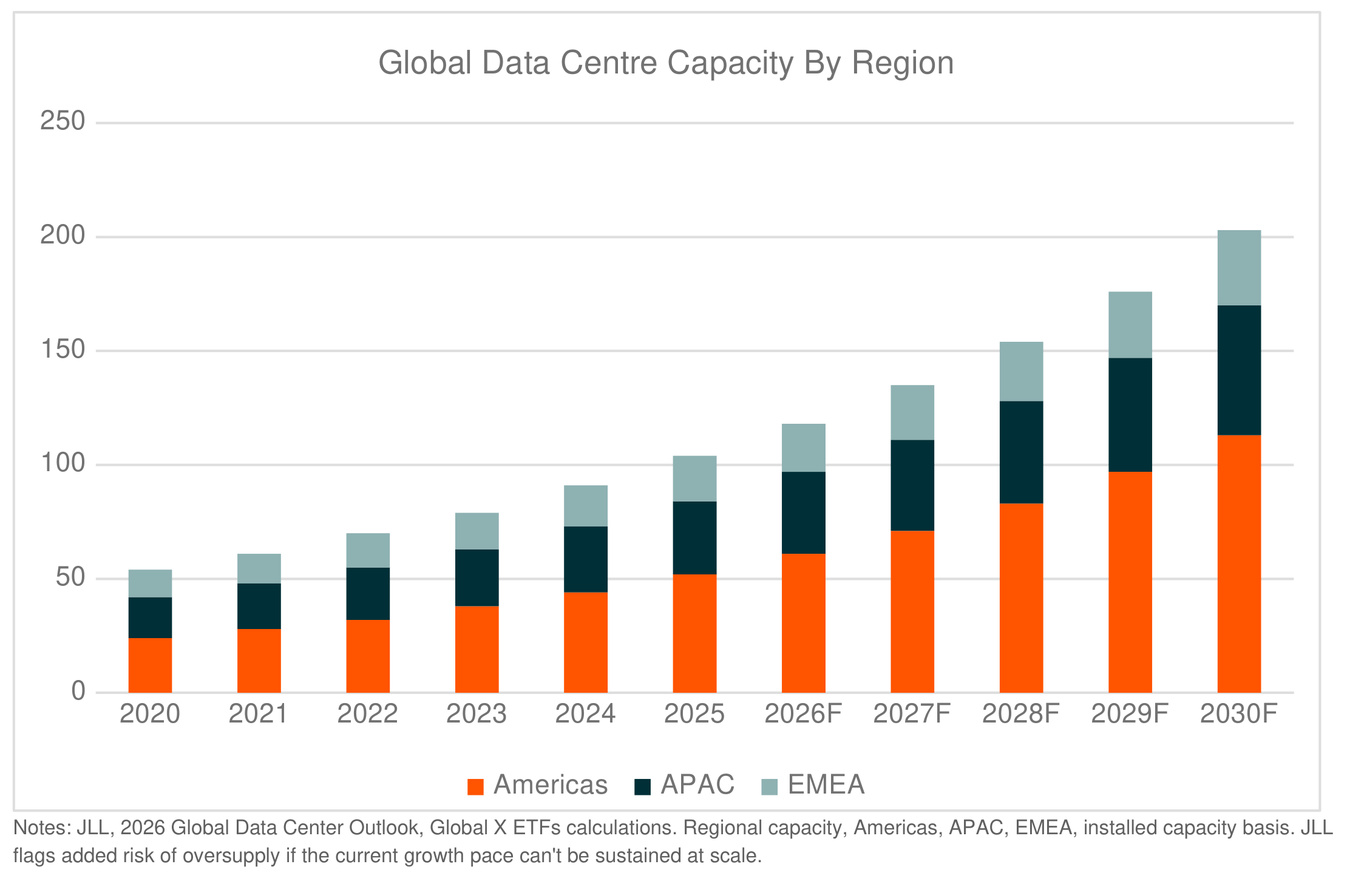
Data centre demand has outrun supply every year since 2020, and the gap is not closing. Global data centre supply and demand have both grown steadily through the forecast period, but demand has grown faster in every single year, pushing the surplus further into deficit as the decade progresses. The Americas leads the physical buildout, but APAC and EMEA are scaling capacity in parallel rather than lagging behind, which points to a shortage that is global rather than regional in nature.
The materials required to close that gap are themselves in tightening supply. Data centre copper demand is expected to rise from around 41 thousand tonnes in 2023 to roughly 112 thousand tonnes by 2030, as copper intensity per megawatt of new hyperscale build rises alongside the volume of build itself. Data centres currently account for a small share of total global copper demand, but that share is expected to rise from around 1% in 2025 to roughly 6% by 2050, adding a second, multi-decade source of demand on top of the electrification and grid investment that was already underway6.
Governments have responded by funding compute capacity directly rather than leaving it to private capital alone. China is reportedly preparing to spend around 2 trillion yuan, or roughly US$295bn, over the next five years on a nationwide network of state-run AI data centres, according to Bloomberg. The UK government has committed more than £1.1bn (approximately US$1.5bn) to a sovereign AI hardware and national supercomputer program, Canada has launched an AI Sovereign Compute Infrastructure Program worth close to US$890m, and sovereign wealth funds across the Gulf and Asia are estimated to have committed on the order of US$120bn to AI and digital infrastructure across 2025 and 2026, including the US$30bn AI Infrastructure Partnership involving BlackRock, MGX, and Microsoft, and a US$20bn joint venture between the Qatar Investment Authority and Brookfield. This is capital being deployed for reasons of national capability and data control, not near term return, which is the same signature that defined post-2020 defence and infrastructure spending.
Baseload Power Becomes the Swing Factor
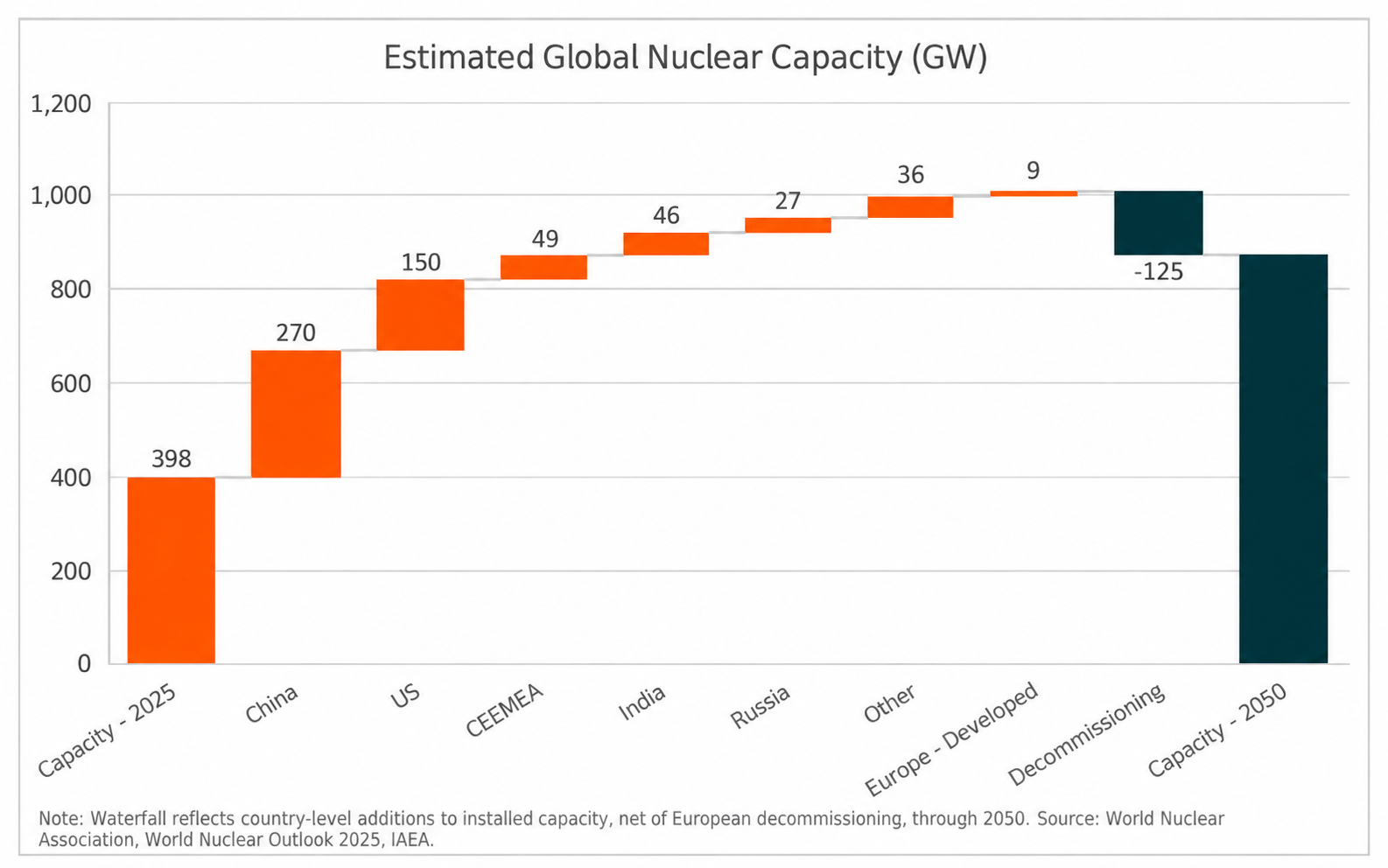
Compute capacity is only as useful as the power available to run it, and AI driven demand is now colliding with a baseload problem that predates AI by decades. Estimated global nuclear capacity is set to grow from around 398GW today to close to 860GW by 2050 on a net basis, even after accounting for roughly 125GW of decommissioning across ageing fleets, largely developed Europe7. China and the US account for the bulk of that net growth, adding an estimated 270GW and 150GW respectively, with India, CEEMEA (Central and Eastern Europe, Middle East, and Africa), and Russia contributing smaller but still meaningful increments8.
Nuclear is widely seen as the only source of scalable, low emission baseload capable of supporting AI driven electricity growth at the pace currently being forecast, which is why it has moved from a niche ESG debate to a mainstream input in national AI strategy. A government that wants sovereign AI capability now has to underwrite the power behind it, and that is increasingly showing up as direct public investment in generation and grid capacity alongside the compute programs described above.
Accessing the Data Centre Buildout
The data centre buildout is the third expression of the same regime shift that our Security Premium case identified in hard power and domestic infrastructure. AI infrastructure has become a strategic consideration in its own right, with data centre capacity, power infrastructure, and the physical networks supporting AI workloads now funded as critical capacity rather than a private sector cost line. The Global X Artificial Intelligence Infrastructure ETF (AINF) captures this layer through the companies building and equipping the data centre itself, energy, materials, and infrastructure, rather than the chips running inside it.
Held alongside the Global X Defence Tech ETF (DTEC) and the Global X US Infrastructure ETF (PAVE), Global X Artificial Intelligence ETF (AINF) completes a set of three products that do not compete for the same dollar. Each captures a different physical layer of the same structural shift, hard power, domestic physical capacity, and the data centre buildout, and each is being funded by the same underlying logic that strategic capability is worth paying for regardless of where the economic cycle sits.
The physical cost of intelligence has become the larger bet, and the assets required to meet it are already being built.
Considerations for investing in AINF, DTEC or PAVE
As with all investments, an investment in AINF, PAVE or DTEC has risks - see the PDS for more information. This fund may expose investors to currency risk, sector risk, concentration risk, and/or market risk. Different investment strategies carry different risks, depending on the assets that make up the strategy. The value of your investment may fall, you may receive back less than your original investment.