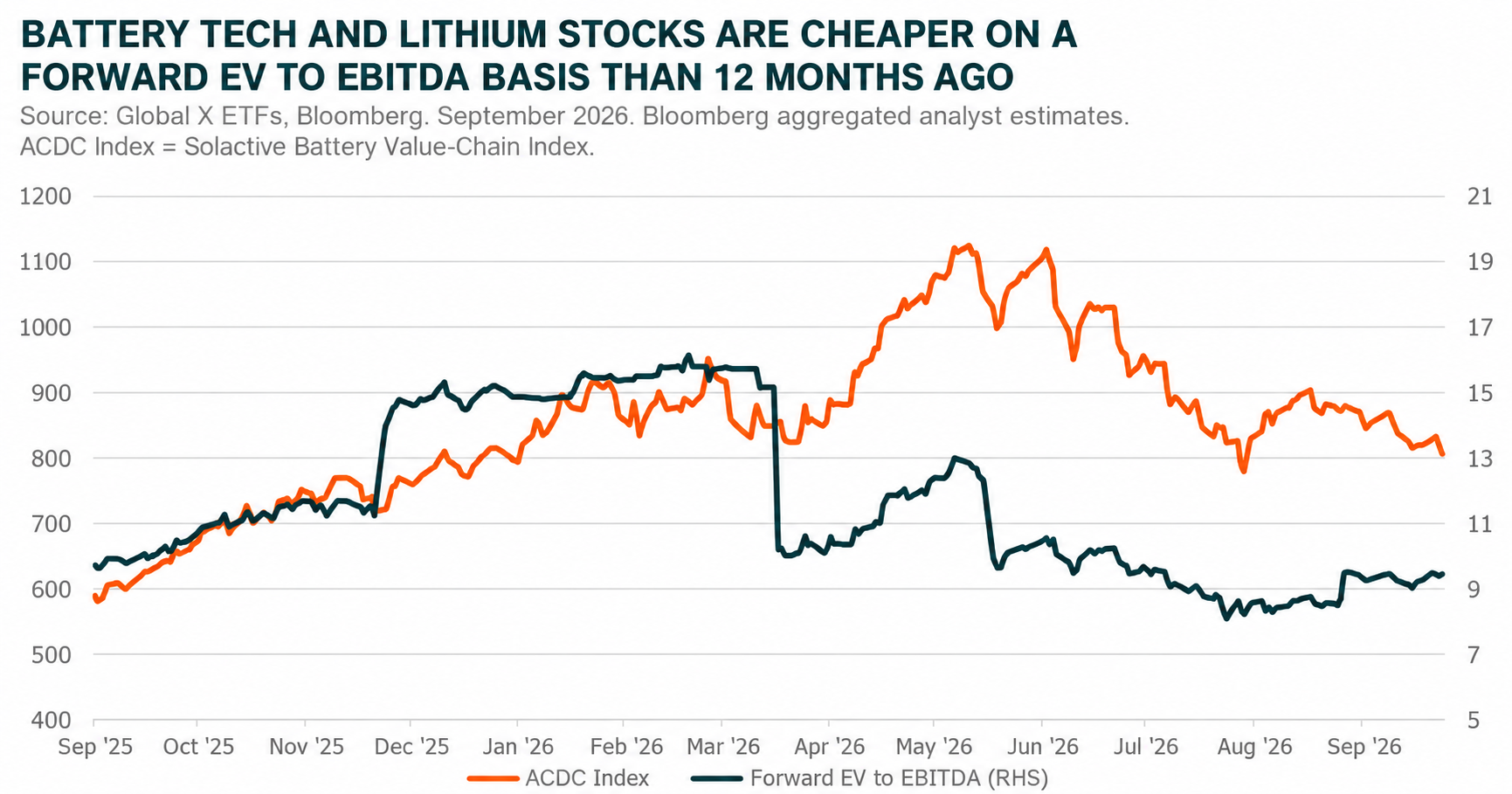
Battery technology and lithium stocks have had a rollercoaster year, rising more than 40% at one point during the Iran War before sliding back toward flat year-to-date performance by the end of Q3. To us, this wide range in price action reflects the numerous, and often conflicting, narratives currently surrounding the battery technology industry, which may have encouraged investors to favour “cleaner”, less convoluted thematic opportunities elsewhere.
However, as we enter the final quarter of the year, we believe sentiment toward battery technology and lithium has become overly negative. In this note, we outline the three key concerns weighing on the thematic, address each in turn, and explain why we believe the market reaction may be overstating the risks.
Key Takeaways:
- Battery technology equities have become overly reliant on lithium prices for direction in 2026, causing commodity moves to disproportionately drive the broader thematic despite increasingly divergent fundamentals.
- Key concerns include weaker China NEV sales, tighter battery plant approvals and fears of slower AI datacentre buildout. We see these risks as valid, but increasingly overstated.
- Industry fundamentals may be turning: EV pricing is improving, battery consolidation could support margins, and AI datacentre development is broadening.
Lost in the Storm
Battery tech investors have been forced to navigate an unusually mixed set of signals over the past year. On one hand, the thematic continues to benefit from powerful long-term growth drivers and, at times, highly bullish catalysts such as the Iran War driven petrol shock. On the other, tactically negative news flow around China, industry capacity and the durability of AI-related demand has repeatedly challenged sentiment.
We believe this uncertainty has produced two main outcomes. First, some investors have simply rotated toward themes with a clearer near-term narrative, such as hard assets or AI hardware. Second, others have increasingly relied on external pricing signals, particularly lithium prices, as a shortcut for valuing the broader battery technology complex.
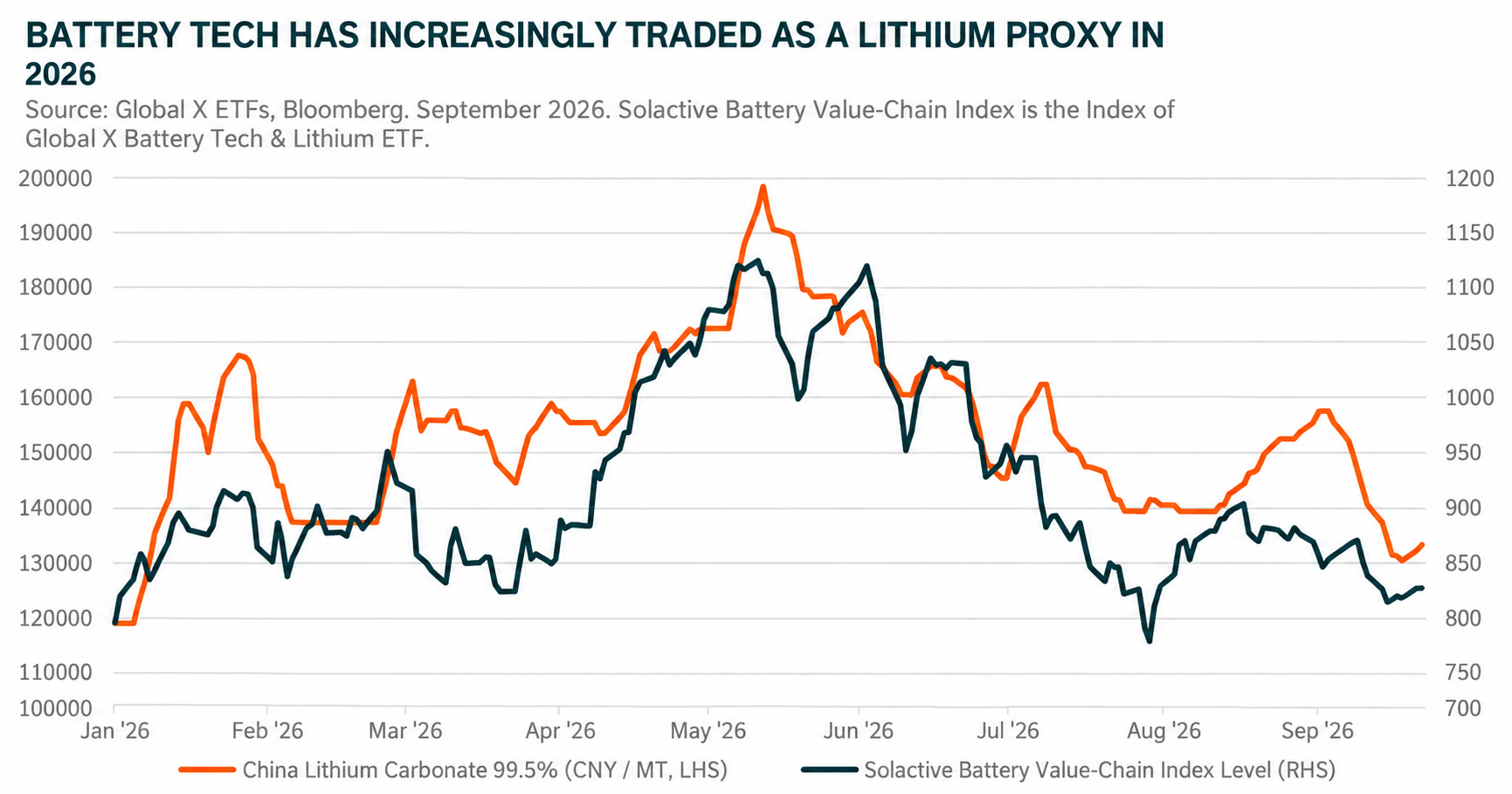
Past performance is not a reliable indicator of future performance. You cannot invest directly in an index. Returns for periods greater than one year are annualised. Solactive Battery Value Chain Index was launched on 07/12/2017. Index performance shown prior to this date is simulated using the Index methodology. Index returns assume reinvestment of dividends/coupons and do not include the impact of fees or costs of investing.
The result has been a rather unusual market pattern in 2026. The thematic surged by around 40% in the first half of the year, only to give back nearly all of those gains by the end of Q3. In our view, that reversal appears difficult to reconcile with the broader fundamentals, including accelerating global EV adoption, the likelihood of stronger clean energy investment following the Iran War, and continued growth in AI datacentre buildout.
Below, we examine the three key developments that have weighed most heavily on sentiment and explain why we believe the market may be overstating their impact on the broader battery technology thematic.
Concern 1: Domestic NEV Sales Have Slowed in China
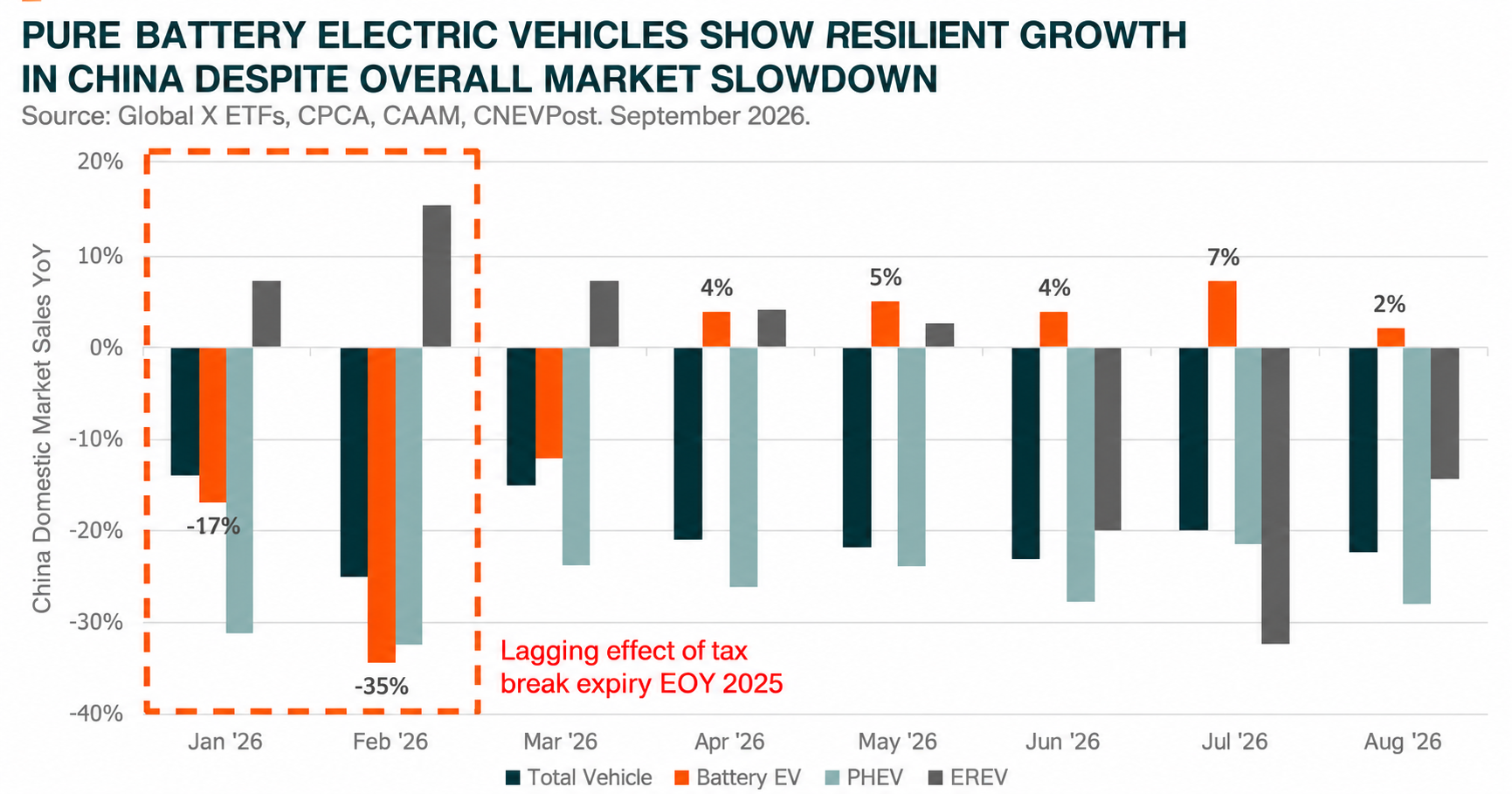
The first major narrative dissonance this year has been the apparent “collapse” in NEV (New Energy Vehicles) sales within China’s domestic market, even as NEV adoption has accelerated across much of the rest of the world. We do not dispute that Chinese sales have slowed, but the picture looks considerably less negative once the weakness is put into context.
First, much of China’s slowdown was concentrated in the first two months of the year, likely reflecting the lagged impact of NEV tax concessions expiring at the end of 2025 alongside a broader slowdown in private vehicle purchases. More importantly, even against this softer backdrop, pure BEV (Battery Electric Vehicles) sales have returned to year-on-year growth since April. In our view, this provides further evidence that the Iran War has truly accelerated the shift toward fully electric vehicles everywhere, no doubt a meaningful tailwind for long-term lithium demand given their larger battery requirements.
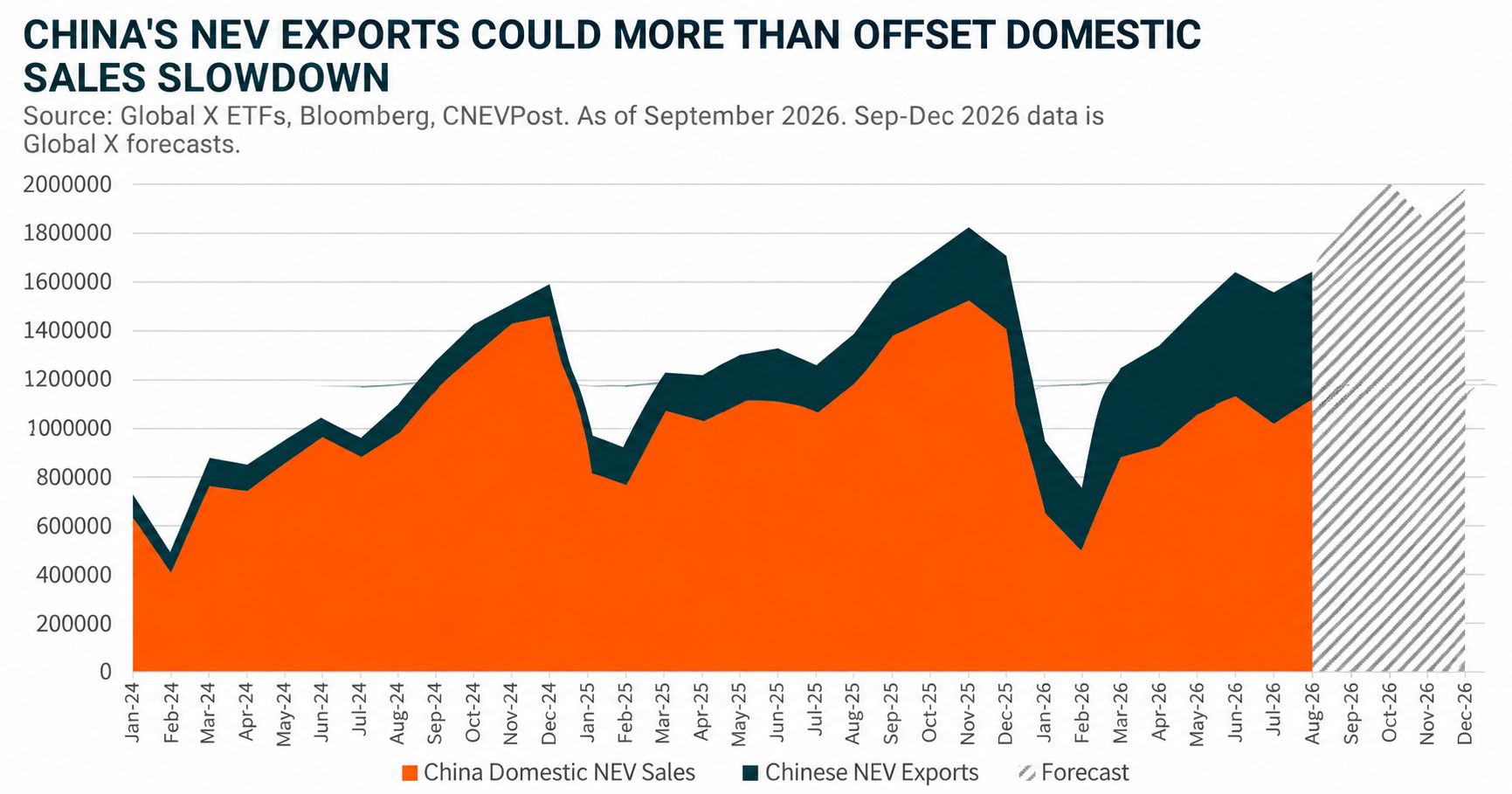
Second, while China is now the world’s largest NEV market and a domestic slowdown is meaningful, accelerating adoption worldwide is more than offsetting the weakness. Chinese domestic NEV sales are down around 10% year-on-year YTD (as of August 2026), but exports have risen by more than 120%. Combined, exports and domestic sales still point to another year of growth for China’s NEV industry in 2026.
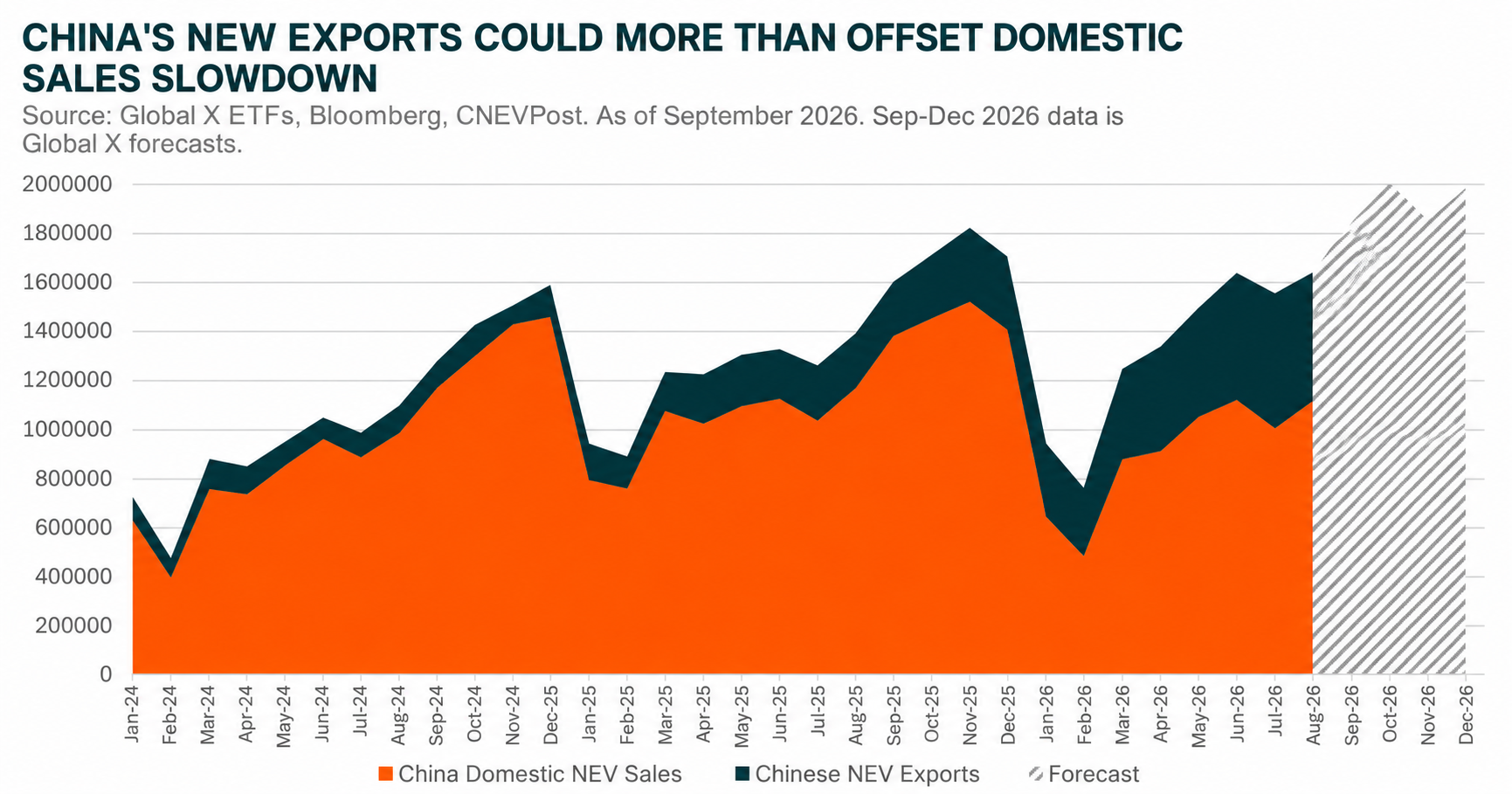
Forecasts are not guaranteed, and undue reliance should not be placed on them. This information is based on views reasonably held by Global X as at 25/09/2026.
The picture is far from perfect, but it is equally far from catastrophic. Underlying demand continues to expand, BEV penetration is improving and Chinese manufacturers are increasingly capturing growth overseas - incremental improvements that, in our view, are barely reflected in current market sentiment.
Concern 2: China Suspends Battery Manufacturing Plant Development
The second major concern in markets, with direct implications for both lithium and battery names, is recent news that Chinese regulators have suspended construction of new battery manufacturing projects pending a year-end review of industry capacity. Markets have largely interpreted the move as a negative for the battery industry and, naturally, for lithium demand. However, this view may prove short-sighted.
According to media reports, regulators are placing significant weight on plant utilisation rates, likely favouring expansions from companies demonstrating high utilisation and genuine demand, while rejecting less efficient projects contributing to excess capacity, price competition and involution. While temporarily disruptive, this type of policy could ultimately catalyse healthier industry consolidation by removing weaker players, encouraging more rational pricing and improving margins for industry leaders.
An analysis of Chinese battery manufacturers held in the Global X Battery Tech & Lithium ETF (ACDC) shows utilisation rates well above the industry average, suggesting these companies could ultimately emerge as beneficiaries of the changes.
Concern 3: AI Safety Concerns Could Potentially Slow Datacentre Buildout
The final major concern investors appear to be overreacting to is the risk of an AI datacentre development slowdown, and in turn weaker ESS demand, following safety concerns raised by leading AI labs such as Anthropic and OpenAI. Here, we see a fundamental disconnect between the market narrative and actual industry developments.
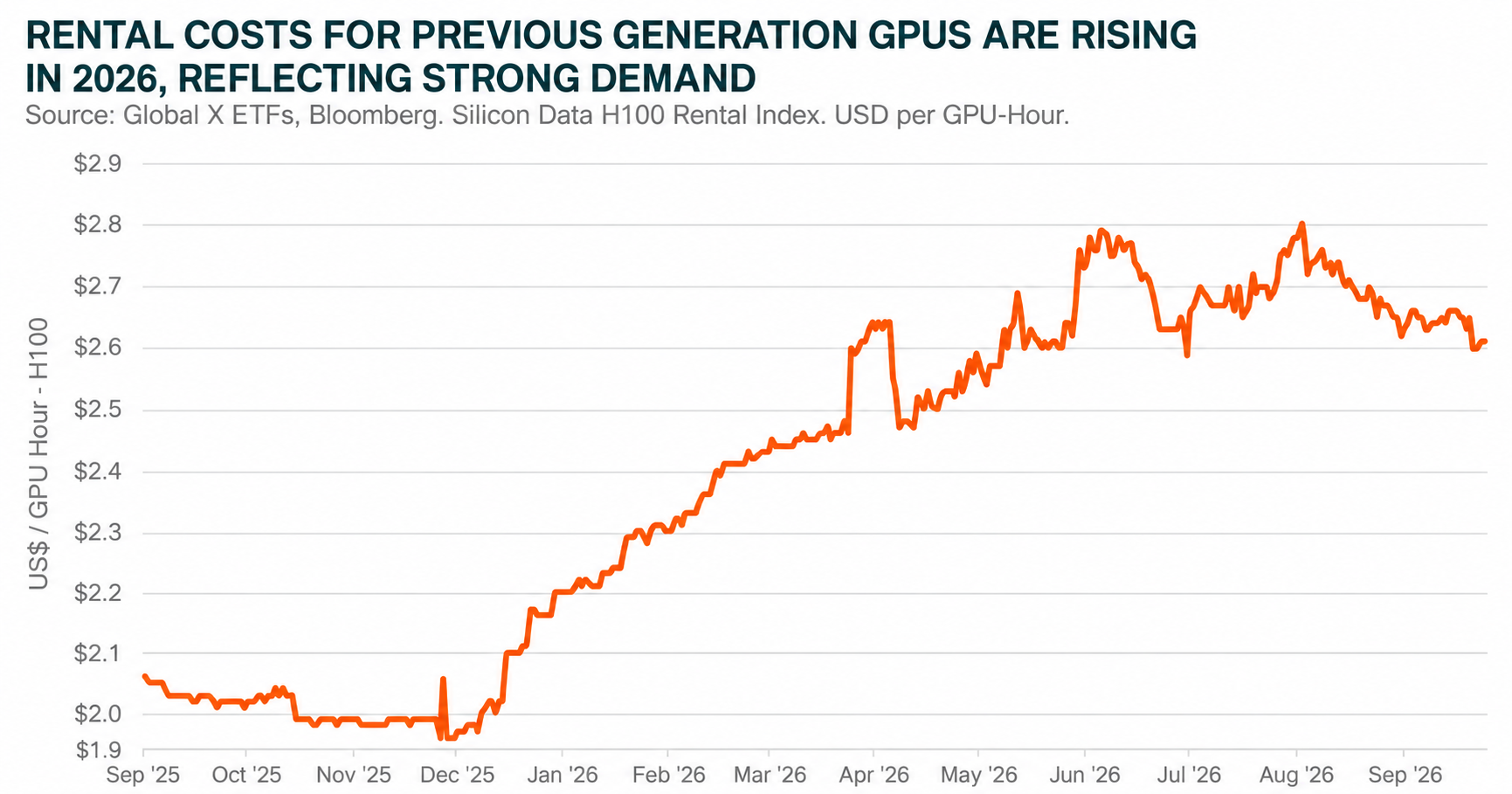
While AI safety concerns are valid, debate around regulating or slowing development at the frontier has limited direct bearing on current datacentre demand and construction pipelines. Demand for existing consumer and commercial AI models already exceeds available capacity, reflected in rising rental costs even for older-generation GPUs. From this perspective, hyperscalers have little reason to materially slow datacentre construction because of concerns surrounding frontier models that are not yet widely available, and may never be.
Political pushback against datacentre development, particularly in the US, is another legitimate concern. However, future capacity is also becoming increasingly geographically diversified. China is emerging as a major source of new development, with Alibaba announcing on 22 September plans to build 20GW of datacentre capacity by 2032 - equivalent to almost 70% of China’s current capacity and roughly 15% of planned global buildout as of 20261.
One Man’s Noise Is Another Man’s Opportunity
Battery technology has not lost its growth story in 2026; it has lost its clarity. When a thematic is pulled in several directions at once, investors tend either to step away or to reach for the simplest signal available. In our view, this has left the sector trading more on noise than on the direction of its fundamentals.
That gap between sentiment and substance is, we believe, where the opportunity lies. Storms are loud but they pass, while the forces behind electrification, energy security and AI infrastructure are quieter and far more persistent.
For investors willing to look through the headlines, today's confusion may prove less a warning sign than an opening. The Global X Battery Tech & Lithium ETF (ACDC) offers diversified exposure to the companies we believe are best placed to emerge from the storm stronger.